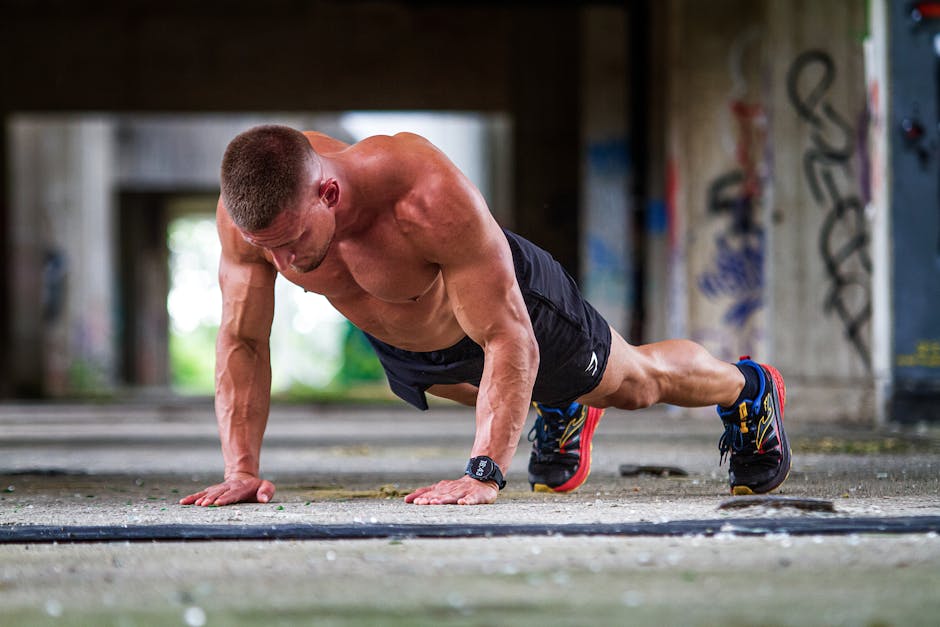
Your gym membership card is gathering dust in your wallet. The weights set you bought with good intentions now serves as an expensive coat rack. Sound familiar? Here’s the truth that fitness companies don’t want you to know: you don’t need any of it to build genuine, functional strength that transforms how you move through daily life.
📖 Reading time: 15 minutes
Picture this: It’s 6:30pm on a rainy Tuesday in November. You’re finally home after a long commute, the gym bag you packed this morning still untouched by the door. The thought of heading back out into the cold, dark evening feels impossible. But what if you could build serious strength right there, in the space between your sofa and coffee table, using nothing but your own bodyweight? Thousands of people across the UK are discovering that the most effective bodyweight strength workout at home doesn’t require fancy equipment, just the right knowledge and twenty minutes of floor space.
Common Myths About Bodyweight Strength Workouts
For more on this topic, you might enjoy: No Gym? No Problem: Your Complete Bodyweight Strength Workout Guide.
Myth: You Can’t Build Real Strength Without Weights
Reality: Olympic gymnasts possess some of the most impressive strength-to-weight ratios of any athletes, built almost entirely through bodyweight training. Research from the University of Birmingham found that bodyweight exercises can increase muscular strength by up to 30% in untrained individuals within twelve weeks. Your body doesn’t know the difference between lifting a dumbbell and lifting itself against gravity. Progressive overload works with bodyweight too, by adjusting leverage, tempo, and volume rather than adding plates to a bar.
Myth: Bodyweight Workouts Are Only for Beginners
Reality: Elite military units, including the British Royal Marines, build phenomenal strength using predominantly bodyweight exercises. The key is progression. A standard press-up becomes significantly harder when you elevate your feet, slow down the tempo to five seconds down and five seconds up, or progress to one-arm variations. According to research published in the Journal of Strength and Conditioning, advanced bodyweight progressions can challenge even seasoned athletes who’ve spent years in traditional gyms.
Myth: You Need at Least an Hour for an Effective Workout
Reality: A focused bodyweight strength workout at home can deliver substantial results in just twenty to thirty minutes. A study from McMaster University demonstrated that short, intense bodyweight circuits produced similar strength gains to longer traditional workouts. What matters isn’t duration but intensity and consistency. Three twenty-minute sessions weekly will outperform sporadic hour-long attempts that leave you too exhausted to maintain the habit.
Why Bodyweight Training Builds Functional, Real-World Strength
Related: Your Complete Kettlebell Full Body Workout: Build Strength From Home.
Traditional gym machines often isolate individual muscles, moving your body through fixed paths that rarely occur in real life. When did you last need to perform a leg extension in your daily routine? Contrast this with bodyweight exercises, which demand coordination between multiple muscle groups simultaneously, exactly as your body moves when carrying shopping bags up stairs, playing with children, or preventing a fall.
The NHS recommends strength activities on at least two days per week for adults, focusing on major muscle groups. Bodyweight training ticks every box whilst developing something machines can’t: proprioception and balance. Every press-up requires your core to stabilize your spine. Each squat demands ankle, knee, and hip coordination. You’re not just building stronger muscles; you’re creating a more resilient, capable body.
What’s more, bodyweight exercises automatically scale to your current ability. A weighted barbell presents the same challenge whether you’re ready or not. But press-ups can start against a wall, progress to a kitchen counter, then to the floor, and eventually to decline or single-arm variations. Your body provides the perfect resistance at every stage.
The Essential Six: Core Movements for Complete Body Strength
You may also find this helpful: Your Essential Beginner Home Workout Routine: No Gym, No Problem.
An effective bodyweight strength workout at home revolves around six fundamental movement patterns. Master these, and you’ll develop balanced strength throughout your entire body without missing a single muscle group.
The Push: Upper Body Pressing Power
Press-ups form the foundation of pushing strength, targeting your chest, shoulders, and triceps whilst demanding full-body tension. Start with wall press-ups if floor variations feel too challenging. Position your hands slightly wider than shoulder-width, create a straight line from head to heels, and lower with control until your chest nearly touches the surface.
Progress by adjusting the angle. Kitchen counter press-ups sit between wall and floor difficulty. Once you’re managing fifteen floor press-ups with solid form, slow the tempo or elevate your feet on a sturdy chair. Advanced progressions include diamond press-ups (hands forming a triangle) for triceps emphasis, or pike press-ups with hips high to target shoulders.
The Pull: Building Back Strength Without a Bar
Pulling movements present the biggest challenge in a bodyweight strength workout at home, as you typically need something to pull against. However, resourceful solutions exist. A sturdy table allows inverted rows: lie underneath, grip the edge, and pull your chest towards the table whilst keeping your body rigid. Alternatively, a towel looped over a closed, solid door provides pull-up resistance when you lean back and pull.
Door frame pull-ups work if you have a suitable frame, though be mindful of your door’s integrity. Test it cautiously first. For those without pull-up options, focus on scapular retraction exercises: lie face-down, arms extended overhead, and lift your chest and arms simultaneously, squeezing your shoulder blades together for three seconds.
The Squat: Lower Body Foundation
Squats build powerful legs and glutes whilst improving mobility and balance. Stand with feet hip to shoulder-width apart, toes slightly turned out. Lower by pushing your hips back as if sitting into a chair, keeping your chest up and weight distributed through your whole foot. Aim to lower until your thighs reach parallel with the floor, though depth depends on your individual mobility.
Common technical points often get overlooked: your knees should track over your toes, not collapse inward. If you struggle with depth or balance, practice by squatting to a chair initially. Progress by adding pauses at the bottom, slowing the tempo, or advancing to Bulgarian split squats (rear foot elevated on a low step or sturdy box) for a challenging single-leg variation.
The Hinge: Posterior Chain Power
Hip hinge movements target your hamstrings, glutes, and lower back, the posterior chain muscles essential for lifting objects safely and maintaining healthy posture. Single-leg Romanian deadlifts develop these muscles brilliantly without equipment. Stand on one leg, maintain a slight knee bend, and hinge forward at the hips whilst extending your free leg behind you for balance. Keep your back flat and squeeze your glute to return upright.
Glute bridges provide another excellent hinge pattern: lie on your back, knees bent with feet flat, and drive through your heels to lift your hips until your body forms a straight line from shoulders to knees. Hold for two seconds at the top, squeezing your glutes hard. Single-leg variations significantly increase difficulty once you’ve mastered the basic movement.
The Core: Functional Stability
Forget endless crunches. Functional core strength comes from anti-movement exercises that resist unwanted motion. The plank exemplifies this perfectly: hold a press-up position (or forearm variation), creating total body tension whilst preventing your hips from sagging. Start with three twenty-second holds, gradually building duration.
Side planks address lateral stability, crucial for preventing lower back issues. Dead bugs challenge anti-extension strength: lie on your back, raise your arms and bent knees to ninety degrees, then slowly extend opposite arm and leg whilst keeping your lower back pressed to the floor. Bird dogs offer similar benefits from a hands-and-knees position.
The Loaded Carry: Integrated Full-Body Strength
Carrying heavy objects might not feel like a formal exercise, but it builds tremendous real-world strength. Without dumbbells, get creative with household items. Fill a sturdy backpack with books (start with 5-8kg), wear it on your front, and walk around your home maintaining perfect posture. Hold heavy shopping bags (distributed evenly) and perform walking circuits. Even holding a challenging plank position counts as a static carry, demanding full-body tension throughout.
Your Four-Week Bodyweight Strength Programme
Consistency trumps perfection. This progressive plan develops strength systematically without overwhelming you. Perform these workouts three times weekly, allowing at least one rest day between sessions. Each session takes twenty to thirty minutes.
Week 1-2: Building the Foundation
Workout Structure: Complete three rounds of the following circuit, resting sixty to ninety seconds between exercises and two minutes between rounds.
- Press-ups (wall, counter, or floor depending on ability): 8-12 repetitions
- Bodyweight squats: 12-15 repetitions
- Inverted rows or scapular retractions: 8-12 repetitions
- Glute bridges: 12-15 repetitions
- Plank hold: 20-30 seconds
- Bird dogs: 8 repetitions each side
Focus entirely on movement quality during these foundational weeks. Film yourself from the side to check form. Can you maintain a neutral spine throughout? Do your squats reach adequate depth? This investment in technique pays dividends later when you increase intensity.
Week 3-4: Increasing Challenge
Workout Structure: Complete four rounds, reducing rest between exercises to forty-five seconds and maintaining two minutes between rounds.
- Press-up progression (move to more challenging variation): 10-15 repetitions
- Tempo squats (three seconds down, one second pause, one second up): 12-15 repetitions
- Inverted rows or scapular retractions: 10-15 repetitions
- Single-leg glute bridges: 10-12 repetitions each leg
- Plank hold: 30-45 seconds
- Side plank: 20-30 seconds each side
- Single-leg Romanian deadlifts: 10 repetitions each leg
You’re building work capacity now, increasing both volume and intensity. Notice how movements that challenged you initially become manageable. This progress, though sometimes subtle day-to-day, becomes obvious when you compare week four to week one.
Maximising Results: The Details That Matter
Tempo and Time Under Tension
Rushing through repetitions shortchanges your strength development. Research from the European Journal of Applied Physiology found that controlled tempo, particularly emphasizing the lowering (eccentric) phase, produces superior strength gains compared to explosive repetitions with the same exercise. For most movements, adopt a three-second lowering phase, brief pause at the bottom, and one-to-two second lifting phase.
This approach also improves safety and control. That three-second descent on a squat develops far more strength and stability than dropping quickly and bouncing back up. Time under tension matters more than repetition count for building strength.
Progressive Overload Without Weights
Your muscles grow stronger only when consistently challenged beyond their current capacity. Without weights to add, progress your bodyweight strength workout at home through several variables. Increase repetitions (from ten press-ups to fifteen). Reduce rest periods (from ninety seconds to sixty). Slow the tempo (from three-second eccentrics to five-second). Advance the exercise variation (from floor press-ups to decline press-ups).
Track these variables in a simple notebook or phone app. Each session, aim to improve just one element. This systematic progression prevents plateaus and maintains motivation as you witness concrete advancement.
Recovery: The Forgotten Component
Strength doesn’t build during your workout; it develops during recovery as your body adapts to the stress you’ve imposed. The NHS emphasizes that most adults need seven to nine hours of quality sleep for optimal health, and this becomes even more critical when training regularly.
Between sessions, prioritize protein intake (roughly 1.6-2.2 grams per kilogram of bodyweight daily for muscle development), stay hydrated, and resist the temptation to train daily. Your muscles need forty-eight hours to recover fully from strength training. Three sessions weekly with adequate recovery outperforms six sessions with insufficient rest.
Mistakes to Avoid (And How to Fix Them)
Mistake 1: Prioritising Quantity Over Quality
Why it’s a problem: Performing fifty sloppy press-ups builds poor movement patterns and risks injury whilst delivering minimal strength gains. Bad form under fatigue teaches your nervous system to move incorrectly, making proper technique harder to relearn later.
What to do instead: Stop each set two to three repetitions before your form deteriorates. If your hips sag during press-ups or your knees collapse inward during squats, that set is finished regardless of your target number. Quality repetitions build strength; poor ones build injuries.
Mistake 2: Skipping the Warm-Up
Why it’s a problem: Launching straight into challenging exercises with cold muscles increases injury risk and reduces performance. Your joints lack adequate synovial fluid circulation, your nervous system hasn’t activated, and your range of motion feels restricted.
What to do instead: Invest five minutes before each bodyweight strength workout at home in dynamic movement preparation. Perform leg swings, arm circles, bodyweight squats, gentle lunges, and a few easy press-ups. Gradually increase range of motion and intensity. Think of your warm-up as priming your body for optimal performance, not wasted time.
Mistake 3: Following the Same Routine Indefinitely
Why it’s a problem: Your body adapts quickly to familiar stimuli. The workout that challenged you tremendously in month one barely registers as difficult in month three. Without progression, you maintain rather than build strength.
What to do instead: Every four weeks, modify your programme. Progress exercise variations, adjust tempo, change rest periods, or alter the workout structure (try a different set and repetition scheme). This doesn’t mean completely reinventing your approach; small changes provide sufficient stimulus for continued adaptation.
Mistake 4: Training Through Pain
Why it’s a problem: There’s a critical difference between muscular fatigue (the burning sensation during exercise) and pain (sharp, acute discomfort in joints or specific areas). Training through actual pain worsens injuries and creates lengthy setbacks that erase months of progress.
What to do instead: Learn to distinguish between productive discomfort and warning signals. Muscle fatigue is expected; joint pain is not. Sharp, shooting, or localized pain means stop immediately. If pain persists beyond a couple of days or worsens with activity, consult your GP or a physiotherapist. The NHS provides guidance on safe exercise practices and when to seek professional advice.
Mistake 5: Neglecting Lower Body Training
Why it’s a problem: Many people focus obsessively on upper body exercises (press-ups, planks) whilst giving minimal attention to lower body work. This creates muscular imbalances and ignores your largest muscle groups, which have the greatest potential for strength development and metabolic benefits.
What to do instead: Structure your bodyweight strength workout at home with equal emphasis on upper and lower body movements. Your legs contain more muscle mass than your arms and chest combined, making lower body training essential for overall strength and even body composition changes. Aim for a balanced ratio of pushing, pulling, squatting, and hinging movements each session.
Adapting Your Space: Making Any Room Work
You don’t need a home gym or even a spare room. Most bodyweight exercises require roughly the space of a yoga mat, approximately six feet by three feet. Clear this modest area in your bedroom, living room, or even a hallway, and you’re equipped for comprehensive training.
Strategic furniture use expands your options considerably. A sturdy chair or coffee table enables decline press-ups, elevated Bulgarian split squats, and inverted rows. Kitchen counters work perfectly for incline press-ups at various heights. Door frames can accommodate pull-ups if structurally sound (always test cautiously first). Even your walls serve as equipment for wall press-ups, wall sits, or handstand progressions.
Consider noise if you live in a flat. Jumping exercises might disturb neighbours, but plenty of effective alternatives exist. Replace jump squats with tempo squats. Substitute mountain climbers with dead bugs. Most strength-focused bodyweight exercises generate minimal noise, making them ideal for any living situation regardless of time.
Quick Reference Checklist
- Train three times weekly with at least one rest day between sessions for optimal recovery
- Warm up for five minutes with dynamic movements before each workout
- Focus on six fundamental patterns: push, pull, squat, hinge, core stability, and carries
- Maintain slow, controlled tempo with emphasis on three-second lowering phases
- Track your workouts in a simple notebook to monitor progression over time
- Stop each set two repetitions before your form deteriorates significantly
- Progress by adjusting tempo, rest periods, exercise variation, or repetitions every four weeks
- Prioritise seven to nine hours of sleep nightly and adequate protein intake for recovery
Frequently Asked Questions
How long before I notice strength improvements from bodyweight training?
Most people notice initial improvements within two to three weeks, though these early gains primarily reflect nervous system adaptations rather than actual muscle growth. Your body learns to recruit muscle fibres more efficiently, making movements feel easier. Visible physical changes typically emerge around the six to eight week mark with consistent training three times weekly. Significant strength development requires three to six months of progressive training, though you’ll feel stronger and more capable well before that timeframe.
Can I build muscle mass with bodyweight exercises, or only strength?
Absolutely, you can build substantial muscle mass through bodyweight training alone. Muscle growth (hypertrophy) requires progressive mechanical tension, metabolic stress, and muscle damage, all achievable without external weights. The key is training close to muscular failure, using slower tempos to increase time under tension, and progressively challenging yourself with harder exercise variations. Research from the Journal of Exercise Science and Fitness found no significant difference in muscle growth between bodyweight training and traditional weight training when volume and intensity were matched.
I can barely do one proper press-up. Is this programme too advanced for me?
Not at all. Every exercise in a bodyweight strength workout at home can be scaled to match your current ability. Start press-ups against a wall, which reduces the resistance to roughly 40% of your bodyweight compared to 60-65% on the floor. As these become manageable, progress to kitchen counter height, then to a sturdy coffee table, and eventually the floor. Similarly, squats can be performed to a chair initially, removing the balance component and providing a depth target. The beauty of bodyweight training is its infinite scalability. Meet yourself where you are now, and progress systematically from there.
What should I eat before and after my home workout?
For most people training at moderate intensity for twenty to thirty minutes, elaborate pre-workout nutrition isn’t necessary. A light snack containing some carbs with simple sugars such as a banana or an apple are more than adequate to provide the energy you need to power through and make progress!


