You’re tired of commuting 30 minutes to the gym, waiting for equipment, and training around other people’s schedules. Perhaps you’ve calculated that your £45 monthly gym membership costs £540 annually, money that could fund equipment you’ll own forever. Maybe you want the freedom to train at 6am or 11pm without leaving home, or you simply prefer privacy whilst learning new movements. The appeal of a home gym is undeniable, but the prospect of choosing equipment, managing space, and building something functional feels overwhelming. Research from ukactive reveals that home fitness equipment sales increased by 170% in recent years, yet 60% of buyers report struggling with equipment selection and space optimisation.
Most people approach building a home gym with either excessive minimalism (buying too little and limiting training options) or wasteful spending (accumulating equipment that gathers dust). Both extremes prevent you from creating a functional training environment. An effective home gym requires strategic planning that balances your training goals, available space, budget constraints, and long-term needs. Without proper planning, you risk either underequipping your space or overspending on unnecessary items.
This comprehensive guide will teach you everything you need to build a home gym that serves your needs perfectly. You’ll discover how to assess your requirements, select equipment strategically, optimise available space, and create a motivating training environment. Whether you have a spare bedroom, garage, or just a corner of your living room, you’ll receive practical frameworks to transform any space into an effective home gym.
Who This Guide Is For
This guide is designed for UK adults aged 25-45 who want to train at home effectively. You’ll benefit from this resource if you’re tired of commercial gym limitations, want to save money long-term, need flexible training times, or simply prefer private workout environments. Suitable for all budgets from minimal setups (under £500) to comprehensive home gyms (£2,000+).
Understanding Home Gym Benefits and Considerations
Before investing in equipment, you need to understand both the advantages and limitations of training at home. Many people romanticise home gyms without considering practical realities, leading to disappointment or underutilisation.
A home gym provides unparalleled convenience, eliminating commute time and enabling spontaneous training sessions. You can exercise whenever suits your schedule without adjusting to facility hours. Privacy allows you to experiment with movements, take your time learning techniques, and train without self-consciousness. Long-term cost savings prove significant, with equipment purchases typically breaking even within 18-24 months compared to commercial memberships.
However, home gyms require upfront investment, dedicated space, and self-motivation without the external accountability that commercial facilities provide. Equipment selection becomes your responsibility, requiring research and careful decision-making. Space limitations may restrict certain exercises or equipment options. Understanding these realities helps you create appropriate expectations and plan accordingly.
Cost Analysis: Home Gym vs Commercial Membership
Financial considerations often drive home gym decisions. A typical UK gym membership costs £30-50 monthly (£360-600 annually). Over five years, membership fees total £1,800-3,000 without accounting for price increases. Meanwhile, a well-equipped home gym might cost £1,000-2,000 initially but requires minimal ongoing expenses beyond occasional equipment additions or replacements.
Budget considerations extend beyond equipment costs. Factor in flooring protection (rubber mats cost £40-150), storage solutions (racks or shelves adding £50-200), and potential electrical work for lighting or ventilation (£100-500). However, you eliminate travel costs (fuel, parking, or public transport adding £10-30 monthly) and time savings (2-3 hours weekly commute translates to 100+ hours annually).
The break-even point typically occurs within 18-30 months, after which your home gym provides essentially free training for years. Equipment maintains value well, with quality items retaining 50-70% of purchase price if you later sell them. This financial analysis becomes more compelling if multiple household members will use the equipment.
Space Requirements for Different Training Styles
Your training preferences determine space needs. Strength training with barbells requires more space than bodyweight training or dumbbells. Understanding minimum space requirements prevents frustration and ensures your home gym functions properly.
Minimal Setup (bodyweight and light dumbbells): 2m x 2m space suffices for bodyweight exercises, yoga, and dumbbell work. This fits in most bedrooms or living room corners. Ceiling height matters less unless performing jumping movements, though 2.4m minimum is ideal for comfort.
Intermediate Setup (dumbbells, bench, squat rack): 3m x 3m space accommodates a power rack, bench, and workout area. You need room to load plates onto barbells (extending 50-60cm from rack ends) plus clearance for movements. Ceiling height becomes critical if pressing overhead; 2.4m represents the absolute minimum, with 2.7m+ being preferable.
Comprehensive Setup (full equipment range): 4m x 4m or larger allows barbells, cardio equipment, cable machines, and dedicated workout space. This typically requires a garage, basement, or dedicated room. Ceiling height of 2.7m+ proves essential for overhead lifts and pull-up bars.
Essential Equipment: Building Your Foundation
Effective home gyms start with versatile, multi-purpose equipment that enables progressive training across various goals. Understanding which items provide maximum value versus which are optional helps you invest wisely.
The Core Home Gym Equipment
Adjustable Dumbbells represent the single most versatile purchase for home training. They enable hundreds of exercises, require minimal space, and accommodate various training styles. Quality adjustable dumbbells like Powerblock or Bowflex sets range from £200-600 (5-40kg range) compared to £400-800 for equivalent fixed dumbbell sets.
Choose systems offering easy weight adjustment (dial or pin mechanisms work better than screw collars) and sturdy construction (metal components outlast plastic). Consider your strength level when selecting weight ranges; beginners might start with 2.5-20kg sets whilst experienced lifters need 5-40kg or heavier options.
Adjustable Weight Bench expands exercise options dramatically, enabling pressing movements, supported rows, and various isolation exercises. Quality adjustable benches cost £150-400 and should offer flat, incline, and decline positions. Look for sturdy construction supporting 200kg+ total weight (your bodyweight plus dumbbells), comfortable padding (5cm thick minimum), and stable positioning that doesn’t wobble during use.
Avoid cheap benches under £100 as they typically wobble, use uncomfortable padding, and break quickly. A quality bench lasts 10+ years with proper care, making it a worthwhile investment.
Resistance Bands provide portable, affordable training options perfect for warm-ups, assistance work, and travel. A comprehensive set (light through heavy resistance) costs £20-50 and stores in a drawer. Bands enable progressive resistance, accommodate various strength levels, and complement other equipment effectively.
Choose loop bands over tube bands with handles (loop bands prove more versatile and durable). Quality bands from brands like Rogue or Serious Steel last years whilst cheap versions snap quickly, making quality purchases worthwhile despite higher initial costs.
Power Rack or Squat Stand: The Strength Training Foundation
For serious strength training, a power rack or squat stand becomes essential, enabling safe barbell training without a spotter. This decision significantly impacts your home gym functionality and budget.
Power Racks
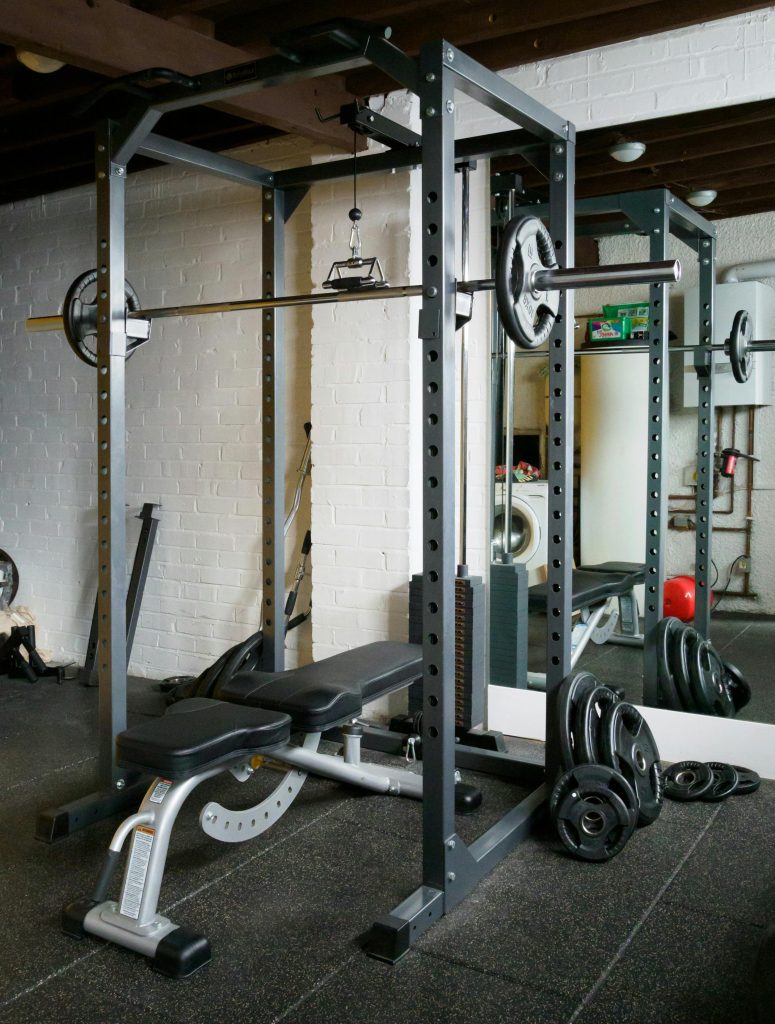
(£300-1,000+) provide maximum versatility and safety. They include safety bars preventing barbell dropping, pull-up bars, and often attachment points for cables, dip bars, and other accessories. Full racks require 2.1m width, 1.3m depth, and 2.1-2.4m height, making them suitable for garages or dedicated rooms but challenging in smaller spaces.
Look for racks with 50mm or 60mm uprights (thicker is sturdier), weight capacity of 300kg+ (ensuring safety margins), adjustable safety bars, and hole spacing of 25mm or less (allowing precise bar height adjustment). J-hooks should be lined with plastic protecting your barbell’s knurling.
Squat Stands
(£150-400) occupy less space whilst enabling similar exercises. They lack the enclosed safety of racks but include spotter arms on quality models. Stands require 1.5m width, 1m depth, and 2.1-2.3m height. They’re ideal for spaces where full racks won’t fit but you still want barbell training capability.
Choose stands with wide bases for stability (60cm+ width), spotter arms included or available separately, and weight capacity matching your goals. Adjustable height proves essential as you’ll use them for squats (higher setting) and bench pressing (lower setting).
Olympic Barbell and Weight Plates
complete your strength training foundation. Olympic barbells (20kg, 2.2m long for men; 15kg, 2m long for women) cost £100-300 for quality options. Cheap barbells under £80 bend easily, spin poorly, and rust quickly, whilst quality bars last decades.
For weight plates, cast iron proves most affordable (£1.50-2 per kg) whilst bumper plates (£2.50-3.50 per kg) allow dropping from overhead safely. Start with 100kg total if you’re a beginner male lifter or 60kg for females, adding weight as you progress. Buying plate sets (20kg, 40kg, 60kg combinations) costs less than individual plates.
Cardio Equipment for Home Gyms
Cardiovascular equipment enables varied training but requires careful selection due to space, cost, and noise considerations. Understanding options helps you choose appropriately for your circumstances.
Space-Efficient Cardio Options
Rowing Machines provide full-body cardiovascular training in a compact, storable format. Quality rowers like Concept2 (£900-1,000) fold for storage, operate quietly, and deliver excellent training stimulus. Air rowers create natural resistance increasing with effort, whilst magnetic rowers offer quieter operation at slightly higher prices (£400-800 for quality models).
Rowers require approximately 2.4m length when extended, 60cm width, and fold to about 1.3m for vertical storage. They accommodate various fitness levels, provide low-impact training protecting joints, and enable both steady-state and interval work effectively.
Assault Bikes or Air Bikes (£400-800) offer brutal cardiovascular training in minimal space. These fan bikes increase resistance as you pedal harder, making them self-regulating and perfect for interval training. They occupy roughly 1.2m x 1m floor space and operate relatively quietly (fan noise but no electronic components).
Air bikes prove ideal for high-intensity interval training but less suitable for steady-state cardio compared to rowers. They’re practically indestructible, require zero maintenance, and accommodate any fitness level.
Jump Ropes (£10-40) provide excellent cardiovascular training in the cheapest, most portable package possible. A quality speed rope costs £15-25 and fits in a drawer. Jump rope training burns significant calories, improves coordination, and requires only 2m x 2m space plus adequate ceiling height (2.4m minimum).
Larger Cardio Investments
Treadmills (£400-2,000) offer convenient running regardless of weather but require significant space, cost, and noise consideration. Folding models save space when not in use but still need 1.8m x 80cm during operation. Motor noise and vibration may disturb others in your home, requiring careful placement.
Budget models under £400 typically feature weak motors unsuitable for running (walking only), whilst quality options supporting regular running start around £800. Premium treadmills (£1,200+) include better cushioning, stronger motors, and longer warranties.
Exercise Bikes range from basic upright models (£200-500) to sophisticated spin bikes (£400-1,000) and recumbent bikes (£300-800). They occupy approximately 1.2m x 60cm, operate quietly, and enable reading or watching television whilst training. Magnetic resistance bikes run quieter than friction models whilst requiring less maintenance.
Spin bikes suit high-intensity training, upright bikes provide general fitness training, and recumbent bikes offer comfortable, low-impact options for those with back issues or mobility limitations.
| Equipment | Floor Space | Cost Range | Noise Level | Best For |
|---|---|---|---|---|
| Rowing Machine | 2.4m x 60cm | £400-1,000 | Low-Medium | Full-body cardio |
| Assault Bike | 1.2m x 1m | £400-800 | Medium | HIIT training |
| Jump Rope | 2m x 2m | £10-40 | Low | Portable cardio |
| Treadmill | 1.8m x 80cm | £400-2,000 | High | Running indoors |
| Exercise Bike | 1.2m x 60cm | £200-1,000 | Low | Low-impact cardio |
Optimising Your Home Gym Space
Strategic space utilisation transforms cramped quarters into functional training environments. Understanding layout principles, storage solutions, and multi-purpose strategies maximises your available area.
Layout Principles for Maximum Functionality
Position your heaviest, most-used equipment first. Barbells and power racks require fixed positions with adequate clearance, whilst lighter items like dumbbells and bands adapt to remaining space. Allow 1m minimum clearance around workout areas for safe movement, with 1.5m preferred if space permits.
Create distinct training zones when possible. A strength area houses your rack, barbell, and bench. A floor work zone accommodates bodyweight exercises, stretching, and core work. If space allows, a cardio area keeps machines separate from lifting zones. This organisation improves workflow and reduces equipment repositioning between exercises.
Consider traffic flow through your space. Can you move between exercises efficiently? Will you need to move items frequently? Equipment on wheels increases flexibility but ensure they lock securely during use. Wall-mounted storage maximises floor space, keeping frequently-used items accessible whilst maintaining clear workout areas.
Lighting significantly impacts training quality and motivation. Natural light proves ideal when available, whilst LED strip lighting or workshop fixtures provide bright, energy-efficient alternatives for windowless spaces. Aim for 300-500 lumens per square metre minimum, with 500+ lumens preferred for detailed work like form checks.
Storage Solutions and Organisation
Wall-mounted Storage maximises space efficiency. Plate storage trees or wall-mounted plate holders (£50-150) keep weights organised and accessible. Dumbbell racks (£60-200) prevent floor clutter whilst protecting equipment. Horizontal bar storage holds barbells, resistance bands, and accessories on pegboards or slat wall systems (£40-100 for materials).
Installing wall storage requires finding studs or using appropriate anchors supporting significant weight. Professional installation costs £100-300 if you’re uncomfortable with DIY, but most systems include mounting hardware and instructions for straightforward installation.
Vertical Storage utilises height effectively in garages or basements with adequate ceiling clearance. Vertical plate trees (£80-150) store 200kg+ of plates in 40cm x 40cm floor space. Wall-mounted fold-away racks enable squat racks or benches that fold against walls when not in use, though these cost significantly more (£400-800) than standard equipment.
Mobile Storage enables flexible space use. Equipment trolleys or carts (£40-100) let you move dumbbells, kettlebells, or accessories easily. Rolling equipment like bikes or rowers relocate quickly between storage and workout positions. Weight trolleys or plate carts (£60-150) transport heavy plates safely without damaging floors.
Creating Multi-Purpose Spaces
Many home gyms share space with other functions. Garages accommodate cars alongside equipment. Spare bedrooms serve multiple purposes. Understanding how to balance different uses maximises your home’s utility without dedicating entire rooms solely to fitness.
Garage Gyms represent the most common UK home gym location, offering space, ceiling height, and floor durability. However, cars, storage, and workshops must coexist with training equipment. Create a dedicated training zone along one wall, using the opposite side for vehicles. Install overhead storage for seasonal items, keeping floor space clear for workouts.
Insulation becomes important in UK garages where temperature extremes occur. Basic insulation costs £200-600 DIY or £500-1,500 professionally installed, making winter training comfortable whilst protecting equipment from moisture. Consider a small heater (£30-100) for winter sessions.
Bedroom or Living Room Gyms require aesthetic consideration and noise management. Choose equipment with small footprints and store items discreetly when not in use. Resistance bands, suspension trainers, adjustable dumbbells, and foldable benches work well in shared spaces. Use furniture pads under equipment protecting floors and reducing noise.
Rubber flooring or thick mats (10-20mm) absorb impact and protect surfaces beneath. Interlocking foam tiles (£20-60 per 20 square metres) work for light training, whilst rubber mats (£40-150 per 10 square metres) handle heavier loads and protect better.
Budget-Based Home Gym Setups
Your available budget determines equipment possibilities, but effective training happens at any investment level. These frameworks demonstrate how to maximise value across different price points.
Minimal Budget Setup (Under £300)
Focus on versatile, space-efficient equipment enabling full-body training. This budget builds a functional foundation for strength and fitness development without requiring dedicated space.
Equipment List:
- Adjustable dumbbells (10-30kg): £150-200
- Resistance band set: £25-40
- Yoga mat: £15-30
- Jump rope: £10-15
- Pull-up bar (doorway mounted): £20-35
- Total: £220-320
This setup enables hundreds of exercises including presses, rows, squats, lunges, core work, and cardiovascular training. Progressive overload happens through adding repetitions, reducing rest periods, or upgrading dumbbell sets over time. Many people train effectively for years with this minimal equipment before expanding.
Mid-Range Setup (£500-1,000)
Add equipment enabling barbell training and expanded exercise variety. This investment creates a more complete training environment whilst remaining affordable for most budgets.
Equipment List:
- Adjustable dumbbells (5-40kg): £300-400
- Squat stands with spotter arms: £200-300
- Olympic barbell: £100-150
- 100kg weight plates: £150-200
- Adjustable bench: £150-200
- Resistance bands: £30-40
- Rubber flooring (10 square metres): £80-120
- Total: £1,010-1,410 (adjust equipment grades to meet budget)
This setup enables compound barbell lifts (squats, deadlifts, presses), extensive dumbbell work, and progressive strength training. You can train any programme designed for commercial gyms, with only specialty machines unavailable.
Comprehensive Setup (£1,500-3,000)
Build a fully-equipped facility rivalling commercial gyms for most training purposes. This investment creates long-term training capability with equipment lasting decades with proper care.
Equipment List:
- Premium adjustable dumbbells (5-50kg): £500-700
- Power rack with pull-up bar: £500-800
- Olympic barbell: £200-300
- 150-200kg weight plates: £300-450
- Adjustable bench: £250-400
- Rowing machine: £400-800
- Assault bike or quality exercise bike: £400-600
- Rubber flooring (20 square metres): £150-250
- Miscellaneous (bands, mats, accessories): £100-200
- Total: £2,800-4,500 (select mid-range options to meet budget)
This creates a professional-grade training environment enabling any fitness goal. Equipment quality ensures decades of use with minimal maintenance, making the initial investment worthwhile for committed lifters.
Safety Considerations for Home Gym Training
Training without spotters or facility staff requires heightened safety awareness. Understanding potential risks and implementing protective measures prevents injuries whilst maintaining training intensity.
Equipment Safety and Proper Setup
Secure Installation prevents accidents from equipment failure or tipping. Bolt power racks to floors or walls when possible, particularly on uneven surfaces or when training heavy. Weight plate trees and storage should have wide bases preventing tipping. Ensure equipment sits level, using shims if necessary on uneven floors.
Check equipment regularly for wear, damage, or loose bolts. Tighten all connections monthly, inspect cables and pulleys for fraying, and replace worn padding promptly. Quality equipment lasts decades with basic maintenance, whilst neglected items become hazardous quickly.
Safety Bars and Spotter Arms prove essential for solo barbell training. Set safety bars 5-10cm below your lowest position in each exercise, catching the bar if you fail a repetition. Practice failing repetitions intentionally with light weights, ensuring safety systems work properly and you understand the process.
Never train near maximum loads without proper safety equipment in place. Home training’s convenience shouldn’t come at the cost of taking unnecessary risks with heavy weights.
Training Modifications for Solo Sessions
Adjust Rep Ranges when training without spotters. Instead of attempting 1-3 rep maximum efforts requiring spotters, train primarily in 5-12 rep ranges where you maintain reserves. You can still progress strength significantly whilst avoiding the heightened risk of maximal singles or doubles.
Use Alternatives for Dangerous Exercises when training alone. Replace barbell bench pressing with dumbbell pressing (weights drop safely beside you if you fail) or use a power rack for bench pressing with safety bars set appropriately. Substitute back squats with safety squat bars, front squats, or goblet squats when training near maximum effort.
Emergency Planning proves important despite seemingly dramatic. Keep a mobile phone accessible during training. Inform someone in your household when you’re training with heavy weights. Consider a personal alarm if training truly alone in isolated spaces. These precautions rarely become necessary but provide essential safety nets.
Flooring Protection and Noise Management
Rubber Flooring (10-25mm thickness) protects both equipment and the surface beneath whilst reducing noise transmission. Costs range from £40-150 per 10 square metres depending on thickness and quality. Thicker matting provides better protection and noise reduction, essential for upstairs rooms or attached homes.
For ground-floor spaces with concrete underneath, thinner matting (10-15mm) suffices for most training. For upper floors or noise-sensitive situations, use 20-25mm thick matting or double-layer systems. Some setups benefit from combining foam underlayment with rubber top layers, providing maximum noise and vibration absorption.
Strategic Placement reduces noise impact on others. Position cardio equipment away from bedrooms or quiet spaces. Schedule noisy training (dropping weights, high-intensity cardio) during daytime hours when possible. Communicate with family members or neighbours about your training schedule, showing courtesy whilst maintaining your fitness routine.
Maintaining Motivation in Your Home Gym
Home training requires self-motivation without the external accountability and energy of commercial gyms. Understanding psychological factors and implementing motivational strategies maintains consistency over months and years.
Creating an Inspiring Environment
Visual Elements significantly impact training motivation. Paint walls in energising colours (blues, greens, or warm neutrals work well), hang motivational posters or personal goal reminders, and maintain cleanliness creating an inviting space. A cluttered, dingy environment reduces training desire whilst an organised, bright space encourages regular sessions.
Consider mirrors for form checking and psychological benefits. Full-length mirrors (£50-150) help assess technique whilst providing positive visual feedback as your physique develops. Position mirrors where you’ll see yourself during exercises, reinforcing proper form and celebrating progress.
Entertainment Options combat home training boredom for some people. Televisions, tablets, or speakers enable watching training videos, following along with classes, or listening to music or podcasts. Sound systems (£50-200) improve the training atmosphere significantly, whilst wall-mounted tablets (£150-400 including device) enable following programmes or watching entertainment during cardio sessions.
Structured Programming and Progress Tracking
Follow Specific Programmes rather than random workouts. Structured programming provides direction, ensures progressive overload, and creates accountability through planned sessions. Many free programmes exist online, or apps like JEFIT, Strong, or Fitbod (free to £10 monthly) provide programming and tracking.
Track Everything including weights lifted, repetitions completed, workout duration, and subjective difficulty ratings. Visible progress powerfully motivates continued training. Review your log weekly, celebrating improvements and identifying areas needing attention. Progress photos taken monthly provide powerful long-term motivation as changes accumulate gradually.
Schedule Sessions like important appointments rather than training “when you feel like it.” Block training times in your calendar, protecting them from other commitments. Morning training works well for many people as it’s completed before daily demands interfere. Evening training suits others better, providing stress relief after work.
Social Accountability and Community
Training Partners provide accountability and social interaction. Invite friends or family to join sessions, arrange regular training times with partners, or create accountability groups sharing progress and encouragement. Virtual training partners through video calls offer alternatives when in-person training isn’t possible.
Online Communities connect you with other home gym enthusiasts. Reddit’s r/homegym, UK-specific Facebook groups, or Instagram communities share experiences, advice, and motivation. Posting your setup, asking questions, and engaging with others creates connection whilst reducing isolation some people experience training at home.
Professional Guidance through online coaching (£50-200 monthly) provides programming, form checks via video, and regular accountability. Many people train more consistently and progress faster with coaching despite training in home gyms, making the investment worthwhile if self-direction proves challenging.
Frequently Asked Questions About Home Gyms
How much space do I need for a home gym?
Minimum space depends on your training style. Bodyweight training and dumbbells work in 2m x 2m (roughly the size of a king bed). Barbell training with a squat rack requires at least 3m x 3m for safe operation. Comprehensive setups with multiple equipment pieces need 4m x 4m or larger. Measure your available space first, then select equipment fitting those dimensions rather than buying equipment then struggling to place it.
What’s the first equipment I should buy?
Start with adjustable dumbbells (£150-300 for a quality set). They enable hundreds of exercises, require minimal space, and accommodate progressive training for years. After dumbbells, add an adjustable bench (£150-250) expanding exercise possibilities dramatically. These two items create a functional training space before investing in barbells, racks, or cardio equipment.
Can I build muscle effectively at home?
Absolutely. Muscle growth requires progressive resistance training, adequate protein, and proper recovery, all achievable at home. Home gym equipment enables identical exercises and training protocols to commercial facilities. Many bodybuilders train exclusively at home, achieving exceptional results. The key is consistent training with progressive overload, not access to fancy machines.
How do I handle noise complaints?
Install thick rubber flooring (20-25mm), avoid dropping weights unnecessarily, and schedule intense training during reasonable hours. Communicate with neighbours about your schedule, showing courtesy whilst maintaining your fitness routine. Consider quieter equipment alternatives if noise remains problematic (resistance bands, dumbbells, rowing machines instead of treadmills or dropping barbells).
Is buying used equipment safe?
Used equipment often provides excellent value if inspected carefully. Check barbells for excessive rust or bent sleeves, ensure weight plates aren’t cracked, and verify benches and racks show no cracks or loose connections. Avoid electrical equipment with unknown histories. Used cast iron plates, barbells, and simple racks typically last decades, making them smart purchases. However, cheap new equipment often costs less than quality used items and comes with warranties.
Do I need a permit for a home gym?
Generally no permit is required for home gym equipment in residential properties. However, significant structural modifications (removing walls, reinforcing floors in flats) may require building regulations approval. Check with your local council if planning major modifications. Standard equipment installation in garages or spare rooms typically requires no permissions beyond ensuring you’re not violating tenancy agreements if renting.
How do I maintain equipment?
Wipe down equipment after sweaty sessions preventing rust, oil barbell sleeves and bolts annually, and check all connections quarterly. Store weight plates dry, clean rubber surfaces periodically with mild soap, and inspect cables and pulleys regularly. Quality equipment requires minimal maintenance beyond basic cleaning and occasional lubrication, lasting decades with proper care.
Can I train for powerlifting or Olympic lifting at home?
Powerlifting absolutely, Olympic lifting possibly depending on ceiling height and floor durability. Powerlifting requires only a barbell, plates, rack, and bench, all standard home gym equipment. Olympic lifting needs 2.7m+ ceiling height for snatches and ability to drop barbells safely (bumper plates on rubber flooring over concrete or wood). Many Olympic lifters train at home successfully, but space and noise considerations are greater than for powerlifting.
What about cardio in a home gym?
Home cardio options include rowing machines, assault bikes, jump ropes, or outdoor running/cycling using your home gym for strength training. You don’t necessarily need cardio equipment at home if you enjoy outdoor activities. However, rowers and bikes provide weather-independent options for UK’s unpredictable climate. Choose based on preferences, space, and budget rather than feeling obligated to own cardio equipment.
Related Guides: Dive Deeper Into Specific Topics
- Complete Guide to Strength Training Equipment: Detailed reviews of barbells, plates, and racks
- Bodyweight Training Programmes: Effective workouts requiring minimal equipment
- Building Muscle at Home: Comprehensive guide to hypertrophy training in home gyms
- Home Cardio Strategies: Maximise cardiovascular fitness without expensive machines
- Budget Fitness Equipment: Quality items across all price ranges
- Small Space Training Solutions: Effective workouts in limited areas
- Garage Gym Setup Guide: Transform your garage into a functional training space
- Equipment Maintenance and Care: Keep your home gym in perfect condition
Conclusion: Your Path to Home Training Success
Building a home gym transforms fitness from something requiring external facilities into a convenient, private, and cost-effective long-term solution. The difference between successful home gym owners and those with dusty equipment gathering cobwebs comes down to thoughtful planning, strategic purchases, and consistent training habits rather than expensive equipment or large spaces.
Key Takeaways:
- Start with versatile basics (adjustable dumbbells, bench, resistance bands) before expanding to specialised equipment
- Match equipment purchases to your training goals, available space, and budget constraints rather than buying based on excitement or trends
- Quality items purchased gradually create better home gyms than cheap complete setups bought hastily
- Proper space planning, safety measures, and environmental design significantly impact training consistency and results
- Home training requires self-motivation strategies including structured programming, progress tracking, and accountability systems
- Financial break-even typically occurs within 18-30 months compared to commercial gym memberships, with equipment lasting decades
- Success depends more on consistent training habits than equipment quantity or sophistication
Your First Three Actions:
- Assess your available space: Measure the area you’ll use for your home gym, noting dimensions, ceiling height, and potential constraints, then determine which equipment categories fit these limitations.
- Define your training priorities: Identify whether you primarily want strength training, conditioning, flexibility work, or mixed training, allowing equipment selection that directly supports your goals.
- Set your budget and timeline: Determine your total budget, then create a phased purchasing plan starting with essential versatile items and adding specialised equipment over 6-12 months as funds allow.
Remember that effective home gyms evolve over time rather than appearing complete from day one. Start with equipment enabling your current training needs, add items as goals develop and budget permits, and prioritise consistency over perfection. The best home gym is the one you use regularly, regardless of size or sophistication.
Your fitness journey doesn’t require expensive facilities or complicated equipment. With thoughtful planning and strategic purchases, you can create a home gym that serves your training needs perfectly whilst providing convenience, privacy, and long-term value that commercial memberships simply cannot match.


