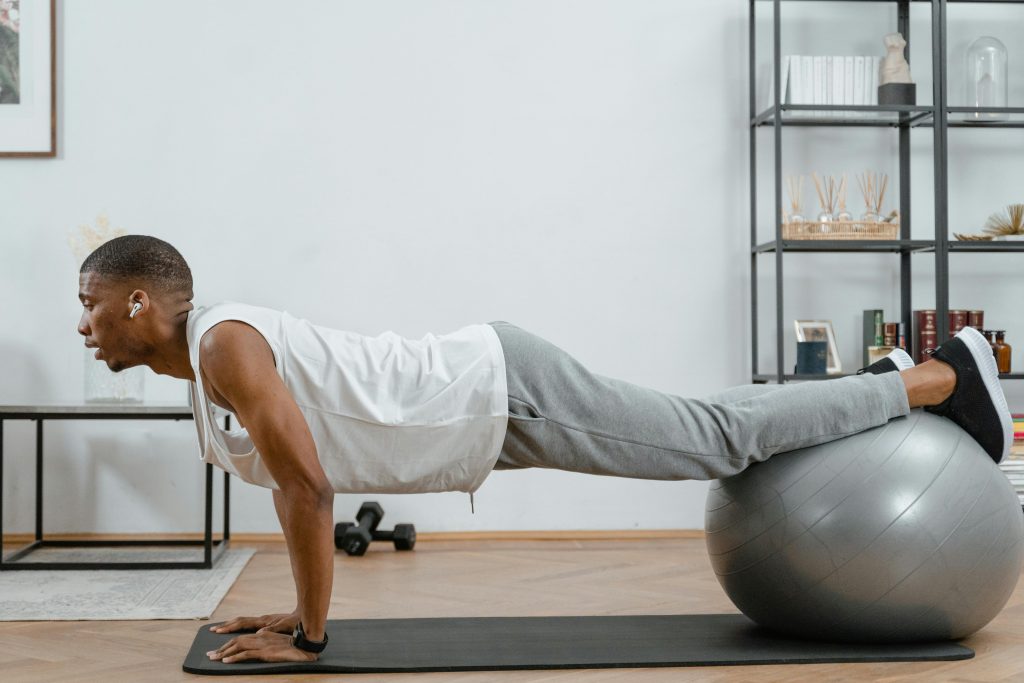
Picture this: you’re playing with your kids at the park, bending down to pick up their football, when a sharp twinge shoots through your lower back. Or perhaps you’re sat at your desk in Manchester after a long commute from Stockport, and by 3pm, your back is screaming for relief. These everyday struggles aren’t just about weak backs but rather undertrained, neglected cores. Your core isn’t simply about achieving visible abs or looking good on the beach in Brighton. This powerhouse region serves as your body’s foundation, stabilising every movement from lifting shopping bags to preventing injury during intense workouts.
Whether you’re a complete beginner who’s never done a plank or an experienced gym-goer looking to optimise your training, this guide transforms your understanding and execution of core training. You’ll discover the science behind effective core training, learn proven exercises for all fitness levels, understand how to programme your workouts, avoid common mistakes, and implement strategies that deliver real-world functional strength.
Who This Guide Is For
This pillar post serves anyone seeking to improve their core strength and function. Complete beginners will find clear progressions and foundational exercises to start safely. Intermediate exercisers can discover new techniques and programming strategies to break through plateaus. Advanced athletes will gain insights into complex training variables. Whether your goal is pain-free movement, athletic performance, aesthetic development, or maintaining independence as you age, this guide provides the evidence-based information and practical tools you need.
Understanding Your Core: Anatomy and Function
Your core consists of far more than the six-pack muscles you see in fitness magazines. This complex system includes numerous muscles working together to stabilise your spine, transfer force between your upper and lower body, and protect your internal organs. Understanding core anatomy helps you train more effectively because you’ll know which movements target specific muscles and why certain exercises deliver better results than others.
The Core Muscles Explained
The rectus abdominis, commonly called the “abs,” runs vertically along the front of your abdomen. These muscles create the six-pack appearance when body fat is low enough, but their primary function involves flexing your spine and providing anterior stability. However, overdeveloping these muscles whilst neglecting others creates imbalances that can lead to poor posture and back pain.
Your transverse abdominis lies deepest in your abdominal wall, wrapping around your midsection like a corset. This crucial muscle acts as your body’s natural weight belt, increasing intra-abdominal pressure to stabilise your spine during movement. Research from the University of Queensland demonstrates that activating your transverse abdominis before movement reduces lower back injury risk by up to 35%. Unfortunately, traditional crunches barely engage this vital stabiliser.
The internal and external obliques run diagonally along the sides of your torso. External obliques angle downward and forward, whilst internal obliques angle upward and forward, creating a cross-hatch pattern. These muscles rotate your torso, bend you sideways, and resist unwanted rotation during athletic movements. Strong obliques are essential for sports involving twisting motions, from golf to tennis to football.
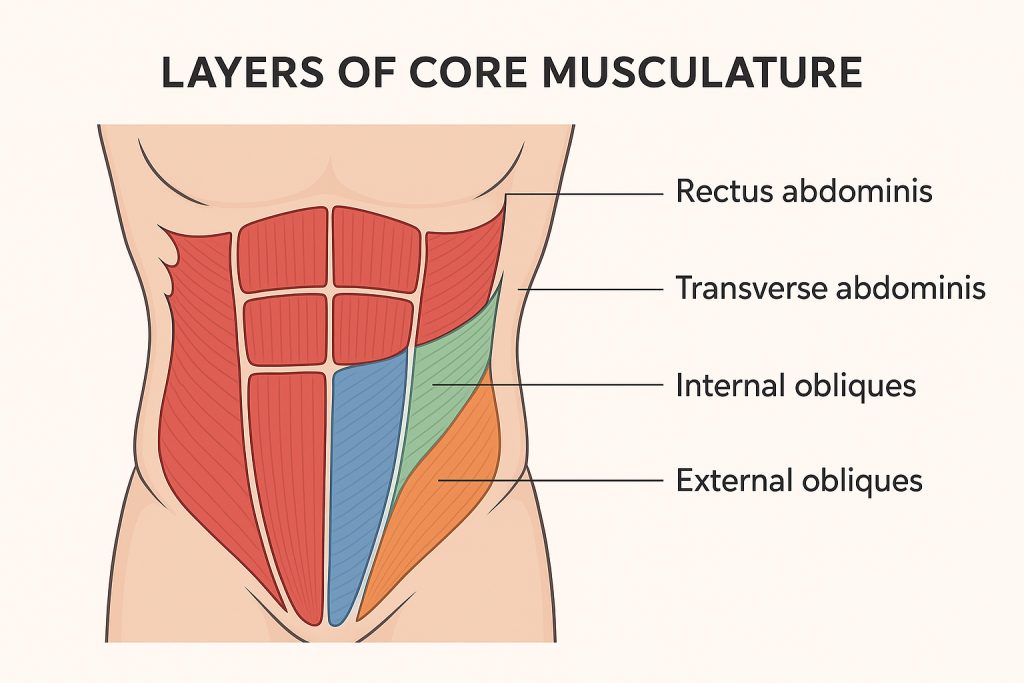
Your erector spinae muscles run along your spine, providing extension and helping you maintain upright posture. The multifidus muscles fill the grooves along your spine, providing segmental stability between vertebrae. These posterior core muscles often receive insufficient attention in core training programmes, yet they’re equally important for balanced development.
The pelvic floor muscles form the base of your core, supporting your internal organs and contributing to intra-abdominal pressure. Your diaphragm caps the top of this cylindrical system, moving downward during inhalation to create space for your lungs whilst simultaneously increasing core stability. This 360-degree core system works in harmony during properly executed movements.
How Your Core Actually Works
Your core functions primarily as a stabiliser rather than a prime mover. During most daily activities and athletic movements, core muscles work isometrically to prevent unwanted motion whilst your limbs generate movement. This anti-movement function distinguishes effective core training from traditional ab work focused solely on flexion and extension.
Anti-extension prevents your lower back from arching excessively during movements like planks or overhead presses. Anti-lateral flexion stops you from bending sideways when carrying a heavy shopping bag in one hand. Anti-rotation resists twisting forces, like when you’re pushing a heavy door open or throwing a ball. These three anti-movement patterns form the foundation of functional core strength.
Force transfer represents another critical core function. When you kick a football, power generated by your legs must transfer through your core to your upper body and arms for balance and follow-through. A weak core acts like a loose link in this chain, dissipating force rather than transmitting it efficiently. Studies in sports biomechanics show that core strength improvements of just 15% can increase throwing velocity by 8-12% in overhead athletes.
💡 Pro Tip: Your core works most effectively when you breathe properly during exercise. Exhale during the hardest part of movements whilst maintaining tension in your midsection. This technique, called bracing, optimises both performance and spinal protection.
Traditional ab exercises rarely engage your deeper stabilising muscles adequately. Research using electromyography (EMG) demonstrates that planks activate the transverse abdominis 20-30% more than crunches do. Exercises emphasising stability and anti-movement patterns provide superior functional benefits whilst reducing injury risk compared to dynamic spinal flexion movements.
The Science of Effective Core Training
Evidence-based core training principles ensure your efforts produce maximum results with minimum injury risk. Understanding how your core adapts to training helps you make informed decisions about exercise selection and programming.
Evidence-Based Training Principles
Progressive overload drives all strength adaptations, including core development. Your core muscles respond to training stress by becoming stronger, but they need progressively increasing challenges to continue adapting. Research confirms that core strength improvements plateau within 4-6 weeks without progressive overload.
Specificity determines training outcomes. Training for endurance develops different adaptations than training for maximal strength. Exercises held for 60+ seconds improve endurance but provide minimal strength gains. Conversely, challenging exercises you can only hold for 10-20 seconds build strength but won’t significantly improve endurance.
Recovery periods between core training sessions enable adaptation. Your core muscles contain high percentages of slow-twitch fibres that recover relatively quickly. Most people can train their core 3-5 times weekly with proper exercise variation and intensity management.
📊 Research Insight: A 2019 meta-analysis found that programmes incorporating anti-movement exercises produced 40% greater improvements in functional performance tests compared to programmes focused solely on traditional ab exercises.
Progressive Overload Methods
Increasing exercise difficulty progressively challenges your core muscles to adapt and strengthen.
Time under tension: Extend hold durations for isometric exercises. Begin with 20-30 second holds, gradually working toward 45-60 seconds before progressing to harder variations. Adding 5-10 seconds weekly provides manageable progression.
Lever length: A plank with hands elevated is easier than a standard plank, which is easier than a plank with feet elevated. Adjusting lever length provides progression without equipment.
External resistance: Weights, resistance bands, or cable machines add measurable load. This method provides clear progression tracking but requires equipment access.
Movement complexity: Progressing from a standard plank to a plank with alternating arm raises requires greater anti-rotation strength and stability.
Core Training Exercise Library
This exercise library organises movements by their primary function, helping you select exercises that match your goals and training level. Each category trains your core to resist specific unwanted movements, building functional strength that transfers to real-world activities. For detailed exercise breakdowns and progressions, see our individual cluster posts on each movement pattern.
Anti-Extension Exercises
Anti-extension exercises train your core to resist forces trying to arch your lower back. These movements protect your spine during overhead pressing, running, and any activity involving forward arm reaching.
Plank: The fundamental anti-extension exercise suitable for all fitness levels. Position your forearms on the ground with elbows beneath shoulders, extending your legs behind you so only your forearms and toes contact the floor. Maintain a straight line from your head to heels, avoiding sagging hips or raised bums. Beginners start with 20-30 second holds, progressing to 60 seconds before advancing to harder variations.
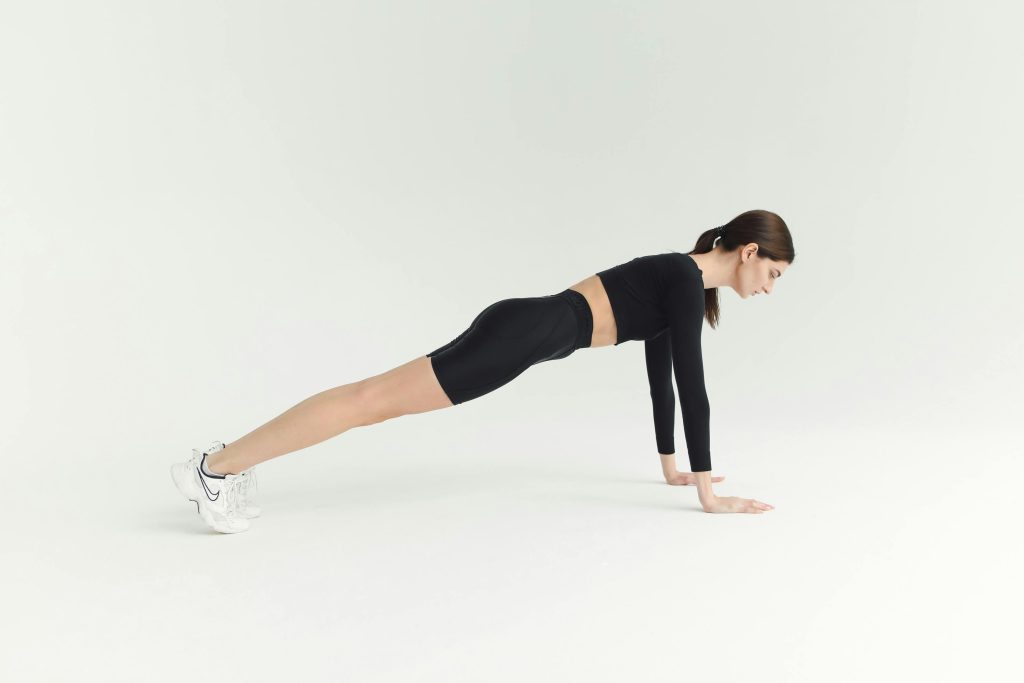
Dead Bug: Lie on your back with arms extended toward the ceiling and knees bent at 90 degrees above your hips. Press your lower back gently into the floor, then slowly lower one arm overhead whilst simultaneously extending the opposite leg toward the floor. This exercise teaches coordination whilst building anti-extension strength in a low-risk position. Perform 8-12 repetitions per side.
Progressions: Stability ball rollouts, ab wheel rollouts, and hollow body holds provide increasingly challenging anti-extension work as you advance.
✅ Quick Win: Can’t hold a standard plank for 30 seconds? Place your hands on a bench or sturdy coffee table instead of the floor. This elevated position reduces the load on your core by approximately 30%, making the exercise more manageable whilst you build baseline strength.
Anti-Lateral Flexion Exercises
Anti-lateral flexion training prevents unwanted sideways bending, building the oblique strength necessary for maintaining upright posture during asymmetric activities.
Side Plank: Lie on your side with your forearm on the ground and elbow beneath your shoulder. Stack your feet or stagger them for easier balance, then lift your hips until your body forms a straight line. Your core must resist the sideways pull of gravity throughout the hold. Beginners start with 15-20 seconds per side, whilst advanced exercisers progress to 60+ second holds.
Suitcase Carry: Hold a heavy kettlebell, dumbbell, or loaded shopping bag in one hand whilst walking 20-40 metres. Your core must work hard preventing you from leaning toward the weighted side. This exercise provides incredible real-world carryover since you frequently carry asymmetric loads in daily life.
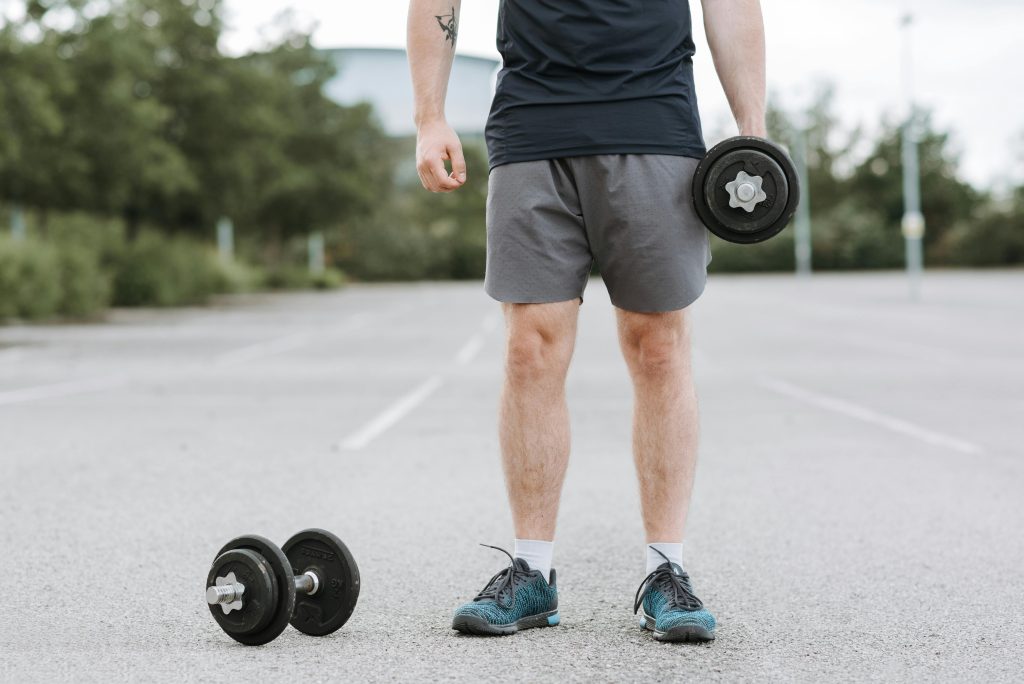
Progressions: Single-arm overhead carries and side plank variations with leg raises or rotations increase difficulty substantially.
Anti-Rotation Exercises
Anti-rotation movements build your core’s ability to resist twisting forces, essential for athletic performance and spinal protection during asymmetric activities.
Pallof Press: Attach a resistance band or use a cable machine at chest height. Stand sideways to the anchor point, holding the handle at your chest with both hands. Press the handle forward until your arms extend fully, resisting the band’s pull trying to rotate you toward the anchor. The band creates constant rotational force your core must counteract. Perform 10-15 repetitions per side.
Bird Dog: Begin on hands and knees with neutral spine alignment. Simultaneously extend one arm forward and the opposite leg backward, creating a straight line from fingertips to toes. Your core must prevent rotation as you balance on two points of contact. Hold each repetition for 5-10 seconds, then switch sides.
Progressions: Single-arm farmer’s carries, renegade rows, and half-kneeling cable chops provide advanced anti-rotation challenges.
Programming Your Core Training
Effective core training requires thoughtful programming that balances exercise variety, training frequency, and progressive difficulty. Random exercise selection without strategic planning limits your results and increases injury risk.
Frequency and Volume Guidelines
Training frequency depends on your overall programme, training experience, and intensity of core work. Your core muscles recover relatively quickly due to their high slow-twitch fibre composition, enabling more frequent training than larger muscle groups like legs or back. Most people benefit from core training 3-4 times weekly, though advanced athletes might train core aspects 5-6 times weekly with proper exercise variation.
Beginners should train core 2-3 times weekly initially, allowing adaptation between sessions. Each workout should include 4-6 exercises covering different movement patterns, performing 2-3 sets per exercise. Total core training time might be 15-20 minutes per session.
Intermediate exercisers can increase to 3-4 weekly sessions with 6-8 exercises per workout. Set volume might increase to 3-4 sets per exercise as work capacity improves. Sessions might extend to 20-30 minutes.
Advanced trainees often integrate core training more frequently but with strategic variation. Some days might emphasise heavy, low-repetition anti-rotation work, whilst other days focus on higher-volume endurance exercises. This approach develops multiple qualities simultaneously without overtraining any single aspect.
💡 Pro Tip: Rather than dedicating entire workouts to core training, incorporate core exercises into your warm-ups or between sets of other exercises. Performing planks or dead bugs during rest periods between squats or presses maximises training efficiency without extending workout duration significantly.
Exercise Selection Strategy
Selecting exercises strategically ensures balanced development across all core functions. Many programmes overemphasise certain movement patterns whilst neglecting others, creating imbalances that limit performance and increase injury risk.
Each training session should include at least one anti-extension, one anti-lateral flexion, and one anti-rotation exercise. This ensures you train all primary core functions regularly. For example, a session might include planks (anti-extension), side planks (anti-lateral flexion), and pallof presses (anti-rotation), providing comprehensive stimulus in minimal time.
Exercise variation within categories prevents adaptation plateaus. Rather than performing standard planks every session, rotate between planks, dead bugs, stability ball rollouts, and hollow holds across different workouts. This variation challenges your core through different angles and positions whilst maintaining anti-extension emphasis.
Sequencing exercises appropriately maximises performance and safety. Programme demanding exercises requiring maximal stability early in workouts when you’re fresh and mentally sharp. Save higher-repetition endurance exercises for later in sessions.
Consider your other training when programming core work. If you’re squatting and deadlifting heavily three times weekly, you’re already training anti-extension strength significantly through these compound movements. Your dedicated core training might emphasise anti-rotation and anti-lateral flexion instead.
Core Training for Different Goals
Your core training approach should align with your specific objectives. Building maximal strength requires different stimulus than developing muscular endurance or achieving visible abs.
Building Maximum Strength
Maximum core strength develops through challenging exercises you can only perform for 10-20 seconds or 3-8 repetitions. This low-repetition, high-intensity approach recruits your highest-threshold motor units, stimulating adaptations that increase force production capability.
Exercise selection for strength emphasises heavily loaded anti-movement patterns and complex stability challenges. Weighted planks, heavy pallof presses, single-arm overhead carries, and advanced anti-rotation exercises provide appropriate stimuli. Bodyweight exercises become too easy for strength development once you can perform them for extended durations.
Set and repetition schemes for strength typically involve 3-5 sets of exercises held for 10-20 seconds or performed for 3-8 repetitions. Rest periods between sets should be relatively complete (2-3 minutes) to allow adequate recovery for maximal effort attempts. Training frequency might be 3-4 times weekly, ensuring 48 hours between sessions emphasising the same movement patterns.
Developing Muscular Endurance
Core endurance enables you to maintain stability and proper posture throughout extended activities like long runs, cycling sessions, or physically demanding work days. Endurance-focused training uses longer hold times (45-90+ seconds) or higher repetitions (15-30+ reps), creating metabolic stress that improves your core muscles’ fatigue resistance.
Exercise selection for endurance includes moderate-difficulty variations you can sustain for extended periods. Standard planks, side planks, bird dogs, and moderate-load pallof presses work well. Avoid exercises so challenging you can only hold them briefly, as these primarily build strength rather than endurance.
Training volume for endurance exceeds strength-focused approaches significantly. You might perform 4-6 sets of exercises held for 45-90 seconds or 3-5 sets of 15-30 repetitions. Rest periods between sets can be shorter (30-90 seconds) since you’re not pursuing maximal force production.
Achieving Visible Abs
Visible abs result from two factors: developed abdominal muscles and sufficiently low body fat percentage. Training builds the muscle, whilst nutritional strategies reduce body fat to reveal them. Understanding this distinction prevents wasted effort performing countless crunches hoping for visible results whilst neglecting necessary dietary changes.
Body fat percentage requirements for visible abs typically fall around 10-15% for men and 18-22% for women, though individual fat distribution patterns create variation. Some people show visible abs at slightly higher percentages if they store minimal fat in their midsection.
⚠️ Common Mistake: Performing hundreds of crunches daily won’t reveal your abs if excess body fat covers them. Spot reduction through exercise doesn’t work. You cannot selectively burn fat from your midsection by training abs more frequently. Fat loss occurs systemically through creating a caloric deficit via proper nutrition and overall physical activity.
Exercise selection for aesthetic development should include both anti-movement exercises building the transverse abdominis and internal structure, plus targeted exercises emphasising the rectus abdominis and obliques that create visible definition. Weighted exercises build more substantial muscle mass than purely bodyweight variations.
Nutrition strategies for revealing abs require maintaining a caloric deficit whilst consuming adequate protein to preserve muscle mass. Most people need to reduce daily intake by 300-500 calories below maintenance levels, creating gradual fat loss of 0.5-1% body weight weekly. Higher protein intake (1.8-2.4g per kg body weight) helps maintain muscle mass during fat loss phases.

Common Core Training Mistakes
Even experienced exercisers frequently make core training errors that limit results or increase injury risk. Recognising these mistakes helps you avoid wasting time on ineffective approaches.
Form and Execution Errors
Holding breath during exercises: Holding breath during isometric exercises like planks creates excessive intra-abdominal pressure whilst reducing exercise duration significantly. Focus on steady, controlled breathing patterns, exhaling gently during the hardest portions whilst maintaining core tension.
Losing neutral spine alignment: When your hips sag during planks or your back arches during rollouts, you’re no longer training anti-extension effectively. Your core should prevent these compensations rather than allowing them. Reduce exercise difficulty immediately if you cannot maintain proper alignment throughout entire sets.
Programming and Progression Mistakes
Training only front core muscles: Excessive anterior strength without adequate posterior development contributes to poor posture and increased lower back injury risk. Every programme should include dedicated lower back training alongside abdominal work, typically in a 1:1 or 2:1 ratio.
Performing identical exercises every session: Your body adapts quickly to repeated stimuli, requiring variation to continue improving. Rotate between different exercises within each movement category, change loading patterns, or adjust tempo and rest periods.
Neglecting progressive overload: If you’re performing the same exercises with the same difficulty month after month, you’re maintaining current abilities rather than improving them. Systematically increase hold times, add resistance, or progress to more challenging variations every 2-3 weeks.
Training core before compound lifts: Fatiguing your core beforehand reduces your ability to stabilise properly during heavy lifts, increasing injury risk whilst limiting the weights you can handle. Always perform compound lifts first, saving dedicated core work until afterward.
Progressing too aggressively: Adding substantial resistance weekly or advancing to very challenging exercise variations before mastering fundamentals compromises form quality. Progress conservatively, especially with anti-extension and anti-rotation exercises where poor form significantly increases lower back strain.
Expecting visible abs without addressing nutrition: Core exercises build muscle but cannot reduce body fat covering them. If aesthetic development is your goal, nutritional strategies for fat loss must accompany training.
Sample Core Training Plans
These evidence-based programmes provide structured templates for different experience levels. Follow these programmes for 4-8 weeks, then progress to the next level.
Beginner Four-Week Programme
This foundation-building programme introduces core training fundamentals through three weekly sessions. Sessions take approximately 15-20 minutes each. Rest 48 hours between sessions.
Weeks 1-2:
- Plank: 2 sets of 20 seconds (rest 60 seconds)
- Side Plank: 2 sets of 15 seconds per side (rest 45 seconds)
- Dead Bug: 2 sets of 8 reps per side (rest 60 seconds)
- Bird Dog: 2 sets of 8 reps per side, 5-second holds (rest 60 seconds)
Weeks 3-4:
- Plank: 3 sets of 30 seconds
- Side Plank: 2 sets of 20 seconds per side
- Dead Bug: 3 sets of 10 reps per side
- Bird Dog: 3 sets of 10 reps per side
- Pallof Press: 2 sets of 10 reps per side (light band)
🎯 Action Step: Record your hold times and repetitions each workout in a training log or phone notes app. This tracking ensures consistent progression.
Intermediate Programme
This eight-week programme develops comprehensive core strength through four weekly sessions. Sessions last 20-25 minutes each.
Sample Week (Alternate Workouts A/B):
Workout A:
- Stability Ball Rollout: 3 sets of 10 reps (rest 90 seconds)
- Single-Arm Farmer’s Carry: 3 sets of 30 metres per arm (rest 90 seconds)
- Pallof Press: 3 sets of 12 reps per side (moderate resistance, rest 60 seconds)
- Side Plank with Leg Raise: 3 sets of 8 reps per side (rest 60 seconds)
Workout B:
- Plank (feet elevated): 3 sets of 45 seconds (rest 90 seconds)
- Renegade Row: 3 sets of 8 reps per arm (light dumbbells, rest 90 seconds)
- Suitcase Carry: 3 sets of 40 metres per side (rest 90 seconds)
- Hollow Body Hold: 3 sets of 20 seconds (rest 60 seconds)
Progression: Increase hold times by 10 seconds or add 2.5-5kg to weighted exercises every 2 weeks.
Equipment and Tools
Effective core training requires minimal equipment investment. Many excellent exercises use only your bodyweight, whilst strategic purchases enhance exercise variety and progression options.
Exercise mat (£15-30): Improves comfort during floor exercises whilst protecting your joints from hard surfaces. Choose mats approximately 10-15mm thick.
Resistance bands (£10-25 for set): Enable progressive overload on pallof presses, anti-rotation exercises, and numerous core variations. Purchase sets including multiple resistance levels.
Stability ball (£15-35): Expands exercise variety significantly, enabling rollouts and unstable surface variations. Choose appropriate size based on your height: 55cm for heights under 5’5″, 65cm for 5’5″-6’0″, 75cm for heights over 6’0″.
Ab wheel (£8-20): Provides exceptional anti-extension training value. This simple tool creates scalable difficulty from kneeling partial rollouts through full standing rollouts.
Pull-up bar (£25-60): Enables hanging core exercises including knee raises and leg raises. Doorway-mounted versions suit most homes without requiring permanent installation.
Budget-friendly alternatives: Loaded backpack replaces expensive weights for many exercises. Fill with books or sand to create adjustable weight. Water bottles provide hand weights for rotations. Playground equipment offers free pull-up bars and structures for outdoor training.
💡 Pro Tip: Before purchasing expensive equipment, master all bodyweight progressions thoroughly. Build your base first, then add equipment strategically.
Tracking Progress
Objective progress tracking maintains motivation, identifies effective strategies, and reveals when programme adjustments are needed.
Hold time measurements: Record exactly how long you maintain perfect form during planks, side planks, and other static holds. Improvements of even 5-10 seconds weekly demonstrate meaningful progress.
Repetition counts: Track the number of quality repetitions you complete each set. Note perfect form repetitions, not total across all sets with declining quality.
Load progression: Record weights used for exercises like weighted planks or cable crunches. Even small increases (2.5kg) represent meaningful strength gains.
Monthly assessments: Perform standardised tests on the same day each month. Plank hold test measures maximum hold time with perfect form. Target 60+ seconds indicates good baseline endurance. Side plank test checks each side for imbalances. Dead bug test counts total quality repetitions before form breakdown.
Photography documentation: Take consistent photos every 2-4 weeks in the same lighting and poses. Front, side, and back views provide complete perspective. These images reveal gradual changes invisible in daily mirror checks.
When to progress: Consistently achieving your current programme’s targets for 2-3 consecutive sessions indicates readiness to progress. Stagnant performance across 3-4 weeks suggests your current approach needs modification. Form deterioration during sets signals the need to reduce difficulty rather than progress.
✅ Quick Win: Use the “two-second rule” for exercise progression. If you can hold perfect form for at least two seconds beyond your target time or perform two more repetitions than prescribed, you’re ready to progress next session.
Frequently Asked Questions
Training Frequency and Timing
How often should I train my core each week?
Most people benefit from core training 3-4 times weekly, allowing at least 48 hours between sessions emphasising identical movement patterns. Beginners might start with 2-3 weekly sessions, whilst advanced athletes sometimes train core 5-6 times weekly with strategic variation.
Should I train core before or after main workouts?
Perform core exercises after compound lifts like squats and deadlifts rather than before. Fatiguing your core beforehand compromises stability during heavy lifts, reducing performance and increasing injury risk.
Results and Expectations
How long until I see visible abs?
Visible abs depend primarily on reducing body fat to approximately 10-15% for men and 18-22% for women. Fat loss typically requires 8-16+ weeks depending on starting point. Core training builds the muscle, but nutritional changes reveal it.
Will core exercises help me lose belly fat?
Core exercises build and strengthen abdominal muscles but cannot selectively reduce fat from your midsection. Spot reduction through exercise doesn’t occur. Fat loss happens systemically through maintaining a caloric deficit via proper nutrition.
Technique and Safety
Can I get a strong core without equipment?
Absolutely. Bodyweight exercises like planks, side planks, dead bugs, and bird dogs build substantial core strength without requiring any equipment. Progress through increasingly difficult variations to continue challenging your core for months or years.
How do I know if I’m bracing my core correctly?
Proper bracing feels like tensing your midsection as if preparing for a punch to the stomach whilst maintaining the ability to breathe normally. Place one hand on your abdomen whilst taking a moderate breath, then tighten your core without holding your breath.
Should core training hurt?
Muscle burning during holds or repetitions is normal. Sharp pain, unusual sensations, or pain radiating into your legs signals problematic stress requiring immediate cessation. Lower back pain during core exercises typically indicates poor form or inappropriate exercise selection.
Conclusion: Your Core Training Action Plan
Building a strong, resilient core transforms your physical capabilities far beyond achieving visible abs. The evidence-based strategies and comprehensive exercise library presented throughout this guide provide everything necessary to develop functional core strength supporting your performance, reducing injury risk, and improving daily movement quality.
Key Takeaways:
- Your core functions primarily as a stabiliser preventing unwanted movement, making anti-movement exercises more functional than traditional crunches
- Comprehensive programmes train all core movement patterns including anti-extension, anti-lateral flexion, and anti-rotation for balanced development
- Progressive overload through increased hold times, external resistance, or more challenging variations drives continuous strength improvements
- Visible abs require both muscular development through training and reducing body fat through proper nutrition
- Most people benefit from core training 3-4 times weekly, performing 4-8 exercises covering multiple movement categories each session
Your Immediate First Steps:
- Perform your baseline assessment: Test your plank hold time, side plank hold times, and dead bug repetitions. Record these numbers as your starting point.
- Schedule your first week: Block out three 20-minute sessions in your calendar for next week. Choose which beginner programme workout you’ll perform each day.
- Begin with one perfect plank: Right now, perform a single 20-30 second plank with obsessive attention to form. Film yourself to check alignment.
Your core represents the foundation supporting virtually every physical activity you perform. Start simple, focus on quality, progress systematically, and trust the process. Twelve weeks from now, you’ll have built measurably stronger core function whilst establishing sustainable training habits serving you for decades.


