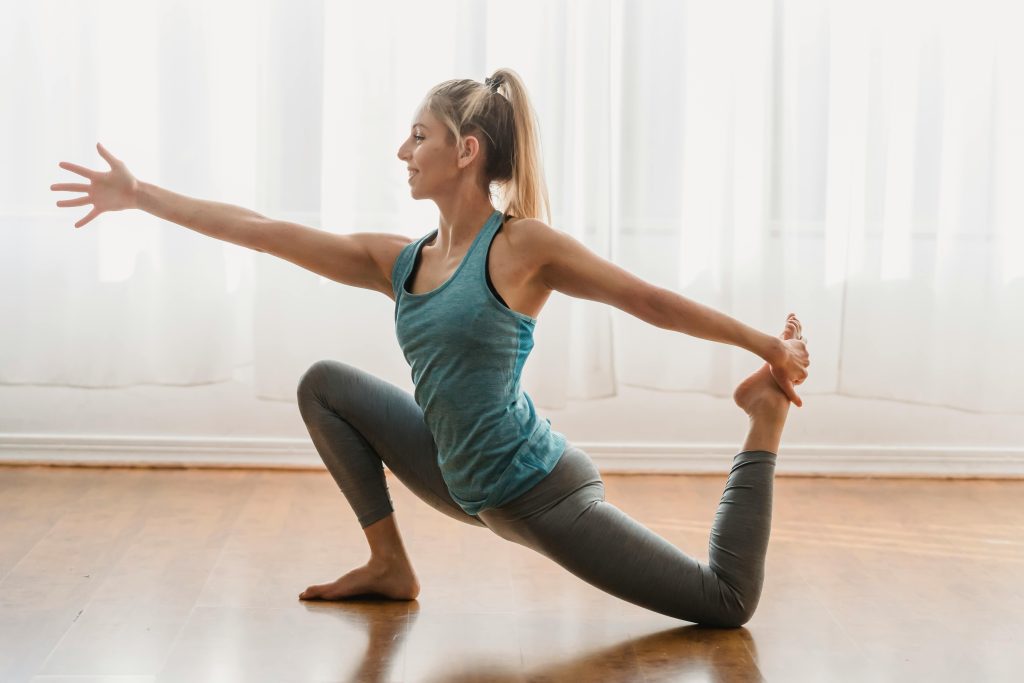
Picture this: It’s 5pm on a Wednesday. You’ve been glued to your desk since 8:30am, and when you finally stand up to grab a coffee, your hips feel like they’ve been welded into a seated position. Daily hip stretches for office workers aren’t just nice to have—they’re essential if you want to move like a functional human being after years of sitting. That stiffness radiating down your legs? That’s your body begging for some attention.
Related reading: Can You Lose Belly Fat by Walking 30 Minutes Daily?.
Sound familiar? Most people working desk jobs spend 7-10 hours sitting each day, and your hip flexors are paying the price. Those muscles at the front of your hips gradually shorten and tighten, pulling your pelvis forward and creating a chain reaction of discomfort that affects everything from your lower back to your knees. Meanwhile, your glutes (the muscles you’re literally sitting on all day) switch off completely, becoming weak and unresponsive. The result? You shuffle to your car like someone twice your age, struggle to tie your shoes without grunting, and feel a persistent ache that paracetamol doesn’t touch.
Common Myths About Hip Flexibility for Desk Workers
Related reading: Hip Mobility Routine for Tight Hips from Sitting.
Myth: You need to stretch for 30 minutes daily to see any benefit
Reality: Consistency beats duration every single time. Seven minutes of targeted daily hip stretches for office workers delivers more results than an hour-long yoga session you do once a month. Your body adapts to what you do regularly, not what you do intensely. Research from the University of Birmingham shows that brief, daily stretching produces better long-term flexibility gains than longer, sporadic sessions.
Myth: Tight hips are just part of getting older
Reality: Age is far less important than activity. Tight hips are primarily the result of prolonged sitting, not your birth year. A 50-year-old who moves regularly has far more hip mobility than a sedentary 25-year-old office worker. According to NHS physiotherapy guidelines, hip stiffness from desk work is completely reversible with consistent movement and stretching—regardless of your age.
Myth: Stretching should hurt to be effective
Reality: Pain is your body’s alarm system, not a badge of honour. Effective daily hip stretches for office workers create a sensation of gentle tension, never sharp pain. Pushing too hard activates your nervous system’s protective response, causing muscles to contract rather than lengthen. Aim for a 5 or 6 out of 10 on the discomfort scale, where you can still breathe normally and hold the position without grimacing.
Why Office Workers Develop Hip Problems
You might also enjoy: Hip Mobility Drills That Actually Deepen Your Squat.
The human hip wasn’t designed for what we’re putting it through. When you sit for hours, your hip flexors remain in a shortened position, essentially training them to stay tight. These muscles—primarily the psoas and iliacus—connect your spine to your thigh bone, and when they’re chronically contracted, they yank your pelvis into an anterior tilt. This creates that characteristic forward lean many desk workers develop.
What’s more, sitting applies constant pressure to your sciatic nerve, which runs directly through or under your piriformis muscle (a small rotator deep in your glutes). Over time, this can lead to piriformis syndrome, where that tiny muscle spasms and irritates the nerve, creating pain that radiates down your leg. Thousands of UK office workers mistake this for a spinal problem when it’s actually a hip flexibility issue.
Your glutes face a different problem: they essentially fall asleep. Prolonged sitting triggers something physiologists call “gluteal amnesia,” where these powerful muscles forget how to activate properly. When you eventually stand up and try to walk, your hip flexors remain tight while your glutes stay switched off, forcing your lower back and hamstrings to pick up the slack. This compensation pattern leads to chronic lower back pain, which affects approximately 31% of UK office workers, according to the Office for National Statistics.
The reality is this: daily hip stretches for office workers aren’t optional if you want to maintain long-term mobility. The good news? Even severe hip tightness responds remarkably well to consistent stretching. Your body is incredibly adaptable—you just need to give it the right signals.
The 7-Minute Daily Hip Mobility Routine
This routine targets every major hip muscle group in less time than your average coffee break. Perform these daily hip stretches for office workers first thing in the morning, during lunch, or right after work. Consistency matters more than perfection.
Standing Hip Flexor Stretch (90 seconds each side)
Step forward into a lunge position with your right foot, keeping your left knee on the ground (use a cushion if you need padding). Your right knee should be directly above your ankle, not pushed forward past your toes. Gently push your hips forward until you feel a stretch through the front of your left hip. For a deeper stretch, raise your left arm overhead and lean slightly to the right. This targets the psoas muscle that spends all day scrunched up while you’re sitting.
Hold the position and focus on breathing deeply. You’ll likely feel the stretch intensify as you relax into it. After 90 seconds, switch sides. Don’t bounce or force the movement—just breathe and let gravity do the work.
Figure-4 Stretch (60 seconds each side)
Lie on your back with both knees bent, feet flat on the floor. Cross your right ankle over your left thigh, just above the knee, creating a figure-4 shape with your legs. Reach through the gap and clasp your hands behind your left thigh. Gently pull your left leg towards your chest while keeping your right foot flexed. You should feel a deep stretch in your right glute and outer hip.
This targets the piriformis muscle that often causes sciatic-like pain in office workers. Breathe steadily and let the stretch deepen naturally. Switch sides after 60 seconds.
90/90 Hip Stretch (60 seconds each side)
Sit on the floor with your right leg bent in front of you at a 90-degree angle, knee pointing right. Your left leg should be bent behind you, also at 90 degrees, knee pointing left. Both knees and both ankles should form right angles. Sit up tall through your spine and lean gently forward over your front leg. You’ll feel this stretch deep in your front hip and outer glute.
This position challenges hip mobility in both internal and external rotation—movements that sitting completely eliminates. Many office workers find this stretch challenging at first. If you can’t sit upright comfortably, place a yoga block or folded towel under your front hip for support.
Butterfly Stretch (90 seconds)
Sit with the soles of your feet pressed together, knees falling out to the sides. Hold your feet with your hands and gently pull them towards your body. Keep your spine long and lean forward from your hips (not by rounding your back). The stretch should be felt through your inner thighs and groins.
Your adductor muscles (inner thighs) also suffer from prolonged sitting, becoming tight and restricting hip mobility. Don’t push your knees down with your elbows—that’s a common mistake that causes discomfort rather than useful stretching. Let the weight of your legs create the stretch.
Supine Twist (45 seconds each side)
Lie on your back and bring your right knee up towards your chest. Use your left hand to guide your right knee across your body towards the left side, keeping your right shoulder on the ground. Extend your right arm out to the side and turn your head to look right. This creates a gentle rotation through your spine and stretches the outer hip.
Office workers often develop restricted hip rotation because sitting locks your hips in one fixed position. This twist restores that rotational mobility and feels absolutely brilliant after hours at a desk. Hold for 45 seconds, then switch sides. These daily hip stretches for office workers specifically target the movement patterns you lose from sitting.
Building Your Hip Stretching Habit
Knowing what to do is only half the battle. Actually doing it consistently requires a system that doesn’t rely on willpower alone. Here’s what works:
Anchor to an existing habit
Pair your daily hip stretches for office workers with something you already do without thinking. Right after your morning coffee? Immediately after brushing your teeth at night? During the ad breaks while watching telly? Choose a trigger that happens at roughly the same time each day. Behavioural psychology research from University College London shows that habit stacking dramatically increases adherence rates.
Lower the barrier to entry
Leave a yoga mat rolled out in your living room or bedroom. Seeing it serves as a visual reminder, and not having to fetch it from a cupboard removes one tiny source of friction. Sounds trivial, but these micro-decisions determine whether you actually follow through when motivation is low. Having something like a simple foam mat (nothing fancy required) makes stretching more comfortable and therefore more likely to happen.
Track your streak
Use a basic calendar or phone app to mark each day you complete your hip stretches. Watching a streak build creates psychological momentum. Missing one day feels manageable. Breaking a 12-day streak feels costly. This isn’t about perfection—it’s about creating a pattern your brain recognises and wants to maintain.
Notice the benefits
Pay attention to how you feel after stretching. Do you stand up from your desk more easily? Does your lower back ache less? Can you tie your shoes without that familiar stiffness? Connecting the habit to tangible benefits reinforces the behaviour far more effectively than abstract health goals. Within two weeks of consistent daily hip stretches for office workers, most people notice measurable improvements in how they move.
Mistakes That Sabotage Your Hip Mobility Progress
Mistake 1: Only stretching when you’re already in pain
Why it’s a problem: Reactive stretching puts you in a constant cycle of discomfort, brief relief, then back to discomfort. By the time your hips hurt, they’re already significantly restricted. Stretching becomes damage control rather than prevention.
What to do instead: Implement daily hip stretches for office workers as a non-negotiable part of your routine, regardless of whether you’re currently experiencing pain. Think of it like brushing your teeth—you don’t wait until you have cavities. Consistent preventative stretching maintains mobility and prevents issues from developing in the first place.
Mistake 2: Rushing through stretches
Why it’s a problem: Your muscles need time to relax and lengthen. Quick, perfunctory stretching barely scratches the surface. Connective tissue requires sustained, gentle tension to actually change length. Rushing defeats the entire purpose.
What to do instead: Set a timer for each stretch and actually honour it. Seven focused minutes beats twenty distracted minutes. Put your phone in another room. Close your laptop. This is remarkably difficult for many office workers—being still and present challenges people who spend their entire day multitasking. But learning to simply breathe and hold a position pays enormous dividends.
Mistake 3: Holding your breath during stretches
Why it’s a problem: Breath-holding activates your sympathetic nervous system (fight-or-flight response), which increases muscle tension—the exact opposite of what you’re trying to achieve. Tense muscles don’t lengthen effectively.
What to do instead: Breathe deeply and continuously throughout each stretch. Inhale through your nose for four counts, exhale through your mouth for six counts. Focus on making your exhales longer than your inhales—this activates your parasympathetic nervous system, telling your body it’s safe to relax. The stretch will naturally deepen on each exhale.
Mistake 4: Ignoring unilateral differences
Why it’s a problem: Most people have one hip significantly tighter than the other—usually opposite to their dominant hand. Doing the same stretch duration on both sides perpetuates this imbalance, which can lead to compensatory movement patterns and eventual injury.
What to do instead: Spend extra time stretching your tighter side. If your right hip needs 90 seconds to feel the same stretch your left hip achieves in 60 seconds, that’s fine. Match the sensation, not the clock. Over time, this balanced approach reduces asymmetry and improves overall movement quality.
Mistake 5: Expecting immediate, permanent results
Why it’s a problem: Unrealistic expectations lead to disappointment and abandonment of the routine. Hip flexibility develops gradually. Missing a few days can undo a week’s progress, especially in the early stages.
What to do instead: Commit to four weeks before evaluating whether daily hip stretches for office workers are making a difference. Mark your starting point by noting how far you can comfortably lunge or how close your knees come to the floor in the butterfly position. Reassess monthly. The changes accumulate quietly, then suddenly you realise you can sit cross-legged comfortably or get up from the floor without using your hands. Trust the process.
Complementary Strategies for Hip Health
Daily hip stretches for office workers form the foundation, but several supporting practices accelerate your progress and maintain long-term mobility.
Break up prolonged sitting
Stand and walk for two minutes every 30-40 minutes. Set a timer if necessary. Brief, frequent breaks prevent your hip flexors from settling into that chronically shortened position. Research from NHS guidelines on workplace movement demonstrates that regular posture changes reduce musculoskeletal complaints more effectively than end-of-day stretching alone.
Strengthen your glutes
Stretching tight muscles only solves half the problem. Strengthening weak glutes restores proper hip function and prevents your hip flexors from taking over. Simple bodyweight exercises work brilliantly: glute bridges, clamshells, and single-leg deadlifts take five minutes and complement your stretching routine perfectly. Once you’re comfortable with bodyweight movements, something like a set of resistance bands adds progressive challenge without requiring a gym membership.
Adjust your workstation ergonomics
Position your chair so your hips sit slightly higher than your knees—this reduces pressure on your hip flexors and lower back. Your feet should rest flat on the floor or on a footrest. Screen height matters too: the top of your monitor should be at or slightly below eye level, preventing you from craning forward and pulling your pelvis out of alignment. Small adjustments compound over thousands of hours.
Walk whenever possible
Walking uses your hips through their full range of motion, preventing the adaptation to sitting that creates tightness. Take phone calls while walking. Park further away. Use stairs instead of lifts. These aren’t revolutionary suggestions, but they’re often ignored because they seem too simple to matter. Yet accumulated daily movement makes an enormous difference to hip health.
When to Seek Professional Help
Most hip tightness from desk work responds beautifully to consistent daily hip stretches for office workers. However, certain symptoms warrant professional assessment. Sharp, shooting pain that travels down your leg, persistent pain that worsens rather than improves with gentle stretching, clicking or catching sensations accompanied by pain, or significant mobility limitations on one side compared to the other all deserve attention from a physiotherapist.
The Chartered Society of Physiotherapy maintains a directory of qualified practitioners throughout the UK. Early intervention prevents minor issues from becoming chronic problems. Don’t wait until you can barely walk before seeking help—that’s like waiting until your car completely breaks down before getting the oil changed.
Your Hip Mobility Quick Reference
- Complete your 7-minute stretching routine at the same time daily for consistency
- Hold each stretch for the full recommended duration without rushing
- Focus on deep, continuous breathing throughout every position
- Stand and move for two minutes every 30-40 minutes during work hours
- Spend extra time on your tighter side to balance asymmetries
- Track your daily completion to build momentum and identify patterns
- Reassess your flexibility monthly to appreciate gradual improvements
- Complement stretching with basic glute strengthening exercises twice weekly
Frequently Asked Questions
How long before I notice improvement from daily hip stretches?
Most office workers report feeling less stiff after just three to five days of consistent stretching. Measurable flexibility improvements typically appear within two to three weeks. Significant changes—like being able to sit cross-legged comfortably or lunge deeply without discomfort—generally take four to six weeks of daily practice. Your starting flexibility level and sitting duration determine your timeline. Someone with severe restriction needs more patience than someone with mild tightness.
Can I do these hip stretches at work during the day?
Absolutely. Several of these stretches work well in an office environment. The standing hip flexor stretch requires minimal space and no equipment. The figure-4 can be done seated in your chair by crossing one ankle over the opposite knee and leaning forward slightly. Breaking up prolonged sitting with brief stretching provides immediate relief and prevents stiffness from accumulating. Even 60 seconds of targeted stretching every few hours makes a noticeable difference.
Should hip stretches hurt or just feel uncomfortable?
Daily hip stretches for office workers should create a sensation of mild to moderate tension, never sharp or stabbing pain. Aim for a 5 or 6 out of 10 on the discomfort scale—noticeable but not distressing. You should be able to breathe normally and hold the position without grimacing. If you’re gritting your teeth or holding your breath, you’ve pushed too far. Pain signals potential injury, whereas productive discomfort feels like a satisfying pull or pressure.
What if one hip is much tighter than the other?
Hip asymmetry is extremely common among office workers, often correlating with leg-crossing habits or phone-holding patterns. Spend additional time stretching your tighter side until both hips reach similar levels of flexibility. This might mean holding stretches for 30-45 seconds longer on one side. Imbalances usually improve within three to four weeks of focused attention. Persistent, severe asymmetry that doesn’t respond to consistent stretching deserves assessment from a physiotherapist.
Do I need a yoga mat or special equipment for hip stretches?
Not necessarily, though comfort matters for consistency. You can perform most of these stretches on carpet or even a folded towel. That said, having something like an inexpensive foam mat makes floor stretches more comfortable and removes one excuse for skipping your routine. The minimal investment often pays off in increased adherence. Beyond a mat, you need absolutely nothing—these daily hip stretches for office workers use only your bodyweight.
Frequently Asked Questions
How long before I notice improvement from daily hip stretches?
Most office workers report feeling less stiff after just three to five days of consistent stretching. Measurable flexibility improvements typically appear within two to three weeks. Significant changes—like being able to sit cross-legged comfortably or lunge deeply without discomfort—generally take four to six weeks of daily practice. Your starting flexibility level and sitting duration determine your timeline. Someone with severe restriction needs more patience than someone with mild tightness.
Can I do these hip stretches at work during the day?
Absolutely. Several of these stretches work well in an office environment. The standing hip flexor stretch requires minimal space and no equipment. The figure-4 can be done seated in your chair by crossing one ankle over the opposite knee and leaning forward slightly. Breaking up prolonged sitting with brief stretching provides immediate relief and prevents stiffness from accumulating. Even 60 seconds of targeted stretching every few hours makes a noticeable difference.
Should hip stretches hurt or just feel uncomfortable?
Daily hip stretches for office workers should create a sensation of mild to moderate tension, never sharp or stabbing pain. Aim for a 5 or 6 out of 10 on the discomfort scale—noticeable but not distressing. You should be able to breathe normally and hold the position without grimacing. If you’re gritting your teeth or holding your breath, you’ve pushed too far. Pain signals potential injury, whereas productive discomfort feels like a satisfying pull or pressure.
What if one hip is much tighter than the other?
Hip asymmetry is extremely common among office workers, often correlating with leg-crossing habits or phone-holding patterns. Spend additional time stretching your tighter side until both hips reach similar levels of flexibility. This might mean holding stretches for 30-45 seconds longer on one side. Imbalances usually improve within three to four weeks of focused attention. Persistent, severe asymmetry that doesn’t respond to consistent stretching deserves assessment from a physiotherapist.
Do I need a yoga mat or special equipment for hip stretches?
Not necessarily, though comfort matters for consistency. You can perform most of these stretches on carpet or even a folded towel. That said, having something like an inexpensive foam mat makes floor stretches more comfortable and removes one excuse for skipping your routine. The minimal investment often pays off in increased adherence. Beyond a mat, you need absolutely nothing—these daily hip stretches for office workers use only your bodyweight.
Taking the First Step Today
You’ve got the knowledge. You understand why hip tightness develops, what happens when you ignore it, and exactly which stretches reverse the damage. What matters now is action. Not perfect action. Not Instagram-worthy action. Just seven minutes of focused movement today.
Start smaller than feels necessary if you need to. Three stretches are better than zero. Four minutes beat no minutes. Consistency builds confidence, and confidence builds results. Your hips didn’t get tight overnight, and they won’t become mobile overnight either. But four weeks from now, you’ll either wish you’d started today or you’ll be grateful you did.
Close this tab. Roll out a mat or find a clear patch of carpet. Do the standing hip flexor stretch on both sides right now. That’s your entry point. Daily hip stretches for office workers aren’t complicated or time-consuming—they just require the decision to begin. Make that decision today.


