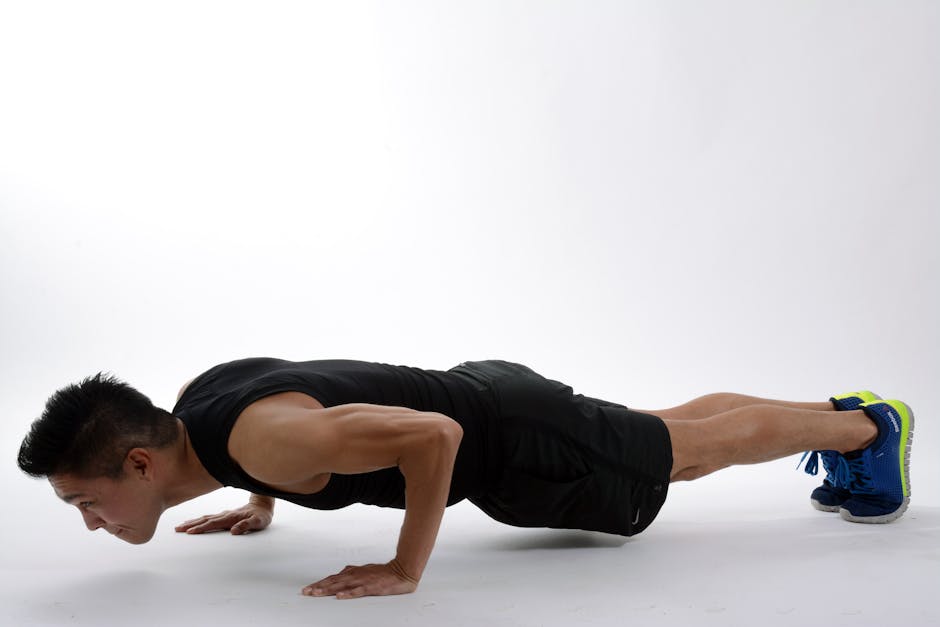
You’ve probably seen claims about how to progress from beginner to advanced push-ups step by step, promising rapid results in mere weeks. But here’s what actually happens: most people either burn out trying to do too much too soon, or they plateau endlessly doing the same variation over and over. Neither approach gets you closer to those impressive advanced push-ups you’re after.
Picture this: You’re on the living room floor, attempting your twentieth push-up of the day. Your form is wobbly. Your shoulders ache. And you’re wondering if you’ll ever get to the point where push-ups actually feel controlled and powerful rather than a desperate struggle against gravity. Sound familiar? Thousands of people across the UK are stuck in this exact spot right now, convinced they’re somehow deficient when the real issue is progression strategy.
Common Myths About Push-Up Progression
Related reading: How Long Should Beginner HIIT Workouts Be to Keep You Injury-Free.
Before we dive into how to progress from beginner to advanced push-ups step by step, let’s clear up some nonsense that’s probably holding you back.
Myth: More repetitions automatically make you stronger
Reality: Banging out endless sets of the same push-up variation builds endurance, not progressive strength. Research from the University of Bath shows that after about 20 repetitions, you’re training muscular endurance rather than strength development. If you can already do 15-20 push-ups comfortably, doing 50 won’t magically unlock advanced variations. You need to increase difficulty through progression, not just volume.
Myth: You need to master 100 standard push-ups before trying harder variations
Reality: This arbitrary benchmark wastes months of potential progress. Once you can perform 12-15 solid standard push-ups with proper form, you’re ready to start exploring progressions. Waiting until you hit some magic number means you’re spinning your wheels in the endurance zone when you could be building actual strength through graduated challenges.
Myth: Advanced push-ups are all about chest strength
Reality: The push-up is a full-body movement requiring coordinated strength from your chest, shoulders, triceps, core, and even your legs. According to NHS guidelines on strength training, compound movements that engage multiple muscle groups simultaneously provide superior functional fitness benefits. Advanced push-up variations demand exceptional core stability and shoulder control, often more than raw pressing power.
Building Your Foundation: The First Four Weeks
You might also enjoy: How to Overcome Gym Anxiety as a Complete Beginner Woman.
Learning how to progress from beginner to advanced push-ups step by step starts with honest assessment. Where are you right now? Can you do even one proper push-up from your toes? Or are you starting from wall push-ups?
No judgment here. Everyone starts somewhere.
Week 1-2: Establish Your Baseline
Start with an assessment. Perform as many push-ups as you can with proper form: hands slightly wider than shoulders, body in a straight line from head to heels, chest touching the floor (or coming within a fist’s width), full lockout at the top. The moment your hips sag or your form breaks, you’re done counting.
Got zero? Begin with incline push-ups against a sturdy kitchen counter or desk. Aim for 3 sets of 8-10 repetitions, three times per week. The higher the incline, the easier the movement.
Got 1-5? Start with knee push-ups or a higher incline. Focus on 3-4 sets of 6-8 repetitions, prioritizing perfect form over quantity.
Got 6-15? Brilliant. Work with standard push-ups, doing 3-4 sets at about 70% of your maximum. If you can do 10, aim for sets of 7. This leaves room for quality over fatigue.
Week 3-4: Add Volume and Frequency
Increase your training frequency to 4-5 days per week. Your muscles adapt quickly to push-up training when you’re starting out. Add one extra set to each workout, and slow down your tempo. Try a 3-1-3 rhythm: three seconds down, one second pause at the bottom, three seconds up.
This controlled tempo builds strength throughout the entire range of motion, addressing weak points that speed reps hide. Many people find that something like a simple exercise mat provides better grip and comfort during floor work, particularly if you’re on hard flooring or carpet that irritates your knees.
Track everything. Use your phone’s notes app or a basic fitness journal. Write down sets, reps, and how each session felt. Progress isn’t always linear, but patterns emerge when you record your work.
The Crucial Middle Phase: Weeks 5-12
This is where most people stall. They reach 20-25 standard push-ups and assume the next step is… more standard push-ups. Wrong. Truth is, this is precisely when you need to introduce variation and progressive overload through different angles and techniques.
Introducing Tempo Variations
Before jumping to flashier variations, master tempo manipulation. Spend Weeks 5-6 working with different speeds:
- Explosive push-ups: Push up as quickly as possible while maintaining control, lower slowly over 3 seconds
- Pause push-ups: Add a 2-3 second pause at the bottom and top of each rep
- Super-slow push-ups: 5 seconds down, 5 seconds up, continuous tension throughout
These variations build strength, body awareness, and muscular control that standard-speed reps don’t develop. Aim for 3 sets of 6-10 repetitions with each tempo style, rotating them throughout your week.
Your First Progression Ladder: Weeks 7-10
Now we start climbing the difficulty ladder systematically. Here’s what’s interesting: small changes in hand position, elevation, or body angle can dramatically shift the challenge level, allowing you to progress from beginner to advanced push-ups step by step without massive jumps in difficulty.
Choose one new variation every two weeks:
Decline Push-Ups: Elevate your feet on a low step or sturdy box (start with 15-20cm height). This shifts more weight toward your upper chest and shoulders. Start with 3 sets of 8 reps, building to 3 sets of 12.
Diamond Push-Ups: Position your hands close together under your chest, forming a diamond shape with your thumbs and index fingers. This hammers your triceps and inner chest. Expect to do about 40-60% of your standard push-up numbers initially. Work toward 3 sets of 10.
Wide-Grip Push-Ups: Place hands 10-15cm wider than standard position. This increases chest activation and reduces tricep involvement. Progress to 3 sets of 12-15 reps.
The key is mastering each variation before moving to the next. Mastery means performing 3 sets of 12 repetitions with excellent form, not struggling through sloppy sets.
Weeks 11-12: Introduce Unilateral Elements
Unilateral training (working one side at a time or shifting weight asymmetrically) is essential preparation for advanced push-up variations. According to research highlighted by BBC Health, unilateral exercises improve muscle imbalances and build functional strength more effectively than bilateral movements alone.
Start with archer push-ups: assume a wide push-up position, then shift your weight predominantly to one side as you descend, straightening the opposite arm. Alternate sides each rep. Begin with 3 sets of 6 reps per side.
These feel incredibly challenging at first. That’s normal. You’re preparing your body for one-arm push-up progressions and other advanced variations that demand serious unilateral strength.
Advanced Territory: Months 4-6 and Beyond
By month four, if you’ve followed a structured approach to progress from beginner to advanced push-ups step by step, you should be comfortable with multiple variations and ready to tackle genuinely advanced movements. This is where things get exciting.
Plyometric Push-Ups
Explosive, jumping push-ups develop power and fast-twitch muscle recruitment. Start conservative: push up with enough force that your hands briefly leave the ground, land softly, and immediately descend into the next rep.
Progress to clapping push-ups once you can do 8-10 basic plyometric reps. These require significant shoulder and wrist stability, so proper warm-up is non-negotiable. Aim for 3-4 sets of 5-8 reps, with full rest between sets (90-120 seconds).
Warning: plyometrics carry higher injury risk. Never attempt these when fatigued, and always perform them at the beginning of your session when you’re fresh.
Pseudo Planche Push-Ups
This variation builds shoulder strength essential for advanced calisthenics skills. Position your hands near your hips (not your shoulders) and lean forward so your shoulders move well past your hands. Keep your body rigid and perform push-ups in this protracted position.
Start with just 2-3 reps per set. These are brutally difficult. Work gradually toward 3 sets of 8 reps over several weeks. The shoulder and core strength you develop here translates directly to skills like planche leans and tuck planches.
One-Arm Push-Up Progression
The holy grail for many people. Here’s how to progress from beginner to advanced push-ups step by step toward this impressive feat:
- Elevated one-arm push-ups: Perform one-arm push-ups with your hand on a raised surface (counter height initially). Lower the height progressively over weeks.
- Assisted one-arm push-ups: Use your opposite hand for minimal support, gradually reducing assistance. Place the assisting hand on a basketball or medicine ball to limit how much help you can provide.
- Negative one-arm push-ups: Lower yourself slowly on one arm (take 5 seconds), then push up with both hands. Build eccentric strength first.
- Full one-arm push-ups: Feet wide for stability, body slightly rotated, one arm behind your back. Expect this to take months of consistent work.
Patience is everything here. Progress in millimeters, not miles. Adding resistance bands to assist the movement can provide just enough support to practice the full range of motion while building strength.
Programming Your Week for Continuous Progress
Knowing individual variations is one thing. Structuring them intelligently into a weekly training plan is another. Here’s a sustainable approach that allows you to progress from beginner to advanced push-ups step by step without overtraining.
Sample Weekly Structure (Intermediate Level)
Monday: Strength focus – 4 sets of 8 diamond push-ups, 3 sets of 10 decline push-ups, 2 sets of 6 archer push-ups per side
Wednesday: Volume focus – 5 sets of 15 standard push-ups (moderate tempo), 3 sets of 12 wide-grip push-ups
Friday: Skill and power – 4 sets of 6 plyometric push-ups, 3 sets of 8 tempo push-ups (5-second descent), 2 sets of pseudo planche holds (20-30 seconds)
Sunday: Active recovery – Light movement, mobility work, or easy incline push-ups if desired
Rest days matter enormously. Your muscles grow stronger during recovery, not during the workout itself. Pushing through excessive soreness or fatigue leads to injury and setbacks, not progress.
Sample Weekly Structure (Advanced Level)
Monday: One-arm progression – 5 sets of 3-5 assisted one-arm push-ups per side, 3 sets of 10 pseudo planche push-ups
Tuesday: Explosive power – 5 sets of 8 clapping push-ups, 3 sets of 10 decline plyometric push-ups
Thursday: Volume and endurance – 100 total push-ups (various grips and tempos), broken into manageable sets
Saturday: Skill work – Practice difficult variations at low volume (planche leans, one-arm negatives, typewriter push-ups)
What really matters is consistency over intensity. Training four times weekly with excellent form beats seven days of sloppy, exhausting sessions every time.
Mistakes to Avoid (And How to Fix Them)
Even with the best intentions, certain pitfalls derail push-up progression repeatedly. Let’s address the most common ones.
Mistake 1: Sacrificing Form for Numbers
Why it’s a problem: Sloppy push-ups with sagging hips, incomplete range of motion, or flared elbows build bad movement patterns and increase injury risk. You’re training dysfunction, not strength. Research from sports science journals consistently shows that partial range of motion exercises produce inferior strength gains compared to full range of motion movements.
What to do instead: Film yourself. Seriously. Set your phone against a water bottle and record your sets from the side. Watch for hip sag, incomplete depth, and elbow position (should track at about 45 degrees from your body, not 90 degrees). Quality reps beat quantity every single time. Reduce your rep count if necessary to maintain perfect form throughout.
Mistake 2: Progressing Too Quickly
Why it’s a problem: Jumping from standard push-ups straight to one-arm attempts or advanced plyometrics without building foundational strength through intermediate progressions leads to frustration, injury, or both. Connective tissue adapts more slowly than muscle. Your tendons and ligaments need time to strengthen.
What to do instead: Follow the two-week rule. Spend at least two weeks on each new variation before advancing. If a progression feels impossibly difficult, you’ve skipped a step. Go back one level and build more strength there. Patience accelerates progress in the long run.
Mistake 3: Neglecting Recovery and Nutrition
Why it’s a problem: Push-ups stress your muscles, nervous system, and connective tissues. Without adequate recovery (sleep, rest days, proper nutrition), you’re constantly breaking down tissue without allowing repair and growth. According to NHS nutrition guidelines, protein intake is crucial for muscle repair and growth, particularly when training regularly.
What to do instead: Prioritize 7-9 hours of sleep nightly. Consume adequate protein (roughly 1.6-2.2g per kilogram of body weight daily if you’re training seriously). Take at least two full rest days weekly. Listen to your body. Persistent joint pain, extended soreness beyond 48 hours, or declining performance all signal inadequate recovery.
Mistake 4: Ignoring Supplementary Strength Work
Why it’s a problem: Push-ups alone create muscular imbalances. They emphasize pushing muscles (chest, shoulders, triceps) while neglecting pulling muscles (back, biceps). This imbalance can lead to rounded shoulders, poor posture, and shoulder injuries. The push-to-pull ratio should be roughly equal for balanced development.
What to do instead: Incorporate pulling exercises into your training. Rows (using resistance bands or something like a TRX-style suspension trainer if you have one), pull-ups, or even face pulls balance your shoulder development. Aim for equal volume: if you do 100 push-ups weekly, perform roughly 100 rowing movements as well.
Fine-Tuning Your Technique
Small technical adjustments make enormous differences in how effectively you progress from beginner to advanced push-ups step by step. These details separate mediocre push-ups from truly excellent ones.
Hand Position and Shoulder Health
Your hand position impacts shoulder stress significantly. Hands slightly wider than shoulders with fingers pointed forward or slightly outward feels natural for most people. Avoid excessively wide hand placement (beyond 1.5 times shoulder width), which increases shoulder joint stress without proportional strength benefits.
Screwing your hands outward (imagine trying to twist them into the floor without actually moving them) creates external rotation torque that stabilizes your shoulders and protects the joint. This subtle cue, popularized by mobility experts, dramatically improves shoulder safety during high-volume push-up training.
Core Engagement Throughout
Your push-up is only as strong as your core stability. Before each rep, take a breath and brace your abs as if preparing for a punch to the stomach. Maintain this tension throughout the entire set. Your body should move as one rigid unit, not as a chest exercise with floppy legs attached.
Practice hollow body holds separately to develop the core strength push-ups demand. Lie on your back, press your lower back into the floor, raise your shoulders and feet slightly off the ground, and hold for 30-60 seconds. Work up to 3 sets of 60 seconds. The core control you build transfers directly to better push-up performance.
Breathing Pattern
Breathe in during the descent, breathe out during the ascent. This feels natural and helps maintain core tension. Some advanced practitioners hold their breath during the most challenging portion of the rep (typically the bottom), then exhale forcefully during the push. Experiment to find what works for you, but never hold your breath for entire sets, which can spike blood pressure dangerously.
Your Push-Up Progression Roadmap
Let’s consolidate everything into a clear, actionable plan showing how to progress from beginner to advanced push-ups step by step over six months.
Months 1-6
1: Foundation Building
- Establish your baseline and choose appropriate starting variation (incline, knee, or standard)
- Train 3 times weekly, focusing exclusively on form and consistency
- Gradually increase volume: start with 3 sets of 8, progress toward 4 sets of 12
- Film yourself weekly to monitor form improvements
- Begin mobility work for shoulders and wrists (arm circles, wrist rotations)
2: Volume Increase
- Increase training frequency to 4 times weekly
- Add tempo variations (slow eccentrics, pause reps) on one workout per week
- Achieve 4 sets of 15 reps on your primary variation before progressing
- Introduce pulling exercises to maintain muscular balance
- Track all workouts in a journal or app
3: First Progressions
- Introduce decline push-ups and diamond push-ups
- Dedicate one workout weekly to each new variation
- Maintain one standard push-up workout for volume
- Begin working archer push-ups for unilateral preparation
- Focus on achieving 3 sets of 10 reps on new variations
4: Advanced Variations
- Add plyometric push-ups (start basic, progress to clapping)
- Introduce pseudo planche push-ups for 2-3 reps per set
- Continue progressing archer push-ups toward 3 sets of 8 per side
- Reduce standard push-up volume, increase variation diversity
- Assess weak points and address with specific assistance work
5: Skill Development
- Begin one-arm push-up progression (elevated or assisted)
- Work explosive variations (clapping, depth jumps)
- Practice pseudo planche push-ups toward 3 sets of 8
- Experiment with new variations: typewriter push-ups, superman push-ups
- Maintain pulling work and mobility practice
6: Consolidation and Mastery
- Continue one-arm push-up progression, lowering assistance gradually
- Achieve consistent sets of 8-10 on multiple advanced variations
- Program weekly structure balancing strength, power, and volume
- Assess progress: film comparison videos from Month 1 to Month 6
- Set new goals: full one-arm push-up, planche progressions, or other calisthenics skills
Troubleshooting Common Plateaus
Even with perfect programming, everyone hits walls. Here’s how to diagnose and overcome the most common sticking points when trying to progress from beginner to advanced push-ups step by step.
Plateau: Can’t Break Past 20 Standard Push-Ups
You’re stuck in the endurance zone. Stop doing sets of 20 and start doing harder variations for lower reps. Replace some standard push-up volume with decline push-ups, diamond push-ups, or tempo variations. Build strength, not just endurance.
Plateau: Shoulder Pain During or After Push-Ups
Check your form first. Film yourself. Look for excessive elbow flare (elbows pointing straight out from shoulders), incomplete scapular control (shoulder blades winging off your back), or internally rotated shoulders. Reduce volume temporarily, add mobility work (shoulder dislocations with a band, wall slides), and incorporate more pulling exercises to balance shoulder development.
If pain persists beyond two weeks, consult a physiotherapist. The NHS offers excellent musculoskeletal services that can assess and address specific shoulder issues before they become chronic problems.
Plateau: Inconsistent Performance (Great One Day, Terrible the Next)
Look at recovery factors: sleep quality, nutrition timing, stress levels, and training frequency. Inconsistent performance typically signals inadequate recovery. Add an extra rest day, improve sleep hygiene, and ensure you’re eating sufficient calories and protein. Sometimes less training produces better results.
Plateau: Can’t Progress to Harder Variations
You’re probably jumping difficulty levels too aggressively. Add intermediate steps. Can’t do archer push-ups yet? Try offset push-ups (hands at different heights). Can’t do one-arm push-ups? Spend more time with archer progressions and one-arm negatives. There’s always a variation between where you are and where you want to be.
Your Push-Up Quick Reference Guide
Save this checklist for immediate reference whenever you train:
- Hands positioned slightly wider than shoulders, fingers forward or slightly outward
- Core braced hard throughout every rep, body moving as one rigid unit
- Chest touches floor (or comes within fist-width) on every repetition
- Elbows track roughly 45 degrees from body, not straight out at 90 degrees
- Shoulders stay away from ears, maintaining stable scapular position
- Full elbow lockout at top position without hyperextension
- Controlled tempo: 2-3 seconds down, explosive up (unless practicing specific tempo variations)
- Rest 90-120 seconds between strength sets, 60 seconds between volume sets
Frequently Asked Questions
How long does it realistically take to progress from beginner to advanced push-ups?
Most people need 4-6 months of consistent training to move from basic push-ups to genuinely advanced variations like one-arm push-ups or planche push-ups. Variables include starting strength level, training frequency, recovery quality, and genetics. Someone starting from zero push-up ability might need 8-12 months to reach advanced skills. That’s completely normal. Consistency matters infinitely more than speed.
Should I train push-ups every day to improve faster?
No. Daily push-up challenges are popular but suboptimal for strength development. Your muscles need recovery time to repair and grow stronger. Training 3-5 times weekly with proper rest days produces superior results compared to daily training, which often leads to overuse injuries, plateaus, and burnout. If you want daily movement, alternate push-ups with pulling exercises or other muscle groups.
Can I build significant muscle mass with just push-ups?
Push-ups can absolutely build muscle in your chest, shoulders, and triceps, particularly when you’re newer to training. However, there are limits. Once you adapt to bodyweight resistance, adding external load (weighted vests, resistance bands) or progressing to extremely difficult variations becomes necessary for continued growth. For maximum muscle development, push-ups work best as part of a comprehensive training program including pulling movements and lower body work.
What if I can’t do even one proper push-up from my toes?
Start with incline push-ups using a kitchen counter, sturdy table, or wall. The higher the incline, the easier the movement. Work at an angle where you can complete 3 sets of 8-10 repetitions with good form. Every week or two, lower the incline slightly (move from counter to chair, chair to low step, step to floor). This gradual progression builds strength systematically without the frustration of attempting movements beyond your current capability.
How important is wrist strength for advanced push-up variations?
Extremely important, particularly for variations like planche push-ups, one-arm push-ups, and explosive movements. Weak wrists limit your progress and increase injury risk. Dedicate 5-10 minutes before each session to wrist preparation: gentle rotations, flexion/extension stretches, and weight-bearing holds in various positions. Consider incorporating finger push-ups gradually, which build extraordinary wrist and forearm strength over time.
Moving Forward with Confidence
Learning how to progress from beginner to advanced push-ups step by step isn’t complicated, but it requires patience, consistency, and intelligent programming. You’ve got a clear roadmap now: start at your current level, progress systematically through variations, prioritize form over numbers, and give your body adequate recovery.
Will every session feel amazing? Absolutely not. Some days you’ll feel strong and powerful. Other days you’ll struggle through workouts that felt easy last week. That’s normal. Progress isn’t linear. It’s a general upward trend with plenty of fluctuation along the way.
The critical bit is this: every perfect rep you perform today builds the strength foundation for the variations you’ll master months from now. The archer push-ups that seem impossible currently will feel manageable after consistent work on your intermediate progressions. The one-arm push-up you dream about is already within reach; you just need to walk the path between here and there.
Start smaller than feels necessary. Choose one variation appropriate for your current level. Perform three quality sets. Rest properly. Train again in two days. That’s it. Complexity isn’t required. Consistency is everything.


