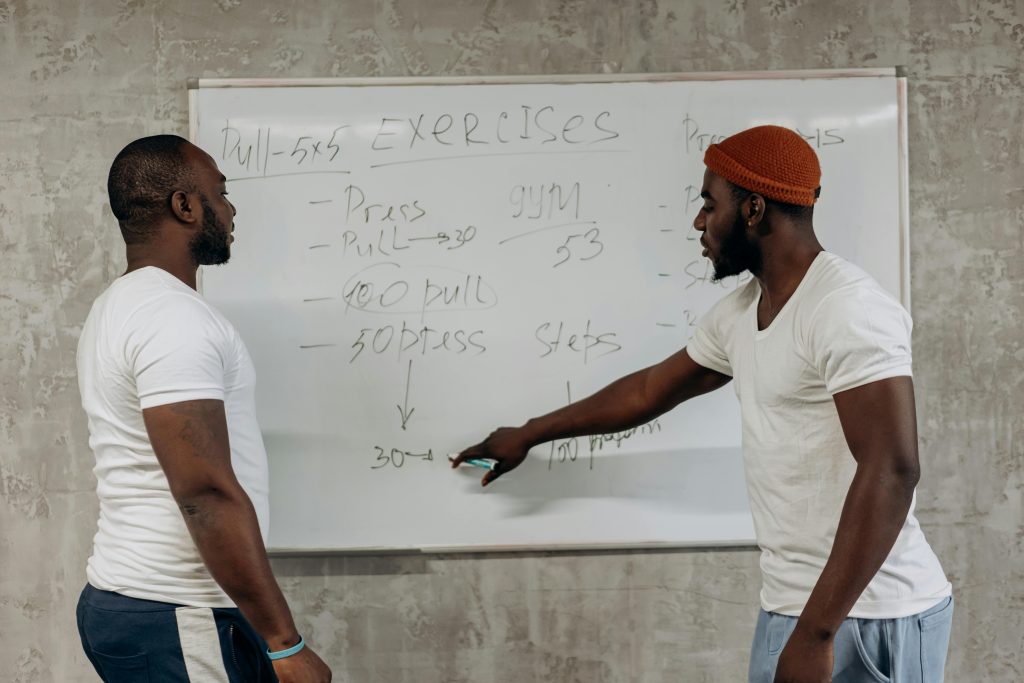
You step into the gym with vague intentions to “get fitter” or “lose some weight,” but three months later, you’re still doing the same workouts with no measurable progress. Perhaps you set an ambitious target to bench press 100kg, achieved it, then lost all motivation. Maybe you’ve bounced between different training goals every few weeks, never sticking with one long enough to see results. You’re not alone. Research from the University of Stirling reveals that 78% of gym-goers fail to achieve their training goals within 12 months, primarily because they set goals poorly or lack structured implementation strategies.
Most people approach training goals with either excessive vagueness (“get stronger”) or unrealistic specificity (“gain 10kg of pure muscle in 8 weeks”). Both extremes sabotage progress. Effective training goals require finding the balance between ambitious and achievable, specific yet flexible, challenging whilst sustainable. Without properly defined training goals, you’re essentially exercising without direction, hoping random activity produces desired results.
This comprehensive guide will teach you everything you need to set and achieve meaningful training goals. You’ll discover the science-backed frameworks for goal setting, learn how to align training goals with your lifestyle and values, and receive practical systems you can implement immediately to transform vague fitness intentions into concrete, achievable outcomes.
Who This Guide Is For
This guide is designed for UK adults aged 25-45 who train regularly or want to start training with clear direction. You’ll benefit from this resource if you’ve struggled to maintain motivation, feel overwhelmed by conflicting fitness advice, want to progress beyond beginner gains, or simply need structure for your training. Suitable for all experience levels from complete novices to advanced athletes.
Understanding Training Goals: The Foundation of Progress
Before diving into specific goal-setting frameworks, you need to understand what makes training goals effective versus ineffective. Many people confuse general desires with actionable goals, creating frustration when their wishes don’t materialise into results.
Training goals are specific, measurable outcomes you aim to achieve through structured exercise and supporting lifestyle behaviours. Unlike vague aspirations (“look better”), effective training goals provide concrete targets (“increase squat 1RM from 80kg to 100kg by June”), clear measurement criteria, and defined timeframes. These elements transform abstract desires into actionable plans.
The Psychology of Goal Setting
Understanding how goals influence behaviour reveals why proper goal setting matters so profoundly. Studies from Loughborough University demonstrate that individuals with specific, challenging goals consistently outperform those with vague intentions or no goals at all. Goals direct attention toward relevant activities, energise effort, increase persistence, and motivate strategy development.
However, not all goals produce equal benefits. Outcome goals (focusing on end results like “lose 10kg”) create motivation but offer limited guidance for daily behaviour. Process goals (focusing on actions like “complete 4 strength sessions weekly”) provide clear direction but may lack inspiring vision. The most effective approach combines both goal types strategically.
Your brain responds differently to various goal types. Outcome-focused training goals activate reward centres, creating excitement and motivation. Process-oriented goals engage planning regions, facilitating consistent execution. Research shows that setting both outcome and process goals produces superior results compared to either type alone, as they leverage different psychological mechanisms simultaneously.
Common Goal-Setting Pitfalls
The most pervasive mistake involves setting purely outcome-based training goals without identifying supporting processes. Someone might target “bench press 100kg” without establishing training frequency, progression protocol, or nutrition support. When progress stalls, they lack frameworks for troubleshooting or adjusting their approach.
Another dangerous pattern involves choosing training goals based on social comparison rather than personal values. Pursuing someone else’s definition of success (perhaps influenced by social media) rarely sustains motivation long-term. If you don’t genuinely value the goal, you’ll struggle to maintain effort through inevitable challenges.
Unrealistic timelines represent another common pitfall. Beginners often expect advanced-level progress, setting themselves up for disappointment and abandonment. Research from Manchester Metropolitan University found that individuals who set moderately challenging training goals (achievable with sustained effort) showed 35% better adherence and 28% greater progress compared to those setting either very easy or impossibly difficult targets.
The SMART Framework for Training Goals
The SMART acronym (Specific, Measurable, Achievable, Relevant, Time-bound) provides a proven structure for defining effective training goals. Whilst widely known, many people apply it superficially. Understanding each element deeply transforms this simple framework into a powerful tool.
Specific: Define Precise Outcomes
Vague training goals like “get stronger” or “improve fitness” provide insufficient direction for planning and inadequate feedback for assessing progress. Specificity requires identifying exact outcomes you want to achieve.
Convert general desires into precise targets. “Get stronger” becomes “increase back squat 1-rep max from 80kg to 100kg” or “perform 5 consecutive pull-ups with bodyweight.” “Improve fitness” transforms into “complete a 5K run under 25 minutes” or “sustain Zone 2 cardio for 45 minutes continuously.”
Specific training goals enable precise programme design. Knowing you want to squat 100kg informs exercise selection, loading protocols, and accessory work. Vague intentions leave you guessing whether your training aligns with desired outcomes.
Measurable: Establish Clear Assessment Criteria
Every training goal requires objective measurement criteria. Subjective assessments (“feel stronger,” “look better”) prove unreliable due to fluctuating self-perception and inability to track incremental progress.
Quantifiable metrics might include weight lifted for specific repetitions, running pace over defined distances, body measurements, or performance in standardised tests. Choose measurements you can assess regularly with consistent methodology. Testing your 5K time monthly on the same route provides reliable feedback. Estimating “how fit you feel” doesn’t.
Establish baseline measurements before beginning goal pursuit. You can’t track progress without knowing your starting point. Initial assessments also reveal realistic goal calibration. Someone currently squatting 40kg shouldn’t immediately target 100kg; intermediate milestones like 60kg and 80kg create achievable stepping stones.
Achievable: Balance Ambition with Reality
Training goals should stretch your current capabilities whilst remaining within the realm of possibility given your circumstances, timeline, and resources. Impossible goals demotivate; trivial goals bore. Finding the appropriate challenge level requires honest self-assessment.
Research suggests optimal training goals require approximately 60-80% confidence of achievement. Goals you’re certain you’ll achieve don’t sufficiently challenge you. Targets you believe are nearly impossible don’t sustain motivation. The “sweet spot” involves goals that seem difficult but attainable with consistent, focused effort.
Consider your training history, available time, and life circumstances when assessing achievability. A novice lifter might progress 5-10kg monthly on major lifts initially. An advanced lifter might add 5kg annually. Your current life stage matters too. Someone working 60-hour weeks with young children faces different time constraints than a university student with flexible schedules.
Relevant: Align with Your Values and Lifestyle
Training goals must connect to what you genuinely value, not what you think you should want or what others expect. Pursuing irrelevant goals produces half-hearted effort and eventual abandonment.
Ask yourself why specific training goals matter to you personally. Does increasing your squat align with functional strength for daily activities? Running a 5K might support cardiovascular health you value. Improving body composition could enhance your confidence in ways that matter to you. If you can’t articulate meaningful personal reasons for pursuing a goal, reconsider whether it’s truly your goal.
Consider how training goals fit within your broader life context. Goals requiring 10 hours weekly training conflict with someone working full-time with family commitments. Relevant goals accommodate your lifestyle constraints whilst still challenging you appropriately.
Time-Bound: Establish Clear Deadlines
Open-ended training goals lack urgency and accountability. Deadlines create productive pressure, focusing effort and enabling progress assessment. Without timeframes, goals drift indefinitely as vague someday aspirations.
Set specific target dates for goal achievement. “Squat 100kg by 30th June” proves more powerful than “squat 100kg eventually.” Deadlines enable working backward to establish required weekly and monthly progress milestones. They also create natural evaluation points for assessing whether your approach works or requires adjustment.
Choose realistic timeframes based on the goal magnitude and your starting point. Beginners might increase lifts 5-10kg monthly; intermediate lifters 2-5kg monthly; advanced lifters 5-10kg annually. Endurance improvements follow similar patterns. Understanding typical progress rates prevents both impatience and complacency.

Types of Training Goals and When to Use Each
Different goal types suit different purposes and psychological preferences. Understanding various approaches allows you to select frameworks most appropriate for your situation.
Performance-Based Goals
Performance goals focus on measurable physical capabilities: weight lifted, distance run, time achieved, or specific skills mastered. These training goals provide objective feedback and clear progression pathways.
Strength Goals: Target specific lifts at defined loads (e.g., “deadlift 150kg for 1 repetition,” “bench press 80kg for 5 repetitions”). Strength goals suit those motivated by tangible physical capability improvements and clear progression metrics. They require structured progressive overload programming and typically show measurable progress within 4-12 weeks for beginners, longer for advanced trainees.
Endurance Goals: Focus on distance, duration, or pace targets (e.g., “run 10K under 50 minutes,” “cycle 100 miles in one session”). Endurance training goals appeal to those enjoying measurable athletic achievements and competitive benchmarks. Progress requires consistent training volume with appropriate intensity distribution.
Skill-Based Goals: Target specific movement competencies (e.g., “perform a muscle-up,” “complete a pistol squat each leg”). Skill training goals suit individuals motivated by movement mastery and who enjoy technical practice. Achievement timelines vary widely based on current ability and movement complexity.
Physique-Based Goals
Physique goals target body composition or appearance changes: weight loss, muscle gain, or measurements. These training goals resonate with those motivated by aesthetic outcomes.
Body Composition Goals: Focus on measurable body changes (e.g., “reduce body fat from 25% to 18%,” “gain 5kg lean muscle mass”). These goals provide objective tracking but require understanding that body composition changes slowly and nonlinearly. Realistic expectations involve 0.5-1% body fat reduction monthly or 0.25-0.5kg muscle gain monthly for natural trainers.
Important Consideration: Whilst valid, physique-based training goals risk promoting excessive focus on appearance. Balance aesthetic goals with performance or health markers to maintain perspective and intrinsic motivation.
Health and Wellbeing Goals
Health-focused training goals emphasise physical and mental wellness markers: blood pressure, resting heart rate, sleep quality, stress management, or pain reduction.
Cardiovascular Health: Target measurable health improvements (e.g., “reduce resting heart rate from 75 to 60 bpm,” “lower blood pressure from 140/90 to 120/80”). Health goals particularly motivate those with medical considerations or those valuing functional longevity over performance.
Functional Capacity: Focus on daily life improvements (e.g., “climb three flights of stairs without breathlessness,” “play actively with children for 60 minutes”). Functional training goals appeal to those prioritising practical life quality over competitive outcomes.
| Goal Type | Example | Measurement | Timeline | Best For |
|---|---|---|---|---|
| Strength | Squat 100kg x 5 | Weight lifted | 8-16 weeks | Performance focus |
| Endurance | 5K under 25 min | Time/distance | 12-20 weeks | Cardiovascular improvement |
| Skill | Muscle-up x 1 | Competency | 12-24 weeks | Movement mastery |
| Composition | Lose 5kg fat | Body measurements | 10-20 weeks | Aesthetic focus |
| Health | RHR to 60 bpm | Heart rate | 8-12 weeks | Wellness priority |
Creating Your Personalised Goal Hierarchy
Effective goal setting involves establishing primary objectives whilst maintaining supporting secondary training goals. This hierarchy prevents conflicting priorities whilst providing clear direction.
Identifying Your Primary Training Goal
Your primary goal receives main focus and programming priority. Training variables (exercise selection, volume, intensity, frequency) align predominantly with this objective. Attempting multiple primary goals simultaneously dilutes focus and compromises results.
Ask yourself: “If I could achieve only one fitness outcome this year, what would matter most?” This forces prioritisation. You might value strength development, body composition changes, endurance capacity, or movement skill acquisition most highly. Your answer determines programming emphasis.
Primary training goals should align with your deepest values and current life priorities. Someone preparing for a marathon prioritises endurance capacity. An individual focused on functional strength for an active lifestyle might emphasise compound lifting.
Establishing Supporting Goals
Supporting training goals complement your primary objective without conflicting. They might maintain other fitness qualities, prevent imbalances, or address prerequisites for your main goal.
If your primary goal involves strength development, supporting goals might include maintaining cardiovascular conditioning (2 weekly cardio sessions), preserving mobility (regular stretching), or managing stress. These prevent neglecting important fitness components whilst focusing predominantly on your priority.
Supporting goals typically receive 20-30% of training time and effort. They shouldn’t compromise recovery from or adaptation to your primary goal training.
Seasonal Goal Adjustment
Consider adjusting training goals seasonally or across training phases. Pursuing the same goal year-round often leads to stagnation or burnout. Cycling between different primary objectives allows comprehensive development whilst maintaining engagement.
A well-structured annual plan might emphasise strength development January through April, transition to body composition focus May through August, and prioritise endurance September through December. Each phase builds complementary qualities whilst providing mental refreshment through variety.
Implementing Your Training Goals: From Planning to Achievement
Setting training goals represents only the first step. Systematic implementation determines whether goals manifest into achievements or remain unrealised wishes.
Reverse Engineering Your Goal
Work backward from your target to establish required monthly, weekly, and daily actions. If you want to squat 100kg in 16 weeks and currently squat 80kg, you need approximately 1.25kg progress weekly. This requires structuring progressive overload appropriately.
Break large training goals into smaller milestones creating momentum and providing regular positive feedback. Someone targeting a 5K time of 25 minutes might establish monthly milestones: 32 minutes (month 1), 29 minutes (month 2), 27 minutes (month 3), and 25 minutes (month 4).
Identify potential obstacles and plan mitigation strategies proactively. What might prevent goal achievement? Time constraints, travel, motivation lapses, injuries, or competing priorities? Developing contingency plans before obstacles arise dramatically improves follow-through.
Designing Your Training Programme
Align your programming with your training goals explicitly. Exercise selection, volume, intensity, frequency, and periodisation should directly support your stated objectives. Many people set goals then follow programmes designed for different outcomes.
If pursuing strength training goals, prioritise heavy compound lifts with appropriate volume and intensity (typically 3-6 reps at 80-90% maximum, sufficient rest periods, progressive loading). Endurance goals require high training frequency with appropriate intensity distribution. Body composition goals need resistance training combined with appropriate calorie management.
Creating Process Commitments
Establish non-negotiable process commitments supporting goal achievement. These are the specific behaviours you’ll execute regardless of motivation fluctuations or immediate results.
Process commitments might include: “Train 4 times weekly on Monday, Wednesday, Friday, and Saturday,” “Complete all programmed sets and repetitions,” “Track nutrition daily,” or “Sleep 8 hours nightly.” These concrete behaviours directly influence goal outcomes whilst remaining within your control.
Unlike outcomes (which depend partially on factors outside your control), you can execute processes consistently. This creates agency and builds self-efficacy.

Tracking Progress Toward Your Training Goals
Systematic tracking reveals whether your approach works and when adjustments are needed. Many people abandon effective strategies prematurely because they don’t measure progress accurately.
Selecting Appropriate Metrics
Choose measurements directly related to your training goals. Strength goals require tracking weights lifted and repetitions completed. Endurance goals need distance, time, pace, or heart rate data. Body composition goals demand regular measurements of weight, circumferences, photos, or body fat percentage.
Measure primary metrics weekly or biweekly. More frequent assessment creates excessive noise from daily fluctuations. Less frequent tracking provides insufficient feedback for timely adjustments.
Use consistent methodology for all measurements. Weigh yourself at the same time under similar conditions. Test running times on identical routes. Inconsistent measurement introduces unreliability.
Understanding Progress Patterns
Progress rarely follows smooth linear trajectories. Expect fluctuations, plateaus, and occasional regressions. Research from the University of Bath demonstrates that typical strength progression shows rapid initial gains (12-16 weeks), followed by decelerating progress requiring increased effort for smaller improvements.
Short-term setbacks don’t indicate programme failure. Week-to-week variations in performance are normal. Assess trends across 4-6 week periods rather than reacting to individual data points.
Making Data-Driven Adjustments
Regular progress reviews determine whether your approach works or requires modification. Schedule monthly assessments examining whether you’re on track toward goal achievement for your training goals.
If progress meets expectations, continue your current programme with appropriate progression. When progress lags expectations, systematic troubleshooting identifies solutions. Common issues include insufficient recovery, inadequate nutrition, programming problems, or external stressors.
Common Challenges in Achieving Training Goals
Understanding typical obstacles allows proactive planning and rapid problem-solving when difficulties arise.
Motivation Fluctuations
Initial enthusiasm inevitably wanes as novelty fades. Motivation naturally fluctuates; relying solely on motivation guarantees inconsistency. Successful goal achievers build systems that function despite motivation variations.
Create environmental supports removing barriers to training. Prepare gym bags the night before. Schedule workouts as non-negotiable appointments. These structures maintain consistency when motivation drops.
Time Management Challenges
“I don’t have time” represents the most common excuse for goal abandonment. Closer examination usually reveals prioritisation issues rather than genuine time scarcity. Most people could find 3-5 hours weekly for training by reducing television, social media, or other low-value activities.
Audit your weekly schedule honestly. Track how you spend time for one week. Most people discover multiple hours weekly spent on activities they don’t value highly.
Injury and Setback Management
Injuries derail training goals more effectively than motivation issues. Whilst some injuries occur unpredictably, many result from excessive training volume, poor technique, or inadequate recovery.
When injuries occur, adapt training rather than stopping entirely. Most injuries affect specific movements whilst leaving others viable. Seek qualified healthcare providers for proper diagnosis and rehabilitation.
Plateau Management
Performance plateaus frustrate even experienced trainees. After initial rapid progress, improvements slow considerably. What worked initially eventually stops producing results.
Strategic deload weeks often break plateaus by allowing fatigue dissipation. Reduce training volume by 40-50% for one week every 4-6 weeks. Programming adjustments might involve increasing frequency, modifying exercise selection, or incorporating periodisation.
Sample Training Goal Frameworks
These practical examples demonstrate how to apply goal-setting principles across different objectives and experience levels.
Beginner Strength Goal (0-1 Year Training)
Primary Goal: “Achieve a 100kg back squat for 5 repetitions by 31st December”
Current Baseline: 60kg x 5 reps (January 1st) Required Progress: 40kg over 12 months (approximately 3kg monthly)
Process Commitments:
- Train 3 times weekly (Monday, Wednesday, Friday)
- Complete 3 working sets squats each session
- Add 2.5kg when completing all prescribed repetitions
- Sleep 8+ hours nightly
- Consume 1.6g protein per kg bodyweight daily
Monthly Milestones: March 66kg, June 78kg, September 90kg, December 100kg (all x 5 reps)
Supporting Goals: Maintain cardiovascular fitness (2 weekly 20-minute sessions), develop mobility through daily stretching.
Intermediate Body Composition Goal (1-3 Years Training)
Primary Goal: “Reduce body fat from 25% to 18% whilst maintaining lean muscle mass by 30th June”
Current Baseline: 80kg bodyweight, 25% body fat (January 1st) Required Progress: 7% body fat reduction over 26 weeks
Process Commitments:
- Maintain resistance training 4 times weekly
- Create 300-500 calorie daily deficit
- Complete 2 weekly cardio sessions (Zone 2, 30 minutes)
- Track food intake daily
Monthly Milestones: February 22-23%, April 20-21%, June 18% body fat
Supporting Goals: Maintain strength on major lifts, preserve training performance.
Advanced Endurance Goal (3+ Years Training)
Primary Goal: “Complete a half-marathon under 1 hour 45 minutes by October 15th”
Current Baseline: 2 hour 5 minute half-marathon time Required Progress: 20 minute time reduction over 28 weeks
Process Commitments:
- Run 5 times weekly with varied intensities
- Complete one long run weekly (90-120 minutes)
- Include 1 speed and 1 tempo session weekly
- Strength train 2 times weekly for injury prevention
8-Week Phase Milestones: Build aerobic base (weeks 1-8), add intensity (weeks 9-16), race-specific work (weeks 17-24), taper (weeks 25-28).
Frequently Asked Questions About Training Goals
How many training goals should I pursue simultaneously?
Focus on one primary goal with 2-3 supporting objectives. Multiple primary goals create conflicting training demands and dilute focus. Attempting to maximise strength, run a fast 10K, and achieve dramatic body composition changes simultaneously compromises all three outcomes.
What if I don’t achieve my goal by the deadline?
Assess whether you executed your process commitments consistently. If you followed your plan reliably but missed the goal, the target may have been unrealistic. If you didn’t maintain consistency, recommit with honest assessment of barriers.
Should I tell others about my training goals?
Research shows mixed results. Public commitment creates accountability but also performance pressure. Share training goals with supportive individuals who’ll encourage rather than judge you. Avoid broadcasting to skeptics.
How do I stay motivated when progress slows?
Accept that progress naturally decelerates over time. Beginners add 5-10kg monthly to lifts; advanced lifters might add 5kg annually. Adjust expectations to match your training age. Focus on process execution rather than obsessing over outcomes.
Can I change my training goals mid-pursuit?
Yes, but consider why you want to change. Genuine shifts in values or circumstances justify goal changes. Chasing novelty or avoiding difficulty doesn’t. If abandoning goals becomes habitual, examine your goal-setting process.
How specific should training goals be?
Very specific. “Get stronger” doesn’t inform programming. “Increase back squat from 80kg to 100kg for 5 repetitions by June 30th” provides clear direction. Specificity enables precise programme design and objective achievement assessment.
What if life circumstances change during goal pursuit?
Adapt flexibly. Major life changes may require goal adjustment or temporary suspension. Don’t view this as failure. Establish maintenance training (2-3 sessions weekly) until circumstances stabilise.
Do I need a coach to achieve training goals?
Not necessarily, but coaching accelerates progress for most people. Coaches provide expertise, accountability, objective feedback, and motivation. However, motivated self-directed individuals can achieve excellent results independently.
How do I prevent boredom whilst pursuing long-term training goals?
Vary training methods whilst maintaining goal focus. If pursuing strength training goals, alternate between different periodisation schemes, rep ranges, or exercise variations. Micro-variations prevent monotony whilst macro-consistency ensures progress.
Related Guides: Dive Deeper Into Specific Topics
- Complete Guide to Progressive Overload: Build systematic strength increases
- Training Periodisation Explained: Structure training for optimal long-term progress
- Body Recomposition Strategies: Simultaneously build muscle and lose fat
- Running Training Plans: Structured programmes for 5K through marathon
- Strength Training for Beginners: Master fundamental movement patterns
- Nutrition for Training Goals: Align eating with fitness objectives
- Tracking Fitness Progress: Measure improvements accurately
- Building Training Consistency: Develop sustainable exercise habits
Conclusion: Your Path to Achieving Training Goals
Setting and achieving training goals transforms exercise from random activity into purposeful progress toward valued outcomes. The difference between those who achieve impressive fitness results and those who spin wheels indefinitely often comes down to goal clarity and systematic implementation.
Key Takeaways:
- Effective training goals combine outcome targets (what you want to achieve) with process commitments (how you’ll get there)
- The SMART framework (Specific, Measurable, Achievable, Relevant, Time-bound) provides structure for defining actionable goals
- Focus on one primary training goal whilst maintaining 2-3 supporting objectives to prevent conflicting demands
- Success requires reverse engineering goals into monthly milestones, weekly actions, and daily behaviours
- Track relevant metrics consistently to assess progress and make data-driven adjustments
- Accept that motivation fluctuates; build systems and processes that function regardless of temporary enthusiasm levels
- Progress naturally decelerates over time; adjust expectations whilst maintaining long-term perspective
Your First Three Actions:
- Define your primary training goal: Write one specific, measurable outcome you want to achieve in the next 12 weeks, including baseline, target, and deadline.
- Establish process commitments: List 3-5 specific behaviours you’ll execute consistently that directly support your training goals.
- Create your tracking system: Set up a simple method for recording relevant metrics weekly and take your first baseline measurements today.
Remember that training goals aren’t about perfection or comparison to others. They’re about defining what matters to you, creating intelligent plans, and executing consistently over time. The most successful fitness enthusiasts aren’t necessarily the most talented; they’re those who set clear training goals, follow structured approaches, and persist through inevitable challenges.
Start implementing these principles today, commit to your defined processes even when motivation wavers, and trust that systematic effort toward well-chosen training goals produces remarkable transformations over months and years.


