Your core is working right now, even as you sit reading this. The best core exercises beyond crunches for stability don’t involve lying on your back doing endless repetitions. They involve training your midsection the way it actually functions: as a stabiliser, a force transmitter, and a protector of your spine through real-world movements.
📖 Reading time: 21 minutes
Picture this: You’re carrying shopping bags up the stairs, reaching for something on a high shelf, or playing with your children at the park. Every one of these actions demands core stability. Yet most people spend their gym time doing exercises that barely translate to daily life. The truth is, those traditional crunches you’ve been told to do? They’re training just one small part of your core, and they’re doing it in a way your body rarely actually moves.
Common Myths About Core Training
For more on this topic, you might enjoy: Medicine Ball Exercises Transform Your Core Power and Stress Relief.
Before we dive into the best core exercises beyond crunches for stability, let’s clear up some widespread misconceptions that might be holding you back.
Myth: Crunches Are the Most Effective Way to Strengthen Your Core
Reality: Research from the University of Waterloo shows that crunches create significant spinal flexion stress whilst activating far less muscle tissue than stabilisation exercises like planks or dead bugs. Your core evolved to prevent movement, not create it. According to spine biomechanics expert Dr. Stuart McGill, exercises that challenge your ability to resist rotation and extension are far more functional and safer for your spine long-term.
Myth: You Need to “Feel the Burn” for Core Work to Be Effective
Reality: That burning sensation comes from muscular fatigue in the superficial abdominal muscles, primarily the rectus abdominis. However, true core stability comes from coordinating deeper muscles like the transverse abdominis, multifidus, and pelvic floor alongside your superficial muscles. The best core exercises beyond crunches for stability often feel more like controlled tension than burning exhaustion.
Myth: Core Training Will Give You Visible Abs
Reality: Visible abdominal muscles are primarily a result of low body fat percentage, which comes down to nutrition. Core stability training strengthens your midsection, improves posture, reduces back pain, and enhances athletic performance. These benefits matter far more than aesthetics. As the NHS points out in their guidance on strengthening your core, functional improvements should be your primary goal.
Why Stability-Focused Core Exercises Transform Your Movement
Related: Medicine Ball Exercises Transform Your Core Power and Stress Relief
When you shift your focus to the best core exercises beyond crunches for stability, something remarkable happens. Your posture improves without you consciously thinking about it. Lower back pain that’s nagged you for months starts to ease. You feel steadier on your feet, more balanced, and capable of moving with confidence.
Your core isn’t a single muscle. It’s a complex system of muscles that work together like guy-wires supporting a tent pole. The rectus abdominis (your six-pack muscle) is just the visible layer. Beneath it, you’ve got the transverse abdominis wrapping around your waist like a corset, the internal and external obliques handling rotation and side bending, and the erector spinae running along your spine. Then there’s the diaphragm above, the pelvic floor below, and the multifidus providing segmental stability to each vertebra.
Traditional crunches work primarily the rectus abdominis through spinal flexion. That’s one muscle performing one movement pattern. The best core exercises beyond crunches for stability engage this entire system simultaneously, training your core to do what it does best: maintain a stable, neutral spine whilst your limbs move around it.
A study published in the Journal of Strength and Conditioning Research found that exercises requiring anti-rotation and anti-extension produced significantly higher activation of the transverse abdominis and obliques compared to traditional crunch variations. This matters because these deeper muscles are what actually protect your spine during daily activities and athletic movements.
The Anti-Movement Foundation: Your Most Functional Core Exercises
You may also find this helpful: 7 Core Strengthening Exercises That Actually Work (No Gym Required)
The best core exercises beyond crunches for stability are built on the concept of “anti-movement.” Rather than creating movement through your spine, you’re resisting it. This includes anti-extension (resisting arching), anti-flexion (resisting rounding), anti-rotation (resisting twisting), and anti-lateral flexion (resisting side bending).
The Plank: More Than Just Holding Still
The humble plank is foundational because it trains anti-extension. When done properly, you’re preventing your hips from sagging towards the floor whilst maintaining a neutral spine. Your entire core system fires to maintain this position.
Start in a forearm plank position with elbows directly beneath your shoulders. Your body should form a straight line from head to heels. Squeeze your glutes, brace your abs as if preparing for someone to punch your stomach, and actively push the floor away with your forearms. Begin with holds of 20-30 seconds, focusing on perfect form rather than duration. Quality trumps quantity every time.
A common mistake is holding your breath. Breathe normally whilst maintaining tension. If your hips start sagging or your lower back aches, end the set. That’s your form breaking down, and continuing serves no purpose.
Dead Bugs: The Pattern That Changes Everything
Dead bugs train anti-extension whilst adding limb movement, which is exactly how your core functions in real life. You’re maintaining spinal stability whilst your arms and legs move independently. This exercise improved lower back pain scores by 43% in a 2019 study of office workers published in the BMC Musculoskeletal Disorders journal.
Lie on your back with arms extended straight up towards the ceiling and knees bent at 90 degrees with shins parallel to the floor. Press your lower back firmly into the floor and maintain this contact throughout. Slowly extend your right arm overhead whilst simultaneously straightening your left leg, hovering it just above the floor. Return to the starting position and repeat on the opposite side. Perform 8-10 controlled repetitions per side.
The key is maintaining that lower back contact with the floor. The moment it arches up, you’ve lost the anti-extension challenge. This is where the real work happens.
Pallof Press: The Ultimate Anti-Rotation Exercise
The Pallof press trains your core to resist rotation, which is crucial for everything from walking to swinging a golf club. This is one of the best core exercises beyond crunches for stability because it directly challenges the obliques and transverse abdominis in their primary role.
You’ll need a resistance band anchored at chest height or a cable machine. Stand sideways to the anchor point with feet shoulder-width apart. Hold the handle at chest level with both hands and step away until there’s tension in the band. Press your hands straight out in front of your chest, resisting the pull trying to rotate you towards the anchor. Hold for 2-3 seconds, then return to your chest. Complete 10-12 repetitions, then switch sides.
Your hips and shoulders should remain square throughout. If you’re rotating even slightly, the resistance is too heavy. Reduce it and focus on maintaining perfect alignment. That rotational resistance is what’s strengthening your obliques and teaching your core to stabilise during rotational forces.
Bird Dog: Coordination Meets Stability
The bird dog combines anti-extension and anti-rotation whilst training cross-body coordination. Your core must work overtime to prevent your spine from rotating as you move opposite limbs.
Start on your hands and knees with wrists under shoulders and knees under hips. Maintain a neutral spine. Simultaneously extend your right arm forward and left leg back, creating a straight line from fingertips to toes. Hold for 3-5 seconds, focusing on keeping your hips level and spine neutral. Return slowly and repeat on the opposite side. Perform 8-10 repetitions per side.
Place a small object like a water bottle on your lower back. If it falls off, you’re moving too much through your spine. This instant feedback teaches you what true stability feels like.
Progressive Loaded Carries: Core Stability in Motion
Walking whilst carrying something challenging is perhaps the most functional core exercise you can do. Loaded carries force your core to stabilise your spine whilst you move through space, dealing with shifting centre of gravity and ground reaction forces. These are unquestionably among the best core exercises beyond crunches for stability because they train exactly what you do daily.
Farmer’s Carry
Hold a heavy weight in each hand (dumbbells, kettlebells, or even heavy shopping bags work). Stand tall with shoulders back and walk forward with controlled steps for 30-60 seconds. Your core works to prevent side bending and maintain upright posture against the downward pull of the weights.
Focus on keeping your shoulders level. A common compensation is hiking one shoulder higher than the other. If this happens, the weight is too heavy. Your gait should remain natural, not choppy or strained.
Suitcase Carry
This variation involves carrying a weight in just one hand, dramatically increasing the anti-lateral flexion demand. Your core must work harder to prevent you from leaning towards the weighted side. Hold a weight in your right hand and walk for 30 seconds, then switch hands and repeat. Your torso should remain perfectly upright throughout, not leaning to either side.
Many people find a simple set of adjustable dumbbells helpful for these carries, as you can progress the weight gradually as your stability improves. Look for ones with comfortable grips to prevent hand fatigue from limiting your set before your core is properly challenged.
Overhead Carry
Press a weight overhead with one arm fully extended. Walk forward whilst maintaining the weight directly over your shoulder. This variation adds an anti-extension component, as the overhead position tries to hyperextend your lower back. Your core must prevent this whilst you navigate space.
Perform this with lighter weight than your farmer’s carry. Shoulder mobility and stability become limiting factors. If your arm starts drifting forward or you feel your lower back arching excessively, lower the weight and rest.
The Bridge Between Static and Dynamic: Stability to Movement
Once you’ve built a foundation with anti-movement exercises, progressing to more dynamic variations of the best core exercises beyond crunches for stability prepares you for sport and complex daily activities.
Mountain Climbers
Begin in a press-up position with your core braced exactly as you would in a plank. Drive one knee towards your chest, then quickly switch legs, maintaining hip height and spinal position. This dynamic anti-extension exercise also challenges your cardiovascular system.
Perform these for 20-30 seconds, focusing on keeping your hips from bouncing up and down. Your body position should remain relatively stable whilst your legs drive.
Side Plank
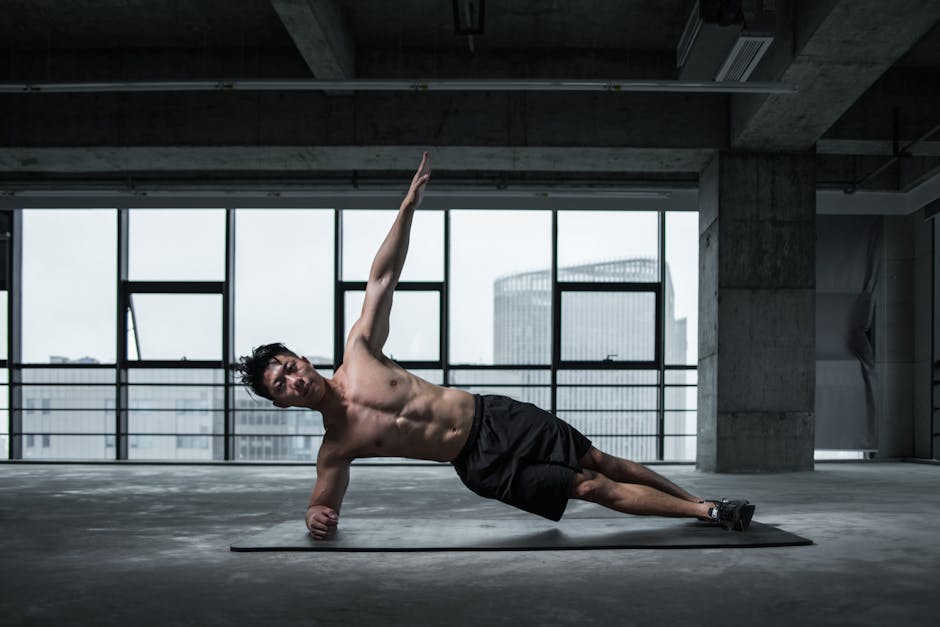
The side plank directly targets anti-lateral flexion, training the obliques and quadratus lumborum to prevent side bending under load. Lie on your side with your elbow directly beneath your shoulder. Stack your feet and lift your hips, creating a straight line from head to feet. Hold for 20-30 seconds per side.
Make it easier by keeping your bottom knee on the ground. Progress it by raising your top leg or adding hip dips that lower and raise your hip whilst maintaining alignment.
Turkish Get-Up
This complex movement takes you from lying down to standing whilst holding a weight overhead. It requires core stability through multiple planes of movement and teaches your body to maintain spinal position through transitions. The Turkish get-up is genuinely one of the best core exercises beyond crunches for stability, though it requires dedicated practice to master the technique.
Start by learning the movement pattern without weight. Search for Turkish get-up tutorials on YouTube from reputable strength coaches. This exercise deserves dedicated learning time, but the payoff in functional core strength is remarkable.
Your 4-Week Core Stability Progression Plan
Building genuine core stability with the best core exercises beyond crunches for stability requires progressive overload and patience. This plan takes you from foundation to functional strength.
- Week 1: Master the basics with dead bugs (3 sets of 8 per side), planks (3 sets of 20-30 seconds), and bird dogs (3 sets of 8 per side). Perform this routine three times during the week with at least one rest day between sessions. Focus entirely on form, not duration or difficulty.
- Week 2: Add the Pallof press (3 sets of 10 per side) and increase your plank holds to 30-40 seconds. Introduce farmer’s carries at the end of your session, walking for 2 sets of 30 seconds. Notice how the movements start feeling more coordinated.
- Week 3: Incorporate side planks (3 sets of 20 seconds per side) and suitcase carries (2 sets of 30 seconds per side). Extend your dead bug sets to 10 repetitions per side. Your core endurance is building, and you might notice improved posture throughout your day.
- Week 4: Add mountain climbers (3 sets of 20 seconds) and increase all your hold times by 10 seconds. Include overhead carries with light weight (2 sets of 20 seconds per arm). Challenge yourself with longer farmer’s carries of 45-60 seconds. Track how much stronger and more stable you feel.
This progression uses the best core exercises beyond crunches for stability in a systematic way. Each week builds on the previous, ensuring your body adapts properly without overwhelming your system. You can repeat this 4-week cycle, gradually increasing weights for carries and hold times for static positions.
Mistakes to Avoid (And How to Fix Them)
Even with the best core exercises beyond crunches for stability, poor execution undermines your results and potentially creates problems.
Mistake 1: Holding Your Breath During Core Work
Why it’s a problem: Breath-holding creates artificially high intra-abdominal pressure and prevents you from learning to maintain core stability whilst breathing normally. Real-life stability demands don’t let you hold your breath. You need to walk, lift, and move whilst breathing continuously.
What to do instead: Practice breathing steadily through your nose during all core exercises. Your abdomen should remain braced even as you breathe. Think about expanding your ribcage laterally rather than letting your belly pooch out with each breath.
Mistake 2: Prioritising Duration Over Quality
Why it’s a problem: A 2-minute plank with sagging hips and a hyperextended neck teaches your body poor movement patterns. You’re reinforcing compensation rather than building stability. Quality repetitions with perfect form create adaptation. Sloppy high-rep work creates nothing useful.
What to do instead: End each set when your form begins breaking down, even if that’s after just 15 seconds. Rest, reset, and perform another quality set. Gradually, your capacity will increase whilst maintaining proper positioning.
Mistake 3: Neglecting Rotation and Lateral Movements
Why it’s a problem: Many people focus exclusively on anti-extension exercises like planks, ignoring anti-rotation and anti-lateral flexion. This creates imbalanced core development. Your daily life involves movement in all planes, and your training should reflect this.
What to do instead: Include exercises from all categories in your routine. Balance your front planks with side planks, your dead bugs with bird dogs, and add Pallof presses for rotation resistance. A comprehensive approach develops complete core stability.
Mistake 4: Training Core in Isolation From Everything Else
Why it’s a problem: Your core doesn’t function alone. It works integrated with your entire body during compound movements. Spending an hour doing isolated core exercises whilst neglecting full-body strength training misses the bigger picture.
What to do instead: Include the best core exercises beyond crunches for stability as part of a complete strength training programme. Compound movements like squats, deadlifts, and overhead presses already demand significant core stability. Dedicated core work supplements these movements rather than replacing them.
Mistake 5: Expecting Immediate Visible Changes
Why it’s a problem: Core stability improvements show up in how you move and feel long before they show up in the mirror. Expecting visible abs within weeks leads to disappointment and often abandoning effective training.
What to do instead: Track functional improvements. Can you hold a plank longer? Does your lower back feel better after a day of sitting? Are you more balanced during single-leg movements? These markers indicate genuine progress. Visual changes follow consistent training and appropriate nutrition over months, not weeks.
Programming the Best Core Exercises Beyond Crunches for Stability Into Your Week
You don’t need dedicated hour-long core sessions. Strategic placement of stability exercises throughout your training week yields better results with less time investment.
Include 10-15 minutes of focused core stability work at the end of your main training sessions two to three times weekly. Your nervous system is primed, your muscles are warm, and you can concentrate on quality movement. Choose 3-4 exercises covering different movement patterns: one anti-extension, one anti-rotation, and one anti-lateral flexion exercise per session.
Alternatively, use core exercises as part of your warm-up. Dead bugs, bird dogs, and planks prepare your core for the stability demands of heavier compound lifts. A 5-minute core activation routine before squatting or deadlifting can improve your performance in those lifts whilst building stability.
For those short on time, loaded carries can be incorporated into your daily life. Carrying your shopping asymmetrically (more weight on one side) for part of your walk home provides core stimulus without requiring gym time. Just be mindful to balance the loading by switching sides.
Beyond the Basics: Advanced Stability Challenges
Once you’ve mastered foundational exercises, these advanced variations provide continued progression with the best core exercises beyond crunches for stability.
Single-Arm Farmer’s Carry With Contralateral Step
Carry a weight in your right hand whilst stepping up onto a box or step with your left foot. This cross-body challenge dramatically increases anti-rotation and anti-lateral flexion demands simultaneously. Perform 8-10 repetitions per side.
Plank With Alternating Arm Reach
From your plank position, lift one hand off the ground and reach forward, holding for 3 seconds before returning. Alternate arms. This challenges your core to prevent rotation whilst reducing your base of support. Complete 8-10 reaches per arm.
Copenhagen Plank
This advanced side plank variation places your top foot on a bench whilst your bottom leg remains elevated. The adductor of your top leg works intensely alongside your obliques. Hold for 15-20 seconds per side. This exercise shows up frequently in football injury prevention programmes due to its effectiveness.
Overhead Pallof Press
Perform the Pallof press whilst simultaneously pressing the band overhead, combining anti-rotation with overhead stability. This variation prepares you for complex athletic movements requiring multi-planar stability. Execute 8-10 repetitions per side with controlled tempo.
Quick Reference Checklist
Keep these principles in mind whenever you’re working on the best core exercises beyond crunches for stability:
- Maintain neutral spine position throughout exercises rather than flexing or extending
- Breathe steadily and continuously, never holding your breath during holds or movements
- End each set when form begins deteriorating, prioritising quality over duration
- Include anti-extension, anti-rotation, and anti-lateral flexion exercises in your programme
- Progress by increasing hold times, adding weight, or reducing stability before adding repetitions
- Train core stability 2-3 times weekly with at least one rest day between sessions
- Watch for functional improvements in daily activities and compound lifts as progress markers
- Combine dedicated core work with compound movements that challenge full-body stability
Frequently Asked Questions
How long does it take to see improvements in core stability?
You’ll notice functional improvements within 2-3 weeks of consistent training with the best core exercises beyond crunches for stability. This includes better posture, reduced lower back discomfort, and increased hold times in planks and carries. Visible changes to your midsection depend primarily on body fat percentage and take considerably longer, typically 8-12 weeks with appropriate nutrition alongside training. Focus on how you feel and move rather than what you see in the mirror during the initial weeks.
Can I do these exercises every day, or do I need rest days?
Your core muscles require recovery just like any other muscle group. Training core stability 2-3 times weekly with at least one rest day between sessions allows for adaptation and growth. On rest days, your nervous system consolidates the motor patterns you’ve been practising. That said, gentle core activation exercises like dead bugs or bird dogs can be performed daily as part of a movement routine without overtaxing your system, provided you’re not working to failure.
What if I have existing lower back pain?
Many people find that the best core exercises beyond crunches for stability actually reduce lower back pain by improving spinal support and reducing excessive movement. However, consult with a physiotherapist before starting if you have chronic or acute back pain. Generally, exercises like dead bugs and bird dogs are well-tolerated even with back sensitivity because they maintain neutral spine throughout. Avoid exercises that cause sharp pain or significantly worsen discomfort. The NHS provides guidance on exercises for back pain that can complement your stability training.
Do I need any equipment to train core stability effectively?
You can build excellent core stability with nothing but your bodyweight using exercises like planks, dead bugs, bird dogs, and mountain climbers. These exercises provide all the stimulus you need initially. As you progress, a resistance band for Pallof presses and some dumbbells or kettlebells for loaded carries add variety and progressive overload. That said, household items work perfectly well: filled water bottles, heavy books, or shopping bags all provide resistance. The exercise selection matters far more than the equipment.
Will these exercises help my performance in sports or running?
Absolutely. Research published in the Journal of Strength and Conditioning Research demonstrates that improved core stability enhances force transfer between upper and lower body, crucial for virtually all athletic movements. Runners with better core stability show more efficient running economy and reduced injury rates according to studies in the British Journal of Sports Medicine. The best core exercises beyond crunches for stability train your midsection to stabilise your spine whilst your limbs generate force, exactly what happens during athletic performance. You’ll likely notice improved balance, more powerful movements, and better endurance in your primary sport within 4-6 weeks of consistent training.
Moving Forward With Purpose and Stability
The best core exercises beyond crunches for stability transform how your body functions. You’re not building a six-pack for show; you’re developing a resilient, capable core that supports everything you do. Whether you’re lifting your child, carrying shopping, sitting at your desk, or pursuing athletic goals, core stability underpins it all.
Start with the foundational movements: dead bugs, planks, bird dogs, and Pallof presses. Master the feeling of maintaining neutral spine whilst resisting unwanted movement. Progress systematically through the 4-week plan, listening to your body and prioritising quality over quantity. Add loaded carries when you’re ready for more challenge.
Remember that building genuine stability takes consistency, not intensity. Three quality sessions weekly trump daily marathon core workouts that leave you exhausted and frustrated. Your core works all day, every day, supporting you through life. Train it with that functional purpose in mind.
You now have everything you need to move beyond ineffective crunches and build the stable, strong core that serves you in real life. Choose one exercise from the anti-extension category, one from anti-rotation, and one from anti-lateral flexion. Perform them with focus and intention three times this week. Notice how different your body feels. That difference is genuine functional improvement, and it’s just the beginning.


