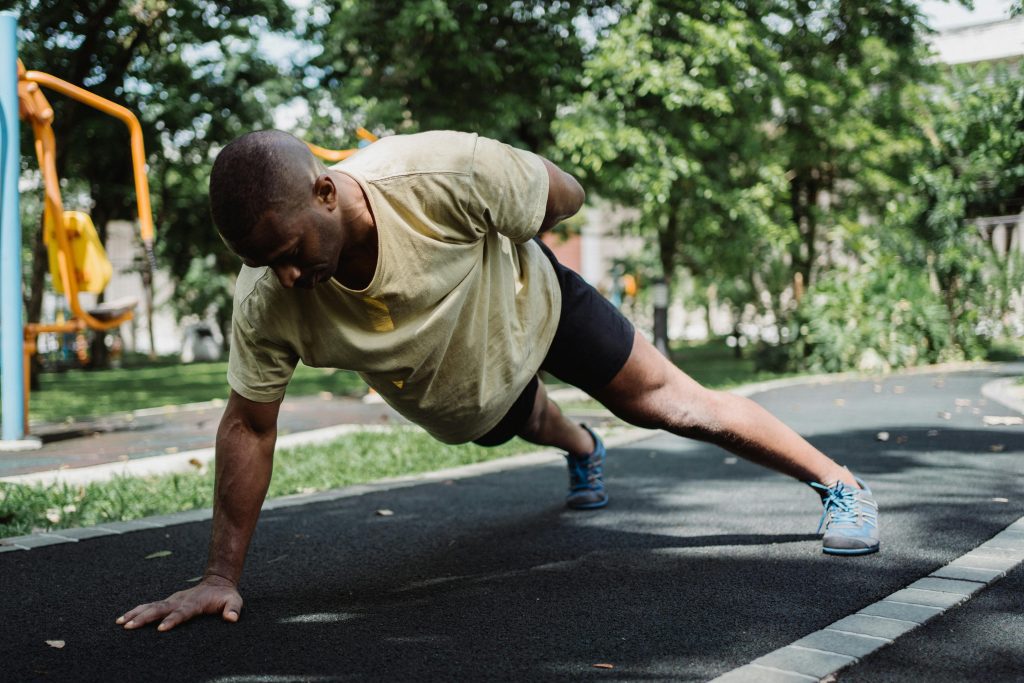
Your local park holds the secret to a transformative park bench workout routine for full body strength that costs nothing and takes less time than driving to the gym. That weathered bench surrounded by dog walkers and joggers? It’s about to become your personal strength training studio.
📖 Reading time: 21 minutes
Picture this: You’re walking past your neighbourhood park on a Tuesday evening, watching people scroll through their phones on benches while you think about the gym membership you haven’t used in two months. The traffic, the crowds, the monthly fees – they’ve become barriers between you and the fitness routine you promised yourself. Meanwhile, that sturdy park bench is sitting empty, waiting to deliver a workout that challenges every major muscle group without a single dumbbell in sight.
Common Myths About Park Bench Workouts
For more on this topic, you might enjoy: Full Body Resistance Band Workout: Your Complete Training Solution for Travel and Small Spaces.
Before we dive into the specifics of an effective park bench workout routine for full body strength, let’s address the misconceptions that might be holding you back from taking your training outdoors.
Myth: Park benches are only for beginners and easy cardio
Reality: A properly designed park bench workout routine for full body strength can challenge even advanced athletes. Olympic gymnasts build incredible strength using parallel bars and elevated surfaces – a park bench offers similar mechanical advantages for progressive overload. By adjusting leverage, tempo, and positioning, you can create muscle-building tension that rivals weighted exercises. Research from the Journal of Strength and Conditioning Research demonstrates that bodyweight training using elevated surfaces activates muscle fibres just as effectively as traditional gym equipment when programmed correctly.
Myth: You need weights to build real strength
Reality: Your body provides all the resistance necessary for significant strength gains. The key lies in positioning yourself to work against gravity at challenging angles. Decline push-ups, elevated single-leg squats, and inverted rows all use your bodyweight as progressive resistance. A study published by the National Health Service found that structured bodyweight training improved functional strength markers by 47% over twelve weeks – results comparable to conventional resistance training.
Myth: Outdoor workouts are weather-dependent and inconsistent
Reality: British weather builds character, and your park bench workout routine for full body strength can adapt to nearly any condition short of lightning storms. A light drizzle actually makes the workout more challenging as you engage stabilising muscles to maintain control on slightly slick surfaces. Pack a small towel to wipe down the bench, dress in layers, and you’ll find that training outdoors year-round builds mental resilience alongside physical strength.
Why a Park Bench Workout Routine for Full Body Strength Works
Related: Clean and Press Technique: Build Full-Body Strength in One Movement.
The humble park bench transforms your training by providing the one thing bodyweight exercises often lack: elevation. This simple feature unlocks dozens of movement variations that target muscles from fresh angles, creating the stimulus your body needs for adaptation and growth.
Traditional press-ups work your chest, shoulders, and triceps effectively, but elevating your feet shifts the resistance pattern dramatically. Suddenly, you’re moving 70-75% of your bodyweight instead of roughly 64%, whilst simultaneously targeting your upper chest and anterior deltoids more intensely. The bench becomes an adjustable training tool that modifies resistance without requiring plates or pins.
What’s more, outdoor training delivers psychological benefits that sterile gym environments can’t match. A 2019 study from the University of Essex found that exercising in natural environments reduced cortisol levels by 15% compared to indoor training, whilst simultaneously improving mood markers and adherence rates. When your gym is a park, you’re more likely to show up consistently – and consistency trumps intensity for long-term results.
The park bench workout routine for full body strength also eliminates common barriers: no membership fees, no peak-time crowds, no waiting for equipment, and no judgment from others. You’re just another person enjoying public space whilst building genuine functional strength that translates to real-world movement patterns.
Essential Exercises for Your Park Bench Workout Routine for Full Body Strength
You may also find this helpful: Daily Mobility Routine: The 15-Minute Practice That Keeps Your Body Moving Pain-Free.
These eight exercises form the foundation of an effective training session that addresses every major muscle group. Master these movements, and you’ll build strength, stability, and muscular endurance that carries over to daily life.
Decline Push-Ups (Chest, Shoulders, Triceps)
Place your feet on the bench seat with hands on the ground shoulder-width apart. Lower your chest toward the ground whilst maintaining a rigid plank position from shoulders to ankles. The elevated position increases resistance on your upper chest and front deltoids significantly. Aim for 3 sets of 8-12 repetitions, controlling the descent over 2-3 seconds.
If standard decline push-ups feel manageable, try the archer variation: shift your weight toward one arm whilst the other extends slightly wider, creating an asymmetrical loading pattern that builds unilateral strength. This progression works toward the impressive one-arm push-up whilst developing shoulder stability.
Bulgarian Split Squats (Quadriceps, Glutes, Core)
Stand facing away from the bench with one foot resting on the seat behind you. Lower into a single-leg squat position until your front thigh reaches parallel to the ground. This exercise builds leg strength whilst revealing and correcting imbalances between sides. Research from Leeds Beckett University indicates that Bulgarian split squats activate the glutes 25% more than traditional back squats.
The balance requirement engages your core intensely throughout the movement. Keep your torso relatively upright and drive through your front heel to return to standing. Complete 3 sets of 10-15 repetitions per leg, and don’t be surprised if one side feels significantly weaker – that’s valuable information for your training.
Incline Rows (Back, Biceps, Rear Shoulders)
This exercise requires a sturdy bench that won’t tip. Lie underneath with your chest beneath the seat edge, gripping the sides or back support. Pull your chest toward the bench, squeezing your shoulder blades together at the top. This movement counterbalances all the pushing exercises in your park bench workout routine for full body strength, protecting shoulder health whilst building upper back thickness.
For parks with benches that aren’t suitable for rowing, find a low horizontal railing or sturdy fence as an alternative. The pulling pattern remains essential for balanced development and postural strength.
Decline Pike Push-Ups (Shoulders, Upper Chest, Triceps)
Position yourself in a downward dog pose with feet elevated on the bench and hands on the ground. Keep your hips high whilst lowering the crown of your head toward the ground between your hands. This variation hammers your shoulders with vertical pressing force, building strength for overhead movements without requiring weights.
Progress this exercise by walking your hands closer to the bench, increasing the angle and resistance. Eventually, you’ll develop the strength for handstand variations against a tree or wall. Aim for 3 sets of 6-10 repetitions with perfect form.
Step-Ups (Legs, Glutes, Cardiovascular System)
This deceptively simple movement builds single-leg strength whilst challenging your cardiovascular system during higher-repetition sets. Step up with one leg, driving through your heel whilst bringing the opposite knee high. Step down with control rather than dropping, which protects your knees whilst maintaining tension on the working muscles.
For added challenge, pause at the top of each repetition with your non-working leg suspended, forcing your planted leg to stabilise independently. Complete 3 sets of 15-20 repetitions per leg, treating this as both a strength and conditioning exercise within your park bench workout routine for full body strength.
Tricep Dips (Triceps, Chest, Shoulders)
Sit on the bench edge with hands gripping beside your hips, fingers facing forward. Slide your bottom off the seat and lower your body by bending your elbows to roughly 90 degrees. Push back up to straight arms, focusing the effort through your triceps rather than pushing with your legs.
Keep your bottom close to the bench throughout the movement – drifting forward shifts unnecessary stress onto your shoulder joints. If bodyweight dips become too easy, elevate your feet on a second bench or slow your tempo to 4 seconds down, 1 second up. Target 3 sets of 12-20 repetitions.
Elevated Plank Hold (Core, Shoulders, Hip Flexors)
Place your forearms on the bench seat with your body extended behind you in a straight line from head to heels. This elevated position might seem easier than floor planks, but it actually increases the challenge by lengthening the lever arm. Maintain a neutral spine without allowing your hips to sag or pike upward.
Quality matters more than duration. Hold for 30-60 seconds with perfect form rather than 2 minutes with a sagging back. Integrate breathing by inhaling through your nose for 4 counts, exhaling for 6 counts, which enhances core activation whilst building mental focus. Complete 3 sets as part of your routine.
Single-Leg Hip Thrusts (Glutes, Hamstrings, Lower Back)
Sit on the ground with your upper back resting against the bench. Plant one foot flat whilst extending the other leg straight. Drive through your planted heel to lift your hips until your body forms a straight line from knee to shoulder. Squeeze your glutes hard at the top before lowering with control.
This exercise specifically targets the glutes with minimal equipment whilst building unilateral strength and stability. According to research from the University of Stirling, hip thrusts activate the gluteus maximus more effectively than squats or deadlifts. Perform 3 sets of 12-15 repetitions per leg, and prepare for serious muscle engagement.
Your 30-Minute Park Bench Workout Routine for Full Body Strength
Now that you understand the individual exercises, let’s structure them into a comprehensive session that maximizes efficiency whilst allowing adequate recovery between muscle groups. This circuit format keeps your heart rate elevated whilst building strength across your entire body.
Begin with a 5-minute warm-up: walk briskly around the park, perform arm circles, leg swings, and gentle torso rotations. Dynamic movement prepares your nervous system and increases tissue temperature, reducing injury risk whilst improving performance.
Circuit Structure: Perform each exercise for the prescribed repetitions, moving to the next with minimal rest (30 seconds maximum). After completing all exercises once, rest for 2-3 minutes before repeating. Complete 3 total rounds for a thorough 30-minute park bench workout routine for full body strength.
- Decline Push-Ups: 10-15 repetitions (chest, shoulders, triceps)
- Bulgarian Split Squats: 12 repetitions per leg (quadriceps, glutes)
- Incline Rows: 12-15 repetitions (back, biceps)
- Step-Ups: 15 repetitions per leg (legs, cardiovascular system)
- Decline Pike Push-Ups: 8-12 repetitions (shoulders)
- Single-Leg Hip Thrusts: 12 repetitions per leg (glutes, hamstrings)
- Tricep Dips: 15-20 repetitions (triceps, chest)
- Elevated Plank Hold: 45-60 seconds (core, stability)
Finish with a 5-minute cool-down focusing on static stretching for muscles worked: chest, shoulders, quadriceps, hamstrings, and hip flexors. Hold each stretch for 30-45 seconds whilst breathing deeply, allowing your heart rate to return to baseline gradually.
This structure ensures balanced development across pushing muscles, pulling muscles, leg muscles, and core stabilisers. The circuit format also provides cardiovascular benefits alongside strength gains, making your park bench workout routine for full body strength remarkably time-efficient.
Progression Strategies to Build Continuous Strength
Your body adapts quickly to consistent training stimuli, which means you’ll need progression strategies to continue building strength beyond the initial weeks. These methods increase difficulty without requiring additional equipment.
Tempo Manipulation: Slow down the eccentric (lowering) phase of each exercise to 4-5 seconds. This increases time under tension dramatically, creating new muscle damage that stimulates adaptation. A decline push-up with a 5-second descent becomes brutally challenging compared to the standard 1-2 second tempo.
Pause Repetitions: Add a 2-3 second pause at the most challenging point of each exercise – the bottom of a Bulgarian split squat or with your chest inches from the ground during decline push-ups. This eliminates momentum and elastic energy, forcing your muscles to work harder throughout the range of motion.
Asymmetrical Loading: Progress to single-arm and single-leg variations where possible. Archer push-ups, pistol squats onto the bench, and single-arm rows all dramatically increase resistance on the working side whilst simultaneously challenging your core stability. These variations bridge the gap between standard bodyweight exercises and advanced calisthenics.
Increased Volume: Once you can complete 3 rounds of the circuit comfortably, add a fourth round. Alternatively, increase the repetitions for each exercise by 20-30%. Volume drives hypertrophy and strength gains, particularly for intermediate trainees whose nervous systems have adapted to the movement patterns.
Track your workouts in a simple notebook or phone app, recording exercises, repetitions, and any progression notes. When you can complete the prescribed repetitions with 2-3 repetitions remaining before failure, it’s time to increase difficulty. This systematic approach to your park bench workout routine for full body strength ensures continued progress rather than aimless repetition.
Optimising Your Training Environment
Not all park benches suit strength training equally. Select your workout location strategically to maximize both safety and effectiveness whilst avoiding unnecessary hassle.
Bench Stability: Test the bench before beginning your workout by applying pressure from different angles. Wobbly or loose benches create injury risk, particularly during exercises like tricep dips or rows. Seek benches with solid construction – typically, older metal benches with concrete bases offer more stability than newer wooden designs.
Surface Considerations: The ground beneath and around your bench matters significantly. Grass provides cushioning for exercises requiring ground contact but becomes slippery when wet. Tarmac and concrete offer consistent traction but less forgiveness if you slip. Choose based on weather conditions and your specific exercise selection within your park bench workout routine for full body strength.
Timing Your Session: Early mornings and weekday afternoons typically see less foot traffic, giving you space and privacy for your workout. Weekend afternoons bring crowds of families and dogs, which can interrupt your flow and create safety concerns during exercises requiring concentration. According to data from UK park services, visitor numbers peak between 11am-3pm on weekends but remain minimal before 9am daily.
Weather Preparation: British weather demands flexibility. Light rain shouldn’t stop your session – wipe down the bench with a small towel and adjust your grip width slightly for secure hand positioning. Strong winds can make elevated plank holds significantly more challenging as you fight to maintain stability. Extreme cold affects muscle pliability, so extend your warm-up to 7-10 minutes during winter months.
Consider bringing a small gym towel for wiping down benches, a water bottle for hydration, and perhaps a smartphone for timing rest periods and tracking your workout. Some people find that having a basic set of resistance bands adds variety for pulling exercises if the bench design doesn’t accommodate rows, though they’re entirely optional for an effective park bench workout routine for full body strength.
Mistakes to Avoid (And How to Fix Them)
Learning from common errors saves time, prevents frustration, and reduces injury risk. These pitfalls trip up most people when starting outdoor strength training.
Mistake 1: Inconsistent hand and foot positioning between sets
Why it’s a problem: Varying your stance width or hand placement from set to set changes the exercise stimulus, making progressive overload impossible to track. One week you’re performing wide-grip decline push-ups, the next week narrow-grip, and you can’t determine whether you’re actually getting stronger.
What to do instead: Establish specific positioning cues and replicate them precisely each session. For decline push-ups, perhaps your hands align with the outer edges of your shoulders. For Bulgarian split squats, maybe you stand exactly two foot-lengths from the bench. These consistent reference points ensure you’re comparing apples to apples across workouts.
Mistake 2: Rushing through repetitions to finish quickly
Why it’s a problem: Speed reduces time under tension and shifts emphasis from muscles to momentum. You’ll complete more repetitions without building proportional strength, whilst also increasing joint stress through uncontrolled movements. Fast, bouncy reps during step-ups or split squats can strain knee ligaments unnecessarily.
What to do instead: Establish a consistent tempo for each exercise and stick to it religiously. A 2-second lowering phase, 1-second pause, 2-second lifting phase works brilliantly for most movements. Count silently during each repetition to maintain discipline. Quality always trumps quantity in your park bench workout routine for full body strength.
Mistake 3: Training the same routine without variation for months
Why it’s a problem: Your body adapts specifically to imposed demands – once adapted, further progress stalls. Performing identical workouts week after week leads to plateaus, boredom, and eventual regression. Without progressive challenge, you maintain rather than build strength.
What to do instead: Implement the progression strategies discussed earlier every 3-4 weeks. Alternatively, modify your exercise selection slightly – swap decline push-ups for decline diamond push-ups, or replace step-ups with explosive jump-ups. Small variations provide fresh stimulus whilst maintaining the core structure of your training.
Mistake 4: Skipping warm-up and cool-down periods
Why it’s a problem: Cold muscles and connective tissues respond poorly to intense loading, increasing injury risk whilst reducing performance capacity. Similarly, abrupt cessation of exercise leaves metabolic waste products accumulated in tissues, contributing to excessive soreness and delayed recovery.
What to do instead: Invest the full 5 minutes before and after your main workout in preparation and recovery. Your warm-up primes movement patterns and increases tissue temperature. Your cool-down facilitates recovery and maintains flexibility. These bookends make your park bench workout routine for full body strength more effective and sustainable long-term.
Mistake 5: Training through pain rather than discomfort
Why it’s a problem: The burning sensation of muscular fatigue differs fundamentally from joint pain or sharp, localized discomfort. Training through genuine pain signals leads to injuries that sideline you for weeks or months, completely derailing your progress.
What to do instead: Learn to distinguish between muscular discomfort (which indicates productive training) and pain (which indicates tissue damage). Muscle burn, trembling, and general fatigue are normal. Sharp pains, clicking joints, or discomfort that worsens during a set require immediate attention. Stop the exercise, assess the issue, and modify or skip that movement if necessary. According to NHS guidelines on exercise safety, persistent pain lasting beyond 48 hours warrants professional evaluation.
Nutrition and Recovery for Optimal Results
Your park bench workout routine for full body strength provides the stimulus for adaptation, but growth occurs during recovery periods between sessions. Nutrition and rest determine whether that stimulus translates into tangible strength gains or merely accumulated fatigue.
Protein Intake: Aim for 1.6-2.2 grams of protein per kilogram of bodyweight daily when training for strength. For a 75kg person, that’s 120-165 grams spread across meals throughout the day. Protein provides amino acids necessary for muscle protein synthesis – the process by which your body repairs and strengthens muscle fibres damaged during training.
Excellent protein sources include chicken, fish, eggs, Greek yoghurt, cottage cheese, legumes, and tofu. If whole food sources fall short, a simple protein powder can help bridge the gap, though it’s never mandatory. Look for options with minimal additives and approximately 20-25 grams of protein per serving.
Overall Energy Balance: Building strength whilst maintaining or reducing bodyweight requires careful energy management. Track your food intake loosely for one week to establish baseline calorie consumption, then adjust based on your goals. To build muscle optimally, maintain a slight caloric surplus of 200-300 calories daily. To lose fat whilst preserving strength, create a moderate deficit of 300-500 calories whilst keeping protein high.
Strategic Carbohydrates: Despite current low-carb trends, carbohydrates fuel high-intensity training effectively. Position your carbohydrate-rich meals around your workout window – perhaps porridge with fruit before your morning session, or rice with vegetables and protein afterwards. This timing strategy ensures available energy during training whilst supporting recovery afterwards.
Sleep Priority: Sleep deprivation undermines strength gains dramatically. Research from Loughborough University indicates that sleeping less than 7 hours nightly reduces muscle protein synthesis by up to 18% whilst simultaneously increasing cortisol levels. Aim for 7-9 hours nightly, maintaining consistent sleep and wake times even on weekends. Your park bench workout routine for full body strength becomes significantly more effective when supported by adequate sleep.
Training Frequency: Perform this full-body routine 2-3 times weekly with at least one rest day between sessions. Your muscles need 48-72 hours to recover fully from intense training. More frequent training without adequate recovery leads to accumulated fatigue, performance decline, and eventual injury. Trust the process – growth happens during rest, not during the workout itself.
Quick Reference Checklist
Save this list for easy reference before each session:
- Test bench stability before beginning any exercises requiring weight-bearing on the structure
- Complete a 5-minute dynamic warm-up focusing on movement patterns used during the workout
- Maintain consistent hand and foot positioning across all sets and sessions for accurate progress tracking
- Control tempo deliberately – 2 seconds down, 1 second pause, 2 seconds up for most exercises
- Rest 2-3 minutes between complete circuit rounds to allow sufficient recovery for subsequent efforts
- Track your workout details in a notebook or phone app to monitor progress systematically
- Finish with 5 minutes of static stretching for major muscle groups worked during the session
- Consume protein-rich food within 2-3 hours after training to support muscle recovery and adaptation
Frequently Asked Questions
How long before I see strength improvements from a park bench workout routine for full body strength?
Most people notice initial strength gains within 2-3 weeks, though these early improvements stem primarily from neural adaptations rather than muscle growth. Your nervous system learns to recruit muscle fibres more efficiently, improving coordination and force production. Visible muscle development typically becomes apparent after 6-8 weeks of consistent training with proper nutrition and recovery. Functional strength – your ability to perform daily tasks more easily – often improves even faster, sometimes within the first week.
Can I build muscle mass with just bodyweight exercises, or do I eventually need weights?
Bodyweight training builds genuine muscle mass when programmed with progressive overload principles. The key lies in continuously increasing difficulty through the methods discussed: slower tempos, pause repetitions, increased volume, and asymmetrical variations. Research published in the Journal of Physiology found that muscle protein synthesis rates were identical whether participants trained with heavy weights or lighter loads to muscular failure. That said, weighted exercises offer easier progression once bodyweight variations become too easy, but you can develop impressive strength and physique using park bench exercises exclusively.
What should I do if my local park benches feel too unstable for exercises like dips and rows?
Prioritize safety always – never use equipment that wobbles or shifts during loading. For unstable benches, focus on exercises where you’re grounded: decline push-ups, Bulgarian split squats, step-ups, elevated planks, and hip thrusts all work effectively without requiring the bench to bear your full weight directly. For pulling exercises, seek alternative surfaces like sturdy railings, playground equipment, or low tree branches that can safely support your bodyweight. Some parks feature outdoor fitness equipment specifically designed for this purpose. Adapt your park bench workout routine for full body strength based on available resources rather than forcing unsafe equipment usage.
Is training outdoors year-round actually practical in British weather, or should I have an indoor backup plan?
Training outdoors throughout the year is absolutely practical with proper preparation. Light rain and cold temperatures simply require appropriate clothing – moisture-wicking base layers, a water-resistant outer shell, and gloves for winter sessions keep you comfortable. Extreme weather conditions like lightning storms, heavy ice, or strong winds above 30mph warrant postponement for safety reasons. Having an indoor bodyweight routine as backup ensures you never miss sessions during genuinely dangerous conditions. Most dedicated outdoor trainees find they adapt to weather conditions quickly and actually prefer fresh air to stuffy gym environments, even during winter months.
Should I feel sore after every workout, and what if I’m not seeing progress despite consistent training?
Muscle soreness (DOMS – delayed onset muscle soreness) indicates tissue damage but doesn’t correlate directly with productive training or growth. You might experience significant soreness during the first 2-3 weeks as your body adapts to new movement patterns, then less soreness as adaptation occurs – this is normal and healthy. If you’re training consistently for 6-8 weeks without progress, assess three factors: progressive overload (are you genuinely increasing difficulty?), nutrition (are you consuming adequate protein and calories?), and recovery (are you sleeping 7-9 hours nightly?). Plateaus usually stem from one of these factors rather than training programming. Increase difficulty, optimize nutrition, prioritize sleep, and progress will resume within 2-3 weeks.
Your Strength Journey Starts Today
The park bench workout routine for full body strength eliminates the excuses that typically derail fitness goals: cost, time, equipment, and accessibility. Your local park offers everything necessary to build genuine strength that enhances daily life whilst improving your health markers and physical confidence.
Remember that consistency matters more than perfection. Three focused 30-minute sessions weekly, performed with deliberate effort and progressive challenge, deliver remarkable results over months and years. Track your workouts, celebrate small victories like adding two repetitions or slowing your tempo, and trust the cumulative effect of repeated effort.
The bench is waiting. Your future stronger self is counting on the decision you make today. Grab a water bottle, head to your nearest park, and complete that first session. The hardest repetition is always the one that gets you started.


