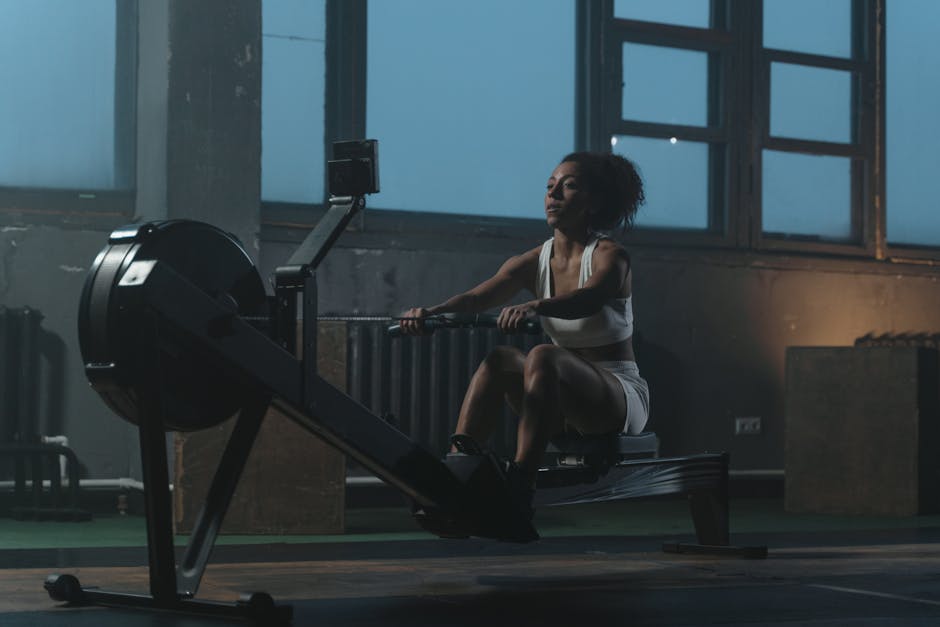
Rowing machine workouts for fat loss might sound like something only serious athletes need to worry about, but here’s the truth: this single piece of equipment could be the game-changer you’ve been missing. Picture yourself burning more calories than running, building full-body strength, and protecting your joints all at once. That’s exactly what rowing delivers.
Related reading: How to Make Friends as an Adult After Moving Cities.
Most people walk past the rowing machine at the gym without a second glance. They head straight for the treadmill or bike, completely unaware that they’re bypassing one of the most effective fat-burning tools available. Meanwhile, those who do try rowing often give up after a frustrating first attempt, convinced it’s too complicated or not worth the effort. What they don’t realize is that proper rowing technique and the right workout structure can torch up to 600 calories per hour while sculpting your entire body.
Common Myths About Rowing Machine Workouts
Related reading: Proper Rowing Machine Form: Master the Technique for Maximum Results.
Let’s clear up some misconceptions before we dive into the good stuff.
Myth: Rowing is mainly an upper body workout
Reality: Your legs actually provide about 60% of the power in each stroke. Your core contributes roughly 20%, with your arms and back making up the final 20%. When you’re rowing correctly, you’re engaging over 85% of your body’s muscles in every single stroke. That’s significantly more muscle activation than running or cycling, which explains why rowing machine workouts for fat loss are so brutally effective.
Myth: You need to row for hours to see results
Reality: Quality beats quantity every time. A focused 20-minute rowing session with proper intensity can deliver better results than an hour of casual pedalling on a bike. Research from NHS exercise guidelines confirms that high-intensity intervals lasting just 15-30 minutes can significantly improve cardiovascular health and support weight management.
Myth: Rowing machines are boring and monotonous
Reality: The variety you can create with rowing workouts is genuinely impressive. Sprints, endurance rows, pyramid intervals, distance challenges, power pieces—you’ve got dozens of workout structures to choose from. Many people find rowing more engaging than running because each stroke requires active coordination and technique refinement.
Why Rowing Machine Workouts Excel at Fat Loss
You might also enjoy: Low Impact HIIT Workouts: Get Your Heart Pumping Without Wrecking Your Joints.
The magic happens through a combination of factors that most other cardio exercises simply can’t match.
Rowing demands constant muscle engagement throughout your entire body. Your quads, hamstrings, glutes, core, back, shoulders, and arms all work together in a coordinated sequence. This massive muscle recruitment means your body burns calories at an accelerated rate both during and after your workout. Exercise physiologists call this afterburn effect EPOC (excess post-exercise oxygen consumption), and rowing machine workouts for fat loss trigger this response beautifully.
Here’s what’s interesting: compound movements that engage multiple muscle groups simultaneously create a higher metabolic demand than isolated exercises. When you’re rowing, you’re essentially performing a moving plank combined with a deadlift and a seated row all at once. Your cardiovascular system works overtime to deliver oxygen to all these active muscles, which translates to serious calorie burn.
Studies conducted at universities across the UK have shown that rowing can burn between 400-600 calories per hour for most people, with trained athletes pushing that number even higher during intense intervals. Compare that to steady-state cycling at around 300-400 calories per hour, and you start to see why rowing deserves more attention.
Better yet, the low-impact nature means you can train more frequently without beating up your joints. Running puts stress on your knees, hips, and ankles with every footfall. Rowing eliminates that pounding while still delivering cardiovascular benefits that match or exceed running. You can realistically incorporate rowing machine workouts for fat loss four to five times per week without risking overuse injuries.
The Conditioning Component Nobody Mentions
Fat loss gets the headlines, but the conditioning benefits of rowing deserve equal attention. Cardiovascular conditioning refers to your heart’s ability to pump blood efficiently and your muscles’ capacity to use oxygen effectively. Rowing develops both aspects simultaneously.
When you maintain consistent rowing intervals, your heart rate typically sits in the optimal zone for improving aerobic capacity—that sweet spot between 70-85% of your maximum heart rate. Over time, your resting heart rate decreases, your stroke volume increases, and everyday activities feel easier. You’ll notice the difference when climbing stairs or rushing for the bus.
Mastering Rowing Technique for Maximum Results
Technique matters more with rowing than almost any other cardio exercise. Get it wrong, and you’ll waste energy while risking lower back strain. Get it right, and you’ll feel powerful, efficient, and unstoppable.
The rowing stroke breaks down into four distinct phases: the catch, the drive, the finish, and the recovery.
The Catch Position
Start with your knees bent, shins vertical, and your body leaning slightly forward from the hips. Your arms should be straight, reaching for the handle with your shoulders relaxed. Many beginners hunch their shoulders up near their ears here—don’t do that. Keep your core engaged and your back straight but not rigid.
The Drive Phase
This is where the power happens. Push through your heels first, driving your legs down to straighten them. Your arms stay straight during this initial push. Once your legs are almost fully extended, lean your torso back slightly past vertical, then pull the handle into your lower ribs. The sequence is crucial: legs, body, arms. Think of it as one fluid motion that starts from your feet and travels upward.
The Finish Position
At the end of the drive, your legs are extended, your torso leans back about 10-15 degrees past vertical, and the handle touches your lower ribs. Your elbows should point behind you, not out to the sides. Hold this position for just a fraction of a second before beginning the recovery.
The Recovery Phase
Reverse the sequence: arms, body, legs. Extend your arms first, then lean your torso forward from the hips, and finally bend your knees to slide back to the catch position. The recovery should take roughly twice as long as the drive. Rushing this phase is the most common mistake among beginners attempting rowing machine workouts for fat loss.
Watching professional rowing technique demonstrations helps tremendously. You’ll notice how smooth and controlled elite rowers look, even when moving at impressive speeds.
Effective Rowing Machine Workouts for Fat Loss and Conditioning
Let’s get specific with workout structures that deliver results. Each of these sessions serves a different purpose in your overall training plan.
The 20-Minute Fat Burner
This interval session maximizes calorie burn in minimal time:
- 5-minute easy warm-up at conversational pace (18-20 strokes per minute)
- 30 seconds hard rowing (28-32 strokes per minute, about 90% effort)
- 90 seconds easy recovery rowing
- Repeat the hard/easy cycle 8 times
- 3-minute cool-down at easy pace
The beauty of this workout lies in its simplicity. You’re alternating between intense bursts that spike your heart rate and recovery periods that allow partial recovery. According to research on high-intensity interval training benefits, this approach can improve metabolic function and support fat loss more effectively than steady-state cardio alone.
The Endurance Builder
Once or twice weekly, include a longer steady-state row:
- 40-50 minutes at moderate intensity (22-24 strokes per minute)
- Keep your heart rate around 65-75% of maximum
- Focus on consistent splits (the time it takes to row 500 meters)
- Maintain excellent technique throughout
These longer sessions build your aerobic base and teach your body to burn fat efficiently. You’ll also develop the mental toughness required for sustained effort. Many people find that having something like a fitness tracker helps them stay in the correct heart rate zone, though it’s certainly not essential when you’re starting out.
The Pyramid Power Session
This structure keeps your mind engaged while challenging your body:
- 5-minute warm-up
- 1 minute hard, 1 minute easy
- 2 minutes hard, 2 minutes easy
- 3 minutes hard, 3 minutes easy
- 4 minutes hard, 4 minutes easy
- 3 minutes hard, 3 minutes easy
- 2 minutes hard, 2 minutes easy
- 1 minute hard, 1 minute easy
- 5-minute cool-down
Rowing machine workouts for fat loss work best when you mix up the stimulus. Your body adapts quickly to repeated stress, so varying interval lengths prevents plateaus.
The Sprint Finisher
Add this to the end of strength training sessions:
- 2-minute easy warm-up
- 8 rounds of: 20 seconds maximum effort, 40 seconds rest
- 2-minute cool-down
These short, brutal efforts torch calories and create that coveted afterburn effect. Research suggests that maximum-effort intervals can elevate your metabolic rate for up to 24 hours after training.
Your 4-Week Rowing Transformation Plan
Consistency transforms everything. Here’s a progressive plan that builds your capacity while avoiding burnout or injury.
Week 1: Foundation Phase
Focus entirely on technique and building the habit.
- Monday: Begin with 15 minutes of easy rowing at 18-20 strokes per minute. Concentrate on the sequence: legs, body, arms on the drive; arms, body, legs on the recovery.
- Wednesday: Increase to 20 minutes at the same easy pace. Every five minutes, do 10 strokes at a slightly harder intensity to practice power application.
- Friday: Row for 20 minutes, including three 2-minute intervals at moderate intensity with 2-minute recovery between each.
- Saturday: Optional 15-minute easy recovery row if you’re feeling good.
Week 2: Building Intensity
Introduce proper intervals while maintaining volume.
- Monday: Complete the 20-Minute Fat Burner workout described earlier.
- Wednesday: Row steadily for 25 minutes at moderate intensity (22-24 strokes per minute).
- Friday: Perform 5 rounds of: 3 minutes hard, 2 minutes easy.
- Sunday: Easy 20-minute recovery row at conversational pace.
Week 3: Peak Intensity
Push your limits with challenging workouts.
- Monday: Tackle the Pyramid Power Session.
- Wednesday: Row 30 minutes steady at 23-25 strokes per minute, aiming for consistent 500-meter splits.
- Friday: Execute the 20-Minute Fat Burner again, but aim for slightly faster speeds during the hard intervals.
- Sunday: Endurance Builder: 40 minutes at moderate, steady pace.
Week 4: Active Recovery and Progression
Scale back slightly to allow adaptation and prepare for progression.
- Monday: Easy 25 minutes with technique focus.
- Wednesday: Modified intervals: 6 rounds of 2 minutes moderate, 1 minute easy.
- Friday: Test your progress: row 2000 meters at maximum sustainable pace and note your time.
- Sunday: Optional 20-minute easy row or rest completely.
After completing this four-week progression, you can repeat the cycle with increased intensity, longer intervals, or faster target paces. The key to successful rowing machine workouts for fat loss is progressive overload—gradually increasing the challenge over time.
Mistakes to Avoid (And How to Fix Them)
Even experienced gym-goers make these errors when they first approach the rowing machine.
Mistake 1: Pulling with your arms first
Why it’s a problem: Your arms are relatively weak compared to your legs. When you lead with an arm pull, you miss out on the powerful leg drive that should generate most of your force. You’ll fatigue quickly and develop poor habits that are hard to break later.
What to do instead: Consciously think “legs, body, arms” on every single stroke. Push through your heels first, feel your legs straighten, then lean back slightly, and finally pull the handle. Film yourself occasionally to check your sequencing.
Mistake 2: Rowing at maximum speed constantly
Why it’s a problem: Sustainable fat loss comes from workouts you can repeat consistently, not from exhausting yourself so completely that you dread the next session. Constantly maxing out also degrades your technique, reducing efficiency and increasing injury risk.
What to do instead: Most of your rowing should feel challenging but manageable. Save the truly hard efforts for designated interval periods. Aim for a stroke rate between 20-26 strokes per minute for steady work, pushing to 28-32 only during intense intervals.
Mistake 3: Hunching your back
Why it’s a problem: Rounding your spine transfers load to your lower back muscles and vertebrae rather than distributing it across your entire posterior chain. Over time, this creates discomfort and potentially serious injury.
What to do instead: Engage your core from the catch position. Think about sitting tall with your chest lifted and shoulders back. Imagine a string pulling the crown of your head toward the ceiling. Lean forward from your hips, not by curling your spine.
Mistake 4: Gripping too tightly
Why it’s a problem: A death grip on the handle wastes energy and creates tension throughout your upper body. Your forearms will fatigue prematurely, and you might develop discomfort in your wrists or elbows.
What to do instead: Hold the handle with a firm but relaxed grip, as if you’re holding a bird—secure enough that it won’t escape, gentle enough that you won’t harm it. Your hands are simply hooks connecting your powerful legs and back to the chain.
Mistake 5: Neglecting the damper setting
Why it’s a problem: Most beginners crank the damper to maximum (usually 10), assuming higher resistance equals a better workout. Actually, a lower damper setting (around 3-5) more closely mimics the feel of rowing on water and allows for better technique development. Setting it too high makes each stroke feel sluggish and can encourage that arms-first pulling we’re trying to avoid.
What to do instead: Start with the damper between 3-5. Experiment to find what feels smooth and powerful. Most people find their sweet spot in the 4-5 range for rowing machine workouts for fat loss and general conditioning.
Combining Rowing with Strength Training
Rowing provides excellent cardiovascular training, but pairing it with strength work accelerates fat loss and builds a more capable, resilient body.
Structure your week to include 3-4 rowing sessions and 2-3 strength training days. You can combine them on the same day or alternate. Many people find success with this pattern:
- Monday: Strength training (legs and core) + 10-minute easy rowing cool-down
- Tuesday: 30-minute moderate-intensity rowing session
- Wednesday: Rest or light activity (walking, yoga)
- Thursday: Strength training (upper body and core) + Sprint Finisher rowing
- Friday: 20-Minute Fat Burner rowing workout
- Saturday: 40-minute endurance rowing session
- Sunday: Complete rest
Strength training preserves and builds lean muscle mass while you’re in a calorie deficit. More muscle means higher resting metabolic rate, which supports long-term fat loss. Exercises like squats, deadlifts, press-ups, and rows complement your rowing machine workouts for fat loss perfectly.
If you’re training at home, bodyweight movements work brilliantly. Once you’re ready to progress, basic equipment like adjustable dumbbells or a simple set of resistance bands gives you nearly unlimited exercise options without requiring much space or investment.
Nutrition Fundamentals for Fat Loss
Training creates the stimulus for change, but nutrition determines whether that change happens. You can’t out-row a poor diet, no matter how hard you try.
Creating a moderate calorie deficit—eating slightly less than your body burns—is the fundamental requirement for fat loss. Aim for a deficit of around 300-500 calories daily. This allows steady progress without triggering excessive hunger or metabolic slowdown.
Prioritize protein at every meal. Aim for roughly 1.6-2.2 grams per kilogram of body weight daily. Protein supports muscle recovery, keeps you feeling satisfied, and has a higher thermic effect than carbs or fats (meaning your body burns more calories digesting it). Good sources include chicken, fish, eggs, Greek yogurt, cottage cheese, legumes, and tofu.
Don’t fear carbohydrates—they fuel your rowing machine workouts for fat loss. Focus on whole food sources like oats, rice, potatoes, fruits, and vegetables. Timing matters: eating carbs around your training sessions supports performance and recovery.
Healthy fats from sources like olive oil, nuts, avocados, and oily fish support hormone production and help you feel satisfied. Include them at most meals, just watch portions since fats are calorie-dense.
Hydration affects everything. Dehydration of just 2% body weight can significantly impair performance. Keep a water bottle handy throughout the day and drink generously before, during, and after training. Having something like a quality water bottle with volume markers can help you track intake without thinking about it constantly.
Tracking Progress Beyond the Scale
Your body weight will decrease if you’re consistent with training and nutrition, but the scale doesn’t tell the complete story.
Monitor your 2000-meter row time monthly. As your conditioning improves, this benchmark will drop steadily. Recording your times in a simple training journal provides motivation and proof of progress when other metrics stall.
Notice how your clothes fit. Fat loss often shows up in how your trousers sit or how your shirts feel across your shoulders before the scale moves significantly. Muscle is denser than fat, so you might actually look leaner while weighing the same or even slightly more.
Track your average wattage or pace during standard workouts. If you can maintain 150 watts for 20 minutes this month and 160 watts next month, you’ve made genuine progress regardless of what your scale says.
Pay attention to how you feel during daily activities. Do those stairs feel easier? Can you keep up with your kids at the park without gasping? Are you sleeping better? These quality-of-life improvements matter more than any number.
Your Rowing Machine Workout Essentials
Save this quick reference for easy access whenever you need a reminder.
- Maintain proper stroke sequence on every rep: legs, body, arms on the drive; arms, body, legs on the recovery
- Set your damper between 3-5 for most workouts, adjusting based on personal feel
- Include at least one longer steady-state row weekly for aerobic base development
- Perform high-intensity intervals twice weekly to maximize fat loss and metabolic benefits
- Rest at least one full day per week to allow complete recovery
- Focus on sustainable paces you can maintain consistently rather than constantly maxing out
- Record your workouts to track progress in times, distances, or watts rather than obsessing over scale weight
- Combine rowing with strength training 2-3 times weekly for optimal body composition changes
Frequently Asked Questions
How long should I row to see fat loss results?
Visible fat loss depends on consistency rather than single session length. Three to four sessions weekly of 20-40 minutes each, combined with proper nutrition, typically produce noticeable results within 4-6 weeks. Most people find that shorter, more intense rowing machine workouts for fat loss deliver better results than longer, casual sessions. Focus on quality and frequency rather than trying to row for hours at a time.
Will rowing make my back bigger and more muscular?
Rowing strengthens and tones your back muscles, but it won’t create bodybuilder-level mass unless you’re specifically eating to gain significant muscle. For most people, especially women concerned about getting “bulky,” rowing creates a lean, defined back and improves posture without excessive size increase. The cardiovascular nature of rowing machine workouts for fat loss typically leads to a leaner overall physique.
Can I row every day?
You could row daily if you vary intensity appropriately, but most people benefit from at least one complete rest day weekly. Consider alternating between harder interval days, moderate steady-state days, and easy recovery rows if you want to row frequently. Listen to your body—persistent fatigue, declining performance, or joint discomfort signal that you need more recovery time.
Is rowing better than running for fat loss?
Both are excellent tools with different advantages. Rowing burns similar or slightly more calories per hour compared to running while eliminating the joint impact. This makes rowing more sustainable for many people, especially those carrying extra weight or dealing with knee or hip issues. Rowing also builds more upper body strength than running. That said, the best exercise is the one you’ll do consistently. Choose based on personal preference and physical limitations.
What should I eat before rowing workouts?
Timing and content depend on when you train. For morning sessions, either row fasted if you tolerate it well, or have something light 30-60 minutes before like a banana with a small handful of nuts. For afternoon or evening rowing machine workouts for fat loss, eat a balanced meal 2-3 hours prior containing protein, carbs, and some fat. If you’re within an hour of training, stick with easily digestible carbs like a piece of fruit or a small bowl of porridge.
Ready to Start?
Rowing machine workouts for fat loss deliver exactly what they promise: efficient calorie burn, full-body conditioning, and sustainable progress. No exercise requires perfect conditions to succeed. You won’t always feel motivated. Some sessions will feel harder than others. That’s completely normal.
Start with Week 1 of the four-week plan. Just that. Forget about perfection or optimal results. Focus on showing up three times this week and executing the basic technique properly. Everything else builds from that foundation.
Six months from now, you’ll have either started or you’ll wish you had. Make the choice that serves your future self.


