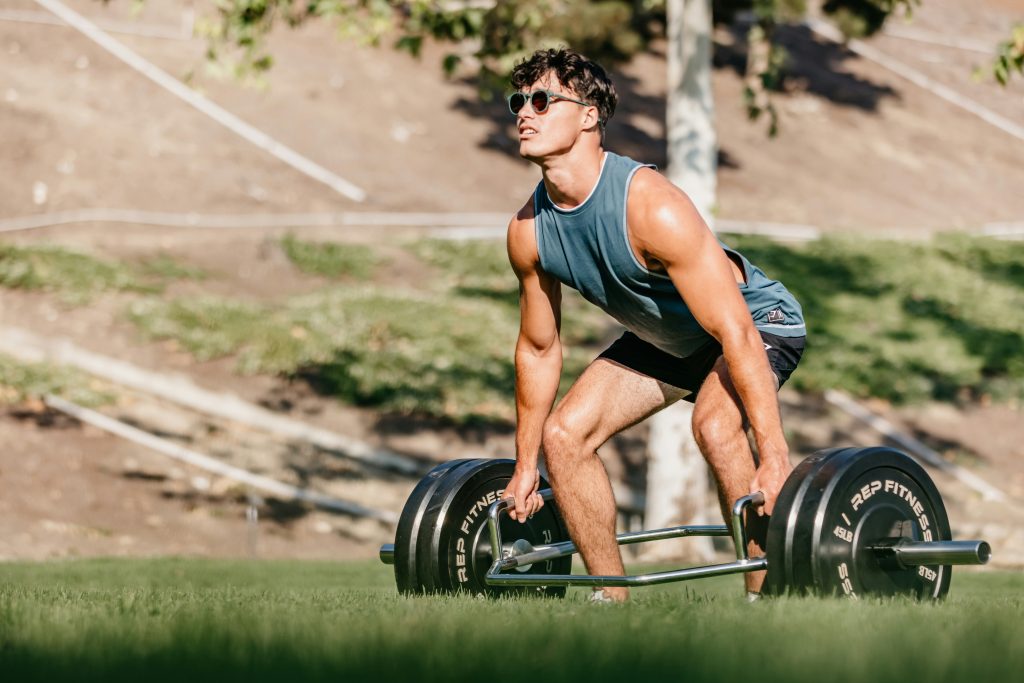
When comparing the trap bar deadlift vs barbell deadlift for strength, most lifters assume the conventional barbell reigns supreme. Walk into any gym and you’ll see people grinding through conventional pulls, convinced it’s the only way to build serious power. But what if that assumption is costing you gains?
Both movements build impressive strength, yet they achieve it through different mechanics, muscle recruitment patterns, and joint loading strategies. Choosing between a trap bar deadlift vs barbell deadlift isn’t about which one is objectively “better”—it’s about which aligns with your body structure, training goals, and injury history. Some lifters pack on strength faster with the trap bar’s neutral grip and reduced spinal load. Others thrive on the conventional barbell’s posterior chain emphasis and technical demands.
Common Myths About Deadlift Variations
For more on this topic, you might enjoy: Stair Climbing Workout Benefits: Transform Your Cardio and Leg Strength.
Myth: The barbell deadlift is always superior for building strength
Reality: Multiple studies, including research from sports science journals on deadlift biomechanics, show the trap bar deadlift generates equal or greater peak force production. The trap bar allows most lifters to handle 10-20% more weight due to improved leverage and biomechanics. More weight lifted through a full range equals more strength stimulus—that’s basic exercise physiology.
Myth: Trap bar deadlifts are just for beginners or injured lifters
Reality: Elite powerlifters and strongman competitors regularly incorporate trap bar work into their programmes. Professional rugby players and NFL athletes build explosive power with trap bar variations because the movement pattern transfers brilliantly to jumping and sprinting. If it’s good enough for athletes lifting 300kg+, it’s hardly a beginner-only tool.
Myth: You need to choose one or the other
Reality: Smart programming includes both variations at different training phases. Strategic rotation prevents accommodation, addresses weak points from multiple angles, and reduces overuse injury risk. When examining trap bar deadlift vs barbell deadlift for strength development, the answer is often “both, used intelligently.”
How Trap Bar and Barbell Deadlifts Build Strength Differently
Related: Park Bench Workout Routine: Build Full Body Strength Outdoors in 30 Minutes.
Understanding the mechanical differences between trap bar deadlift vs barbell deadlift reveals why each develops strength through distinct pathways. The barbell sits in front of your body’s centre of mass, creating a horizontal moment arm that heavily loads your posterior chain—particularly the erector spinae, glutes, and hamstrings. This forward load demands exceptional spinal erector strength and hip hinge mechanics.
The trap bar positions weight around your centre of mass with handles at your sides. This geometry reduces spinal stress by roughly 25-30% according to biomechanical analyses. Your torso stays more upright, shifting emphasis toward quadriceps while still hammering the glutes and hamstrings. Think of it as a hybrid between a squat and a conventional deadlift.
Here’s what’s interesting: the trap bar’s neutral grip (palms facing each other) allows stronger grip strength compared to the barbell’s pronated or mixed grip. Most lifters can hold 10-15kg more with neutral grip positioning, which means grip failure is less likely to limit your working weights. When grip isn’t the limiting factor, your legs and back can work harder.
Muscle Recruitment Patterns
EMG studies reveal fascinating differences in muscle activation between these variations. Conventional barbell deadlifts show higher erector spinae activation throughout the lift, particularly in the bottom position where your back angle is most horizontal. Hamstring activation peaks during the initial pull off the floor.
Trap bar deadlifts demonstrate increased quadriceps activation—sometimes 20-30% higher than conventional pulls. Your vastus lateralis and rectus femoris work harder to drive through the more vertical shin angle. Glute activation remains comparable between both variations, though the peak activation occurs at slightly different joint angles.
For building total-body strength, both movements deliver. The trap bar deadlift vs barbell deadlift debate really comes down to where you want that strength emphasis. Need bulletproof spinal erectors and posterior chain power? The barbell demands it. Want quad-dominant pulling strength with less spinal fatigue? The trap bar provides it.
Force Production and Power Output
Peak force production consistently measures higher with trap bar deadlifts. Research tracking force plate data shows lifters generate 250-400 newtons more peak force with the trap bar compared to equivalent effort barbell pulls. This matters enormously for pure strength development—more force production means greater mechanical tension on muscle fibres.
Bar velocity tells another part of the story. Trap bar deadlifts allow faster concentric speeds, particularly with submaximal loads (60-80% of your 1RM). Faster bar speed at equivalent relative intensities enhances rate of force development—a critical component of functional strength that transfers to athletic performance.
Some lifters respond better to the barbell’s technical demands and longer range of motion. Others thrive with the trap bar’s mechanical advantages and heavier loading potential. Neither is wrong. Both build serious strength when programmed properly.
The Truth About Injury Risk and Joint Loading
You may also find this helpful: The Definitive Guide to Protein Nutrition: Build Strength, Support Recovery, and Optimise Your Health.
Lower back injuries remain the most common concern with heavy pulling variations. When evaluating trap bar deadlift vs barbell deadlift for strength training safety, the biomechanics paint a clear picture. Conventional barbell deadlifts place significantly higher compressive and shear forces on lumbar vertebrae, especially at the L5-S1 junction.
A study on deadlift biomechanics and spinal loading measured approximately 30% reduction in lumbar spine stress with trap bar execution. This doesn’t mean barbell deadlifts are dangerous—millions of lifters pull conventional safely for decades. But if you’ve got a dodgy back (and who in Britain doesn’t after sitting at a desk for years?), the trap bar offers a legitimate strength-building alternative.
Knee loading differs substantially between variations. The trap bar’s more vertical shin angle increases knee flexion moment, placing greater demands on knee extensors and potentially stressing the patellofemoral joint more. Lifters with knee issues sometimes tolerate conventional deadlifts better due to the reduced knee flexion angle and decreased quadriceps demand.
Long-Term Training Sustainability
Accumulating training volume matters more than any single session. Over months and years, the variation that allows consistent training without aggravating injuries builds more strength than the theoretically “optimal” movement you can only perform sporadically.
Many experienced lifters rotate trap bar deadlift vs barbell deadlift blocks throughout their annual training plan. Perhaps 8-12 weeks emphasising conventional pulls for posterior chain development, followed by 8-12 weeks of trap bar work to hammer the quads and give the lower back relative recovery whilst maintaining pulling strength.
This approach prevents pattern overload—the repetitive stress from performing identical movements year-round that gradually accumulates into chronic issues. Strategic variation keeps you training consistently, and consistency beats perfection every single time.
Your 12-Week Strength Building Protocol
Programming trap bar deadlift vs barbell deadlift for maximum strength gains requires strategic periodisation. This protocol alternates emphasis whilst maintaining both patterns, preventing detraining in either movement whilst allowing targeted progression.
Weeks 1-4: Foundation Phase
Begin with moderate intensity to establish movement competency and prepare connective tissues for heavier loads ahead. Training frequency sits at twice weekly with 48-72 hours between sessions.
Session 1 (Barbell Focus): Conventional deadlift for 4 sets of 6 reps at 70% 1RM, followed by trap bar speed pulls for 5 sets of 3 reps at 60% 1RM with maximum bar velocity. Rest 3-4 minutes between working sets.
Session 2 (Trap Bar Focus): Trap bar deadlift for 4 sets of 6 reps at 75% 1RM (you can handle more weight), followed by Romanian deadlifts with a barbell for 3 sets of 8 reps to maintain conventional pulling pattern and build hamstring strength.
Track bar speed informally—if your third rep feels significantly slower than your first, the weight is appropriate. Explosive intent matters here, even at moderate loads.
Weeks 5-8: Accumulation Phase
Volume increases whilst intensity climbs into the strength-building zone. Expect some fatigue accumulation—that’s the point. Recovery quality becomes crucial during this block.
Session 1 (Barbell Emphasis): Conventional deadlift working up to a top set of 3 reps at 82-85% 1RM, then 2 back-off sets at 75% for 5 reps. Finish with trap bar deadlifts at 70% for 3 sets of 5 reps.
Session 2 (Trap Bar Emphasis): Trap bar deadlifts working up to a top set of 3 reps at 85-87% 1RM, then 3 back-off sets at 77% for 4 reps. Conventional deficit deadlifts (standing on a 2-3 inch platform) for 3 sets of 4 reps at 65-70% to strengthen the bottom position.
Deficit work specifically addresses the conventional deadlift’s sticking point off the floor. Standing on something like a weight plate or aerobic step increases the range of motion and builds tremendous starting strength.
Weeks 9-12: Intensification Phase
Peak strength development occurs here. Volume drops whilst intensity climbs toward maximal loads. Focus sharpens on one primary variation whilst maintaining the other.
Choose your primary focus based on goals or competition specificity. For this example, we’ll emphasise trap bar deadlift vs barbell deadlift for maximum strength demonstration.
Session 1 (Heavy Trap Bar): Work up to a challenging single at 92-95% 1RM, then perform 2 sets of 2 reps at 87%. Rest 5 minutes between top sets. Conventional deadlifts at 70% for 2 sets of 3 reps to maintain the pattern.
Session 2 (Moderate Barbell): Conventional deadlifts for 3 sets of 2 reps at 82-85%, focusing on perfect technique. Trap bar Romanian deadlifts for 3 sets of 6 reps to build the eccentric strength component.
Week 12 ends with a test week. Rest 5-7 days, then test your 1RM on your chosen primary variation. Most lifters see 10-20kg strength increases after this protocol executed properly.
Where Most People Go Wrong With Deadlift Programming
Mistake 1: Training both variations heavy in the same week
Why it’s a problem: Your central nervous system and recovery capacity can’t handle maximum-intensity pulling from multiple angles simultaneously. Attempting heavy conventional and trap bar deadlifts in the same training week almost guarantees suboptimal performance on at least one variation, and significantly increases injury risk through accumulated spinal fatigue.
What to do instead: Prioritise one variation each training block. When trap bar deadlift is your primary strength movement, keep barbell work at moderate intensities (70-80% 1RM) for technique maintenance and variation. Swap the emphasis every 4-8 weeks rather than trying to peak both simultaneously.
Mistake 2: Ignoring grip training
Why it’s a problem: Conventional barbell deadlifts often fail due to grip before your legs and back are truly challenged. When comparing trap bar deadlift vs barbell deadlift for strength development, grip limitations artificially cap barbell performance for many lifters, creating an unfair comparison.
What to do instead: Programme specific grip work twice weekly. Dead hangs from a pull-up bar for 3 sets of 30-45 seconds, barbell holds at the top of the deadlift for 10-15 seconds with 110% of your working weight, and farmer’s walks with heavy dumbbells or kettlebells all build crushing grip strength. Consider lifting straps strategically for back-off sets to accumulate leg and back volume without grip limiting you.
Mistake 3: Neglecting the eccentric phase
Why it’s a problem: Many lifters drop the weight after each rep, particularly with conventional pulls. This wastes the eccentric (lowering) portion where significant strength adaptations occur. Controlled eccentrics build muscle, strengthen connective tissues, and improve motor control throughout the entire range of motion.
What to do instead: Lower the weight over 2-3 seconds under control on at least 70% of your working sets. Touch-and-go reps (controlled descent, brief floor contact, immediate ascent) work brilliantly for building strength whilst maintaining tension. Save the drop-and-reset technique for absolute maximal attempts only.
Mistake 4: Poor setup positioning
Why it’s a problem: Starting position determines everything in both variations. With conventional barbell deadlifts, the bar drifting away from your shins creates massive mechanical disadvantage and injury risk. With trap bar deadlifts, poor hip positioning leaves strength on the table and stresses joints unnecessarily.
What to do instead: For barbell pulls, the bar must contact your shins at the start position—you should see vertical scrape marks (wear long socks or tracksuit bottoms). Your shoulder blades should be directly over the bar when viewed from the side. For trap bar deadlifts, position yourself so the handles align with your mid-foot, not your toes. Lower your hips until shins are roughly vertical, then pull. Film yourself from the side periodically to verify positioning.
Mistake 5: Comparing 1RM strength between variations
Why it’s a problem: Athletes obsess over whether their trap bar deadlift vs barbell deadlift numbers are “correct” compared to each other or to online standards. These are fundamentally different movement patterns recruiting muscles differently—comparing them directly is like comparing your squat to your bench press.
What to do instead: Track each variation independently. Celebrate progress in both movements without worrying whether your trap bar pull “should” be higher than your conventional (it usually is by 10-20%). Focus on progressive overload within each pattern—are you stronger this month than last month? That’s what matters for muscle and strength development.
Save This: Your Deadlift Strength Checklist
- Establish which variation serves as your primary strength builder based on body structure and goals
- Programme heavy work for your primary pattern and moderate work for your secondary (never both heavy simultaneously)
- Train pulling movements twice weekly with 72 hours minimum between sessions
- Address grip strength specifically rather than letting it limit your pulling capacity
- Incorporate both trap bar deadlift vs barbell deadlift variations in your annual plan for comprehensive development
- Film your setup position from the side every few weeks to verify optimal positioning
- Control the eccentric on most working sets for maximum strength adaptation
- Rotate your primary emphasis every 8-12 weeks to prevent pattern overload and maintain progress
Frequently Asked Questions
How much stronger should my trap bar deadlift be compared to barbell?
Most lifters handle 10-20% more weight with trap bar deadlifts due to improved leverage and reduced spinal loading. If you pull 150kg conventional, expect 165-180kg with the trap bar. Individual differences in limb length, torso proportions, and training history create significant variation, though. Some lifters show minimal difference whilst others see 25%+ advantage with the trap bar. Both scenarios are completely normal—focus on progressive overload in each pattern rather than worrying about ratios.
Can I build championship-level strength using only trap bar deadlifts?
Absolutely. Unless you compete in powerlifting (which mandates conventional or sumo barbell deadlifts), the trap bar builds equivalent or superior strength for general athletics and physique development. Professional rugby teams, NFL franchises, and Olympic sport programmes utilise trap bar deadlifts as their primary pulling variation. The movement pattern transfers brilliantly to jumping, sprinting, and real-world lifting tasks. If your goal is building a strong, resilient body rather than competitive powerlifting, trap bar deadlifts deliver everything you need.
Which variation is safer for someone with previous lower back issues?
Trap bar deadlifts typically prove more suitable for lifters with lower back history due to 25-30% reduction in lumbar spine stress. The more upright torso position and reduced spinal shear force make it genuinely safer from a biomechanical standpoint. That said, proper conventional deadlift technique with appropriate loading can also be perfectly safe—many lifters with back histories pull conventional successfully. Start conservatively with whichever variation feels better, progress gradually, and consult with a qualified physiotherapist familiar with strength training if you’re uncertain. The NHS provides general exercise guidelines that emphasise gradual progression regardless of movement choice.
Should beginners start with trap bar or barbell deadlifts?
Trap bar deadlifts often provide a gentler learning curve for beginners. The neutral grip feels more intuitive, the weight positioned around your centre of mass is easier to balance, and the reduced technical complexity lets new lifters load progressively without months of technique refinement. Most beginners can perform reasonably safe trap bar deadlifts within 2-3 sessions. Conventional barbell deadlifts demand more coaching, mobility, and motor control development. That doesn’t make them wrong for beginners—just potentially slower to master safely. Starting with trap bar work whilst simultaneously practising light conventional deadlifts gives you competency in both patterns.
How do I programme both variations without overtraining?
Strategic intensity management prevents overtraining when using both trap bar deadlift vs barbell deadlift patterns. Designate one as your primary strength movement (training at 80-95% intensity) and the other as accessory work (65-75% intensity). Swap these roles every 4-8 weeks. Never programme both variations above 85% intensity in the same week—your spinal erectors and CNS can’t recover adequately. A practical split might be heavy trap bar deadlifts on Monday (4 sets of 3-5 reps at 82-87%) and moderate conventional pulls on Thursday (3 sets of 5-6 reps at 72-77%), then reverse the emphasis next training block.
Do I need a specific type of trap bar for strength training?
Standard trap bars work perfectly for strength development, though some design features enhance training effectiveness. Look for a trap bar with dual-height handles—raised handles reduce range of motion for very tall lifters or those with mobility restrictions, whilst low handles provide a conventional deadlift-height starting position. Weight capacity matters if you’re seriously strong; verify the bar is rated for 300kg+ if you’re lifting over 200kg. A knurled grip surface prevents slipping during heavy pulls. Some gyms stock open-back trap bars (one end is open rather than enclosed) which make loading plates easier but function identically for strength purposes.
Making Your Decision: Trap Bar Deadlift vs Barbell Deadlift
Both movements build genuine strength when programmed intelligently. The trap bar deadlift delivers higher peak force production, allows heavier loading, reduces spinal stress, and transfers brilliantly to athletic performance. Conventional barbell deadlifts develop exceptional posterior chain strength, build bulletproof spinal erectors, and remain essential for powerlifting competition.
Your body structure, training history, injury status, and specific goals determine which variation deserves primary emphasis. Long torso with short legs? The trap bar likely suits you better biomechanically. Posterior chain development for sprinting or jumping? Trap bar excels. Competing in powerlifting? Obviously the barbell takes priority. Previous lower back issues? The trap bar’s reduced spinal loading makes consistent training more sustainable.
But here’s the thing—you don’t need to choose exclusively. Smart programming incorporates both trap bar deadlift vs barbell deadlift variations at different training phases, intensities, and volumes. This approach builds comprehensive strength, prevents accommodation to any single pattern, and keeps training interesting across years of lifting.
Start with the variation that feels most comfortable and allows pain-free progression. Build a solid strength foundation there. Then gradually introduce the other variation at moderate intensities. Over time, you’ll develop competency in both patterns and can strategically rotate emphasis based on your current goals.
Pick one variation. Load it properly. Progress consistently. That’s where strength comes from—not from endless debate about which movement is theoretically superior, but from months of intelligent, progressive training with whichever pattern you’ll actually perform consistently. Your stronger self six months from now won’t care which variation you chose. They’ll just be grateful you started.


